

ℹ️ 🛹 Web Média Skate 🛹 ℹ️

★ Chroniques · Opinion
Chocolate turns 32: why Girl's little sister still can't be copied
Née en 1994 parce qu'il manquait une place dans un van, Chocolate a rendu le skate élégant. Tout le monde a copié ses graphismes. Personne n'a copié ce qui comptait vraiment.

→ Pour aller plus loin : Mikel Vidal, 3 min 05 chez Hélas : pourquoi une marque française recrute à Barcelone ?
In 1994, Rick Howard and Mike Carroll started a skate brand because one guy didn't fit in the van. Chico Brenes had been left on the sidewalk while the rest of the team drove off on tour. One year after launching Girl Skateboards, they created Chocolate: a second team, a second van, a second story.
Thirty-two years later, half the independent brands on the planet sell boards with a clean logo, tidy type and minimal urban imagery. All of them looked at Chocolate. None of them got the same result. It isn't a matter of graphic talent — they all copied the wrong thing.
1994: a brand born from one missing seat in the van
(function(){
var VID='Qp_vOLB-OUE';
var container=document.getElementById('yt-Qp_vOLBOUE');
var played=false;
function initPlayer(){
var player=new YT.Player(container,{
width:'100%',height:'450',videoId:VID,
playerVars:{cc_load_policy:1,cc_lang_pref:'fr',hl:'fr',mute:1,rel:0,autoplay:0,enablejsapi:1},
events:{
onReady:function(e){
try{e.target.setOption('captions','track',{'languageCode':'fr'});}catch(x){}
if('IntersectionObserver' in window){
var obs=new IntersectionObserver(function(entries){
if(entries[0].isIntersecting&&!played){played=true;e.target.playVideo();obs.disconnect();}
},{threshold:0.4});
obs.observe(container);
}
}
}
});
}
if(window.YT&&window.YT.Player){
initPlayer();
} else {
var prev=window.onYouTubeIframeAPIReady;
window.onYouTubeIframeAPIReady=function(){if(prev)prev();initPlayer();};
if(!document.querySelector('script[src*="youtube.com/iframe_api"]')){
var s=document.createElement('script');s.src='https://www.youtube.com/iframe_api';document.head.appendChild(s);
}
}
})();
The story sounds too good to be true, and yet the founders themselves have told it: Chocolate came out of a logistics problem. The Girl team grew, the van couldn't keep up, guys got left behind. Rather than cut the team down, Howard and Carroll opened a second brand around Chico Brenes.
The first team: Brenes, Daniel Castillo, Paulo Diaz, Richard Mulder, Shamil Randle, Gabriel Rodriguez and Ben Sanchez. Look at that list for two seconds. At a time when American skateboarding was still mostly white and postcard-Californian, Chocolate fielded a Latino team from Los Angeles — the real LA, the one made of neighbourhoods and cracked sidewalks.
This wasn't marketing invented after the fact. It was simply who the friends were. And that's exactly why it worked: nobody built that identity in a meeting. It already existed — it just needed a logo and some boards.
First in-house video: Las Nueve Vidas de Paco - 1995. Spanish title, no translation, no explanation. Message received.
Chocolate didn't invent an identity. It just stopped hiding the one it already had. — The real start, 1994
Mouse - 1996: Guy Mariano closes the video at 31 minutes 24
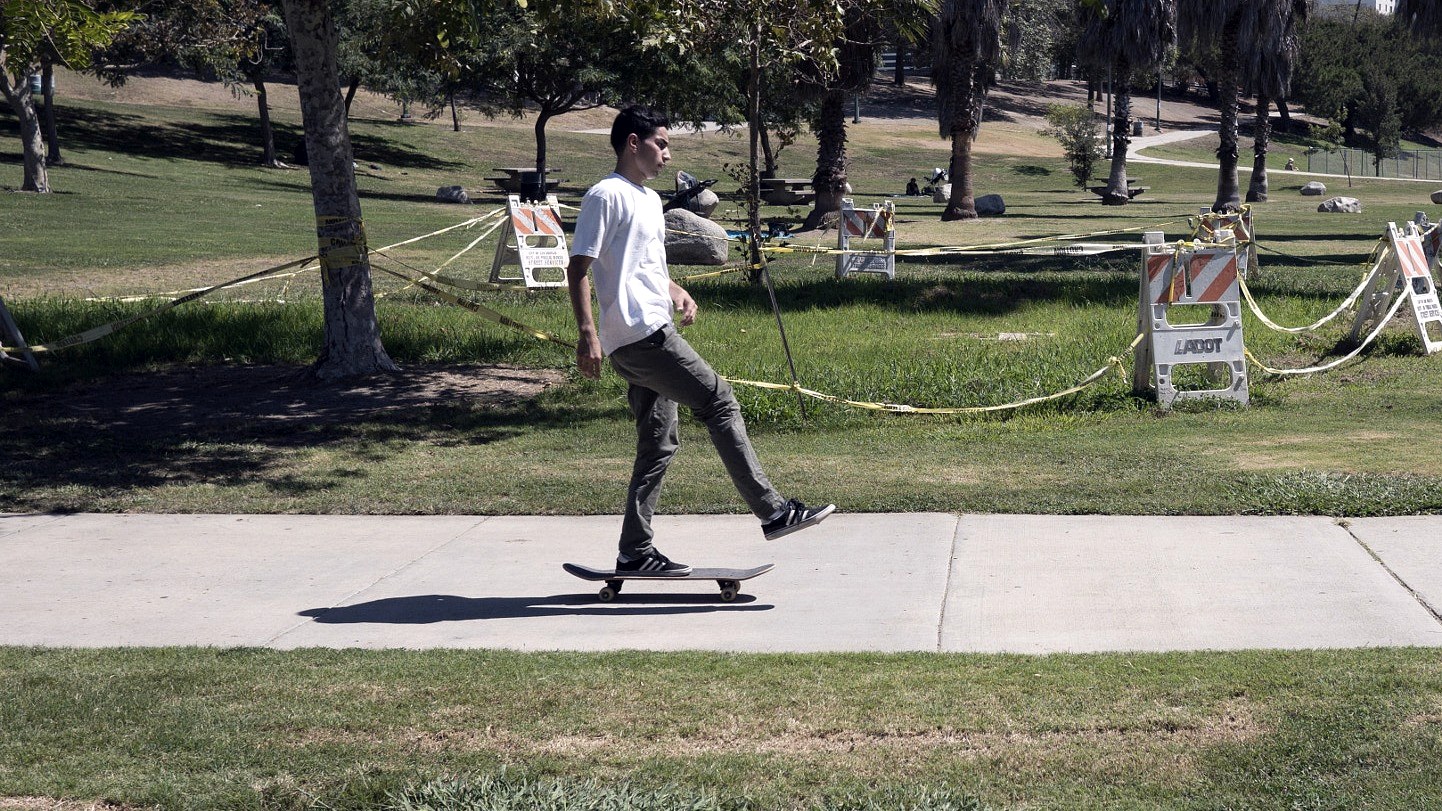
Mouse - 1996 is a Girl video, directed by Spike Jonze and Rick Howard. But it's also the showcase where Chocolate planted its flag for good: Chico Brenes at 11:10, Gabriel Rodriguez, Daniel Castillo and Shamil Randle at 12:11, Ben Sanchez at 15:17, Richard Mulder at 17:55, Keenan Milton and Gino Iannucci at 19:59. Half the video, basically.
Then the last part. Guy Mariano, 31:24, running to the credits at 35:02. Three minutes thirty-eight. He's barely 20. It isn't the hardest part in the video, nor the fastest, nor the most dangerous. It's the one everybody rewound.
In 1996 you didn't click a link. The VHS travelled from deck to deck — the one belonging to the mate who worked at the shop, the one someone's older brother brought back from god knows where, sleeve already bent. You'd put it on a Sunday afternoon, wait 31 minutes, and for those three minutes nobody spoke. Then someone said "run it back", and no one argued. The physical act — pressing rewind, hearing the mechanism grind — was part of the experience.
What Mariano does in that part, technically, others could do too. What he does is do it without ever looking like he's forcing. The trick lands, he rolls, he's gone. No celebration, no insisting. And from then on, a solid half of my generation started judging video parts on that instead of on the size of the gap.
Evan Hecox: twenty-plus years reducing a city to three colours
The other half of Chocolate is graphic. Evan Hecox has worked with the brand for more than twenty years and has signed hundreds of boards. His thing: take a city — poles, wires, a storefront, a bike leaning on a wall — and reduce it to simple shapes and two or three flat colours.
He pulls from Japanese prints, European poster design, 1960s illustration, Bauhaus typography. None of that comes from skateboarding. That's precisely the point.
Because in 1994 the competition was World Industries and its playground humour, Zero and its dark imagery, skulls, blood, crude jokes. Skateboarding sold itself through visual shock. Chocolate showed up with a strip of sunlight on a sidewalk and a chocolate bar for a logo. On a skateshop rack, that was the equivalent of a man in a clean suit at a punk show: impossible to miss.
Everyone was shouting. Chocolate spoke normally, and that's the one we heard. — The graphic strategy nobody saw coming
Chico, Gino, Marc Johnson: signed on a standard nobody wrote down
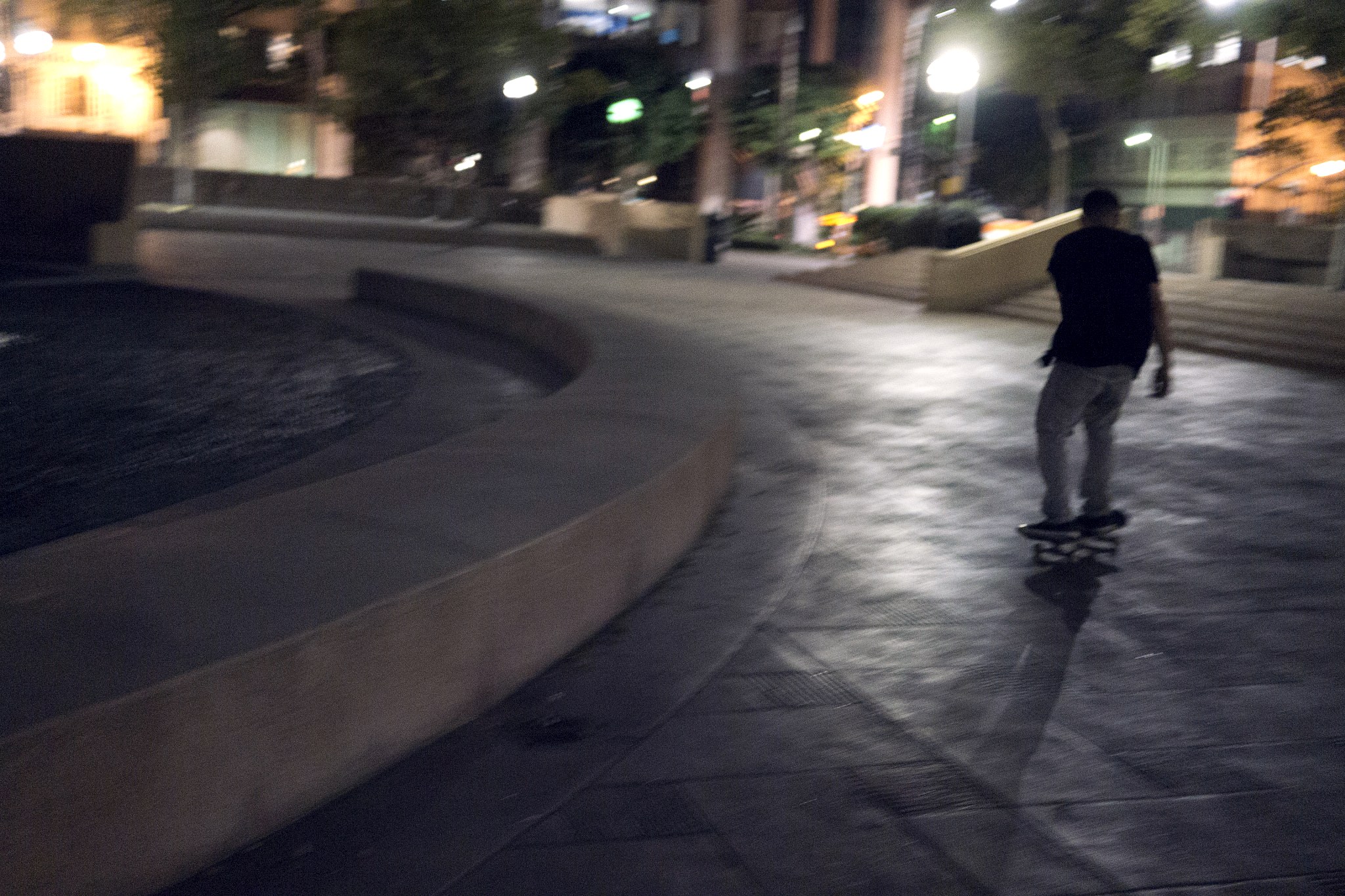
Look at who came through. Chico Brenes and the way he circled a ledge like he was dancing. Gino Iannucci, whose entire reputation rests on landing fewer tricks than everyone else, but better. Marc Johnson, who could pull something absurdly technical while looking like his mind was elsewhere. Keenan Milton, whose name still shows up in every "perfect style" list today.
Not one of those guys got signed for jumping the biggest stair set. You can measure it, too: the Chocolate videos — The Chocolate Tour - 1999, Hot Chocolate - 2004, Pretty Sweet - 2012 with Girl, Bunny Hop - 2021 — were never record-breaking videos. They never existed to announce "nobody had done this before".
They existed to show guys who rolled well. That's it. And that's far harder to sell than a big gap, because it doesn't fit in a thumbnail.
Why nobody ever managed to copy Chocolate
Here's the answer, and it's simple: everyone copied the look. Chocolate wasn't selling a look — it was applying a standard.
A minimal logo can be redrawn in an afternoon. A muted palette, clean type, boards that look like gallery posters — you can commission that from any designer tomorrow morning. Dozens of brands have done it since 2010, some of them very well.
The standard, though, can't be outsourced. The standard is the question you ask yourself when you sign a skater, keep a clip in the edit, decide a part is finished. At Chocolate that question was never "is this impressive". It was always "is this good to watch roll".
Put like that it sounds vague. It isn't — it's brutally demanding, because it removes every shortcut. You can't offset bad style with a bigger spot. You can't rescue an average clip with slow motion. Thirty-two years of selecting on that one criterion, applied without ever drifting, including when the market rewarded the exact opposite: that's the part nobody can copy.
A brand can be imitated. A standard held for three decades can't. That's how Chocolate made skateboarding elegant, and why the rest of the industry only walked away with the packaging.
What's left, thirty-two years on
Practically speaking: the brand still runs, the team still exists, boards still ship with graphics you recognise from ten feet away. It isn't a memory — it's an active catalogue.
But the real legacy is elsewhere. When a 17-year-old posts a clip today with nothing but a clean manual and one fluid line, and the comments say "the style is insane" instead of "that wasn't very hard" — that vocabulary came from somewhere. It came from Yeah Right! - 2003, from Mouse - 1996, from twenty years of Hecox boards, from a team built around a guy who once got left standing in front of a van.
We ended up judging skateboarding the way Chocolate judged it. The brand didn't win a market. It won the standard. That's infinitely rarer — and it can't be lifted.
Which Chocolate board was your favourite? Graphic, year, and why you kept it. Say it in the comments ↓
Le lexique
-
1
part
Section vidéo consacrée à un seul skateur, montée sur son propre morceau de musique. L'équivalent d'un album solo.
-
2
gap
Vide à franchir d'un seul saut : un escalier, un trou entre deux plateformes, un passage entre deux trottoirs.
-
3
ledge
Rebord de béton ou de pierre, généralement bas et long, sur lequel on fait glisser la planche ou les trucks.
-
4
manual
Rouler en équilibre sur les deux roues arrière uniquement, sans que le nose de la planche touche le sol.
Shop NOSK8
Voir toute la boutique →
TEE-SHIRTS
TEE-SHIRT NOSK8® NOSKATE #NSITA
Le prix initial était : 35,00 €.29,00 €Le prix actuel est : 29,00 €.
TEE-SHIRTS
TEE-SHIRT NOSK8® P.B HEART #POLARBEAR
Le prix initial était : 35,00 €.29,00 €Le prix actuel est : 29,00 €.
TEE-SHIRTS
TEE-SHIRT NOSK8® I.L.N #ILOVEN8
Le prix initial était : 35,00 €.29,00 €Le prix actuel est : 29,00 €.
TEE-SHIRTS
TEE-SHIRT NOSK8® P.B HEART #NYC
Le prix initial était : 35,00 €.29,00 €Le prix actuel est : 29,00 €.

TEE-SHIRTS
TEE-SHIRT NOSK8® MATRICE HEART #CTRL
Le prix initial était : 35,00 €.29,00 €Le prix actuel est : 29,00 €.
CASQUETTES
CAP NOSK8® P.B #POLARBEAR
Le prix initial était : 35,00 €.25,00 €Le prix actuel est : 25,00 €.
CASQUETTES
CAP NOSK8® N8 #NOSK8
Le prix initial était : 35,00 €.25,00 €Le prix actuel est : 25,00 €.
CASQUETTES
CAP NOSK8® P.B.P #PAW
Le prix initial était : 35,00 €.25,00 €Le prix actuel est : 25,00 €.
HOODIES
HOODIE NOSK8® P.B HEART #NYC
Le prix initial était : 60,00 €.49,00 €Le prix actuel est : 49,00 €.
HOODIES
HOODIE NOSK8® P.B HEART #ORIGINAL
Le prix initial était : 60,00 €.49,00 €Le prix actuel est : 49,00 €.
HOODIES
HOODIE NOSK8® P.B HEART #PHILI
Le prix initial était : 60,00 €.49,00 €Le prix actuel est : 49,00 €.
HOODIES
HOODIE NOSK8® MATRICE HEART #CMD
Le prix initial était : 60,00 €.49,00 €Le prix actuel est : 49,00 €.
HOODIES
HOODIE NOSK8® P.B HEART #POLARBEAR
Le prix initial était : 60,00 €.49,00 €Le prix actuel est : 49,00 €.
SWEAT
SWEAT NOSK8® P.B HEART #BARÇA
Le prix initial était : 45,00 €.39,00 €Le prix actuel est : 39,00 €.
SWEAT
SWEAT NOSK8® P.B HEART #PHILI
Le prix initial était : 45,00 €.39,00 €Le prix actuel est : 39,00 €.
SWEAT
SWEAT NOSK8® P.B HEART #NYC
Le prix initial était : 45,00 €.39,00 €Le prix actuel est : 39,00 €.
SWEAT
SWEAT NOSK8® P.B HEART #PARIS
Le prix initial était : 45,00 €.39,00 €Le prix actuel est : 39,00 €.
SWEAT
SWEAT NOSK8® P.B HEART #POLARBEAR
Le prix initial était : 45,00 €.39,00 €Le prix actuel est : 39,00 €.
Continue ta lecture
ÉvénementsSLS Tempe, 29 août 2026 : 5 000 places, et une raison précise de revenir en Arizona
Stop 04 du Championship Tour SLS : le 29 août 2026 à la Mullett Arena de Tempe, Arizona. Date, billets, diffusion en direct — et…
Commentaires (0)