

ℹ️ 🛹 Web Média Skate 🛹 ℹ️

 Back
Chroniques · Opinion
Five contests built modern skateboarding. The most decisive one never had judges
Tampa Pro, Münster, Slam City Jam, Street League, and EMB: the 5 skate contests that changed everything. Which one truly decided it all?
On April 12, 2026, Jagger Eaton crushed the Tampa Pro. Thirty-second edition, same concrete skatepark as in 1995, same worn-out deck, same blasted loud music. No opening ceremony, no anthem, no national delegation. But ask any dude who’s 38 what contest meant the most to his skating life—he’ll never say ‘the Tokyo Olympics final.’
On April 12, 2026, Jagger Eaton won Tampa Pro. Thirty-second edition, same concrete park as in 1995. No opening ceremony, no anthem, no national delegation. And still, ask any 38-year-old which contest mattered in his skate life: he will never answer “the Olympic final in Tokyo”.
In this article 6 parts
- Tampa Pro, 1995: the contest skaters built for themselves
- Münster 1982: a German parking lot that became world champ
- Slam City Jam, 1994-2006: twelve years straight, then the Olympics took over…
- Glendale, August 28, 2010: the day a contest paid more than a…
- Glendale, August 28, 2010: the day a contest paid more than a…
- What’s left of it, in 2026
Tampa Pro, 1995: the contest skaters built for themselves
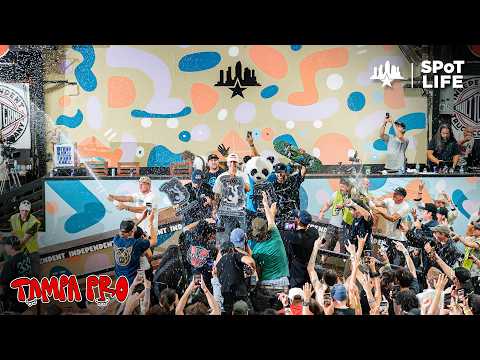
The Skatepark of Tampa opened to the public on January 2, 1993. A Florida warehouse, concrete poured by skaters. Two years later, on April 1st and 2nd, 1995, they hosted their first pro contest. The champ was Mike Vallely.
What makes Tampa different isn’t the skill—it’s the ownership. The contest doesn’t belong to a federation, no TV network, no energy drink brand. It belongs to the skatepark. To the guys sweeping the deck on Monday mornings. Nobody’s ever had to ask permission to run Tampa Pro.
Thirty-two editions later, in 2026, the format hasn’t changed a damn bit. Same warehouse, same concrete, same rider judges. No major contest in the world’s stuck to this line this long. It’s the only skate event that stayed true to itself, while everything else got sold out to outsiders.
Münster 1982: a German parking lot that became world champ

In 1982, a German PE teacher named Titus Dittmann kicks off a halfpipe contest in the parking lot of the Ostbad pool in Münster. A municipal pool parking lot. That’s where the Münster Monster Mastership was born.
Starting in 1988, it moves to the Halle Münsterland, a legit convention center. And in 1989, the comp gets official world championship status. You feel me? For a decade, the world title wasn’t in Cali or Florida—it was in Westphalia, in some German backwater town, in front of a European crowd.
This is the first time US skate had to fly across the pond to prove itself. The US pros showed up to Münster like they were taking a test. In 1999, the event moves to Dortmund’s Westfalenhalle, and the vibe fades. But the legacy stays: Europe can be the skate world’s epicenter.
For a decade, the world skateboarding championships took place in a German city with 300,000 residents. Now, nobody even remembers it. — Münster, 1989-1998
Slam City Jam, 1994-2006: twelve years straight, then the Olympics took over the venue.
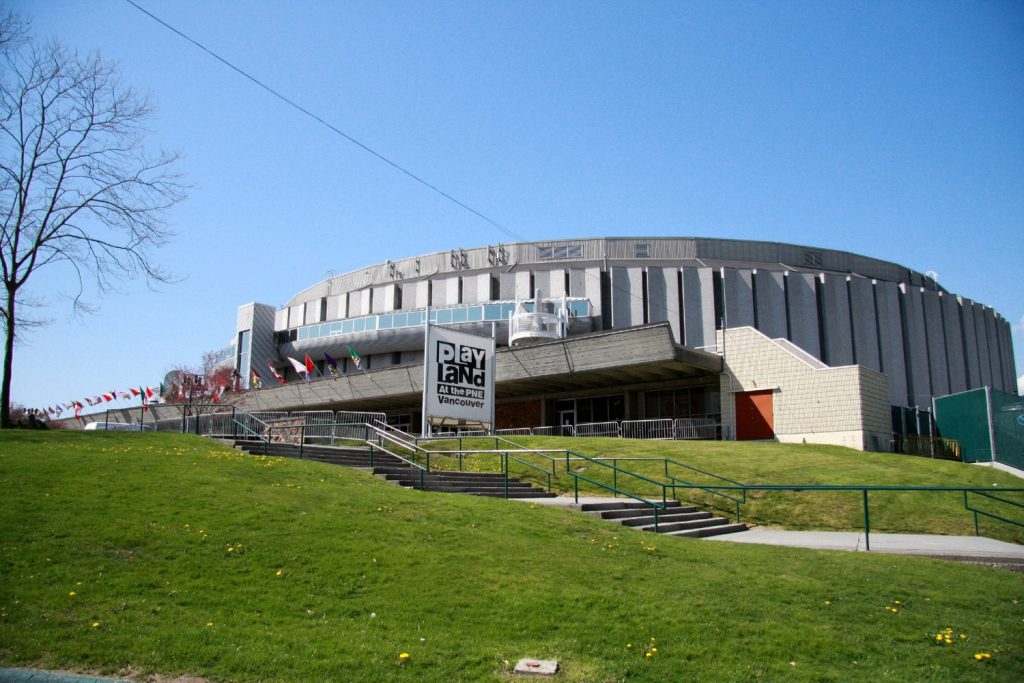
Vancouver, Pacific Coliseum. A hockey rink with 16,000 seats turned into a massive street course, once a year since 1994. The Slam City Jam turned into the longest skate event in North America, and the first to nail something nobody had figured out yet: a contest ain’t just about the tricks—it’s a whole weekend of vibes, shows, and jams.
Bob Burnquist takes it all in 2001. The ladies get paid here — way less than the guys, but they do, back when most contests didn’t even invite them.
Then in 2006, the event moves from Vancouver to Calgary. Official reason: the Pacific Coliseum’s getting a facelift for the 2010 Winter Olympics. Slam City Jam never came back after that. The oldest North American contest shut down ‘cause a building had a date with the IOC. Nobody even wrote about it at the time.
There’s irony in that we should keep in mind when talking about skateboarding’s place in the Olympics. The Olympics didn’t just bring skateboarding in 2021 — they’d already taken a venue from it fifteen years earlier.
Glendale, August 28, 2010: the day a contest paid more than a slice of the pie
On August 28, 2010, at the Jobing.com Arena in Glendale, Arizona, Rob Dyrdek and Brian Atlas launch the Street League Skateboarding. Four rounds, live scoring, cameras everywhere, a custom plaza ramp built inside an omnisports gym.
By 2011, the prize pool hits 1.6 million bucks. Sean Malto wins the Super Crown that year and walks away with 200,000 dollars. Two hundred thousand dollars. For a street dude. Back when the real currency was still a video part and a mag cover.
That’s the shift. Before SLS, pros made their living filming. After SLS, they could make it competing. Talent starts training for a 45-second run instead of three minutes of footage. SLS becomes the World Championship recognized by World Skate, then the path to Tokyo Olympics. The whole route to the Games starts from that Arizona gym, a Saturday in August 2010.
That day, in France, we were watching it on a stream buffering every thirty seconds, on a 15-inch screen, thinking skateboarding just hit a whole new level. We were right. Just didn’t know which way it was gonna go.
Before 2010, a street pro made his living by filming. After that, he could make it by competing. Everything else follows from that.— Glendale, August 28, 2010
Glendale, August 28, 2010: the day a contest paid more than a video part

Here’s the answer, and it ain’t no magic trick: the most pivotal contest of the five was EMB. Embarcadero Plaza, San Francisco. No sign-up, no judges, no date. A permanent contest, open from dawn till dusk, seven days a week, for a few years in the early ’90s.
Plaza pops up for real after the Loma Prieta earthquake in 1989: the Embarcadero freeway, busted, gets torn down in 1991, and the area opens up. What’s left is some granite blocks, gaps, a fountain, and a grindable slab. Within months, EMB becomes one of the first-ever legit street spots in the world.
What went down there was a contest, in the harshest sense. You showed up, didn’t know nobody, and you had to drop something. Not for a score—just to stay. The punishment wasn’t a low grade; it was the cold shoulder. The jury? The locals sitting on the blocks. The reward? Getting talked to the next day.
And this contest had more impact than the other four combined. The modern street lingo—ledges, gaps, manuals, switch—got standardized there. The ’90s pro hierarchy got set there, not on a podium. Brands scouted there by watching, not reading rankings. The parts that defined the decade were filmed with that level of pressure in mind.
Tampa gave skateboarding a date with destiny. Münster gave it a world title. Vancouver gave it a format. Glendale gave it the dough. EMB gave skateboarding its standard. And a standard? That’s heavier than a trophy—it’s what’s left when the venue’s gone.
What’s left of it, in 2026
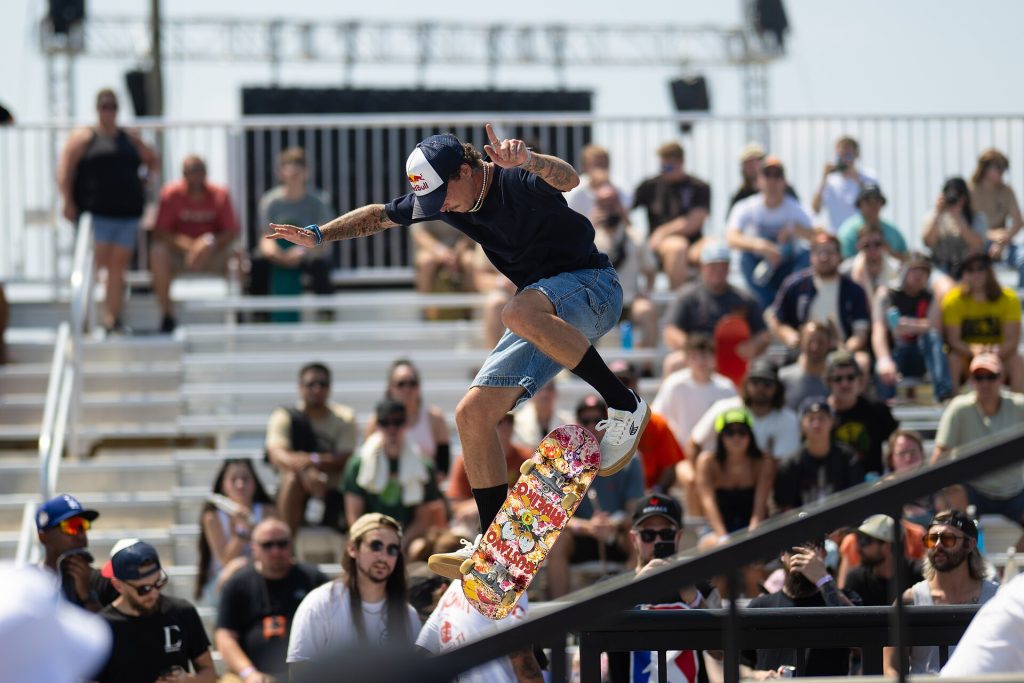
The most decisive of the five is EMB, Embarcadero Plaza in San Francisco. No entry list, no jury, no date. A permanent contest, open from morning to night, in the early 1990s. The plaza opened up after the 1989 Loma Prieta earthquake and the 1991 demolition of the Embarcadero Freeway. You showed up, you knew nobody, and you had to land something — not for a score, but to be allowed to stay. The modern street vocabulary was standardised there. Tampa gave skateboarding its own date. Münster gave it a world title. Vancouver gave it a format. Glendale gave it money. EMB gave it its standard — and a standard outlasts a trophy.
The other four? They’re all in different spots now. Tampa Pro’s still running, untouched, thirty-two editions down. SLS won—that’s the one calling the shots on who’s world champ today. Münster’s just some old-school Euro memory nobody’s talking about. Slam City Jam’s gone, replaced by Olympic grind.
The EMB ritual did not disappear, it moved. It lives in the way a crew sizes up a stranger rolling into the local park: nobody says anything, everybody watches, one attempt is enough. Tampa Pro still runs. SLS won. Münster is a European memory. Slam City Jam is gone. Two out of five survived, and the one that mattered most never needed to officially exist.
What contest blew your mind—where’d you catch it back then? Drop it in the comments ↓
Le lexique
-
1
street course
Plateau de compétition qui reproduit du mobilier urbain — marches, rails, ledges — monté dans une salle ou un stade.
-
2
prize money
Dotation en argent versée aux skateurs classés à l'issue d'un contest, répartie selon le podium.
-
3
ledges
Rebords en béton ou en pierre, hauts d'environ 30 à 60 cm, sur lesquels on glisse en slide ou en grind.
-
4
manuals
Figure d'équilibre où l'on roule sur les deux roues arrière seulement, sans toucher le sol avec le nose.
-
5
part
Section vidéo consacrée à un seul skateur dans un film de skate, montée sur un morceau qui lui est propre.




Continue ta lecture
ÉvénementsUn seul Américain en or sur 11 finales de skate : qui a vraiment gagné la saison XGL ?
XC New York champion pour 10 points. Mais sur les 11 finales de skate du Superdome, un seul vainqueur était américain — et la meilleure…
Commentaires (0)