
ℹ️ 🛹 Web Média Skate 🛹 ℹ️

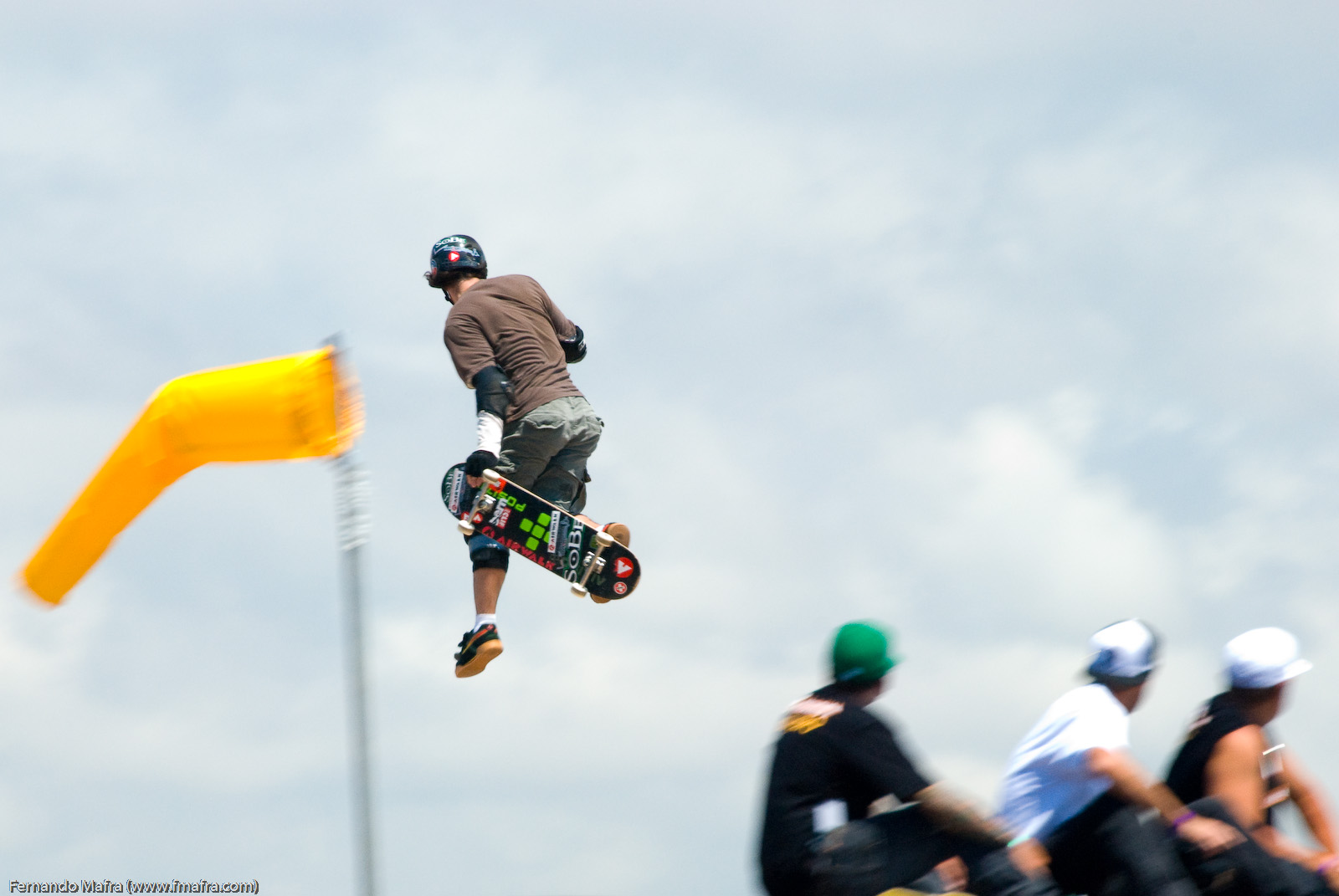
★ Tricks
Point X, 2003: Danny Way jumps 75 feet on his Mega Ramp, a year after his 65 — how far can a skateboard jump go?
En 2003, Danny Way saute 75 pieds sur la Mega Ramp de Point X, un an après ses 65. On décortique sa part de The DC Video, plan par plan.

June 2003, Point X Camp, in the hills north of San Diego. Danny Way drops from the top of a wooden tower, clears a 75-foot gap, 23 meters, with a backside 360, then hits the quarterpipe and boosts a 23.5-foot backside air. Two world records in the same run. One year earlier, on the same ramp, he had jumped 65 feet.
Ten more feet in twelve months. The end card of The DC Video says it in white letters, and a whole generation watched it on repeat on a worn-out VHS.
We went through his part shot by shot: the line-up, the ramp, the song, the camera, the gear. And one question that has stayed open ever since: how far can a skateboard jump go?
Video
The DC Video - 2003
Record spot
Point X Camp, California
Distance
75 ft (23 m)
Height
23.5 ft (7.2 m)
Danny Way before the 75 feet: a broken neck, 65 feet and a brand of his own
To understand 2003, you have to rewind a little. Danny Way was born on April 15, 1974, in Portland. He turned pro very young and became Thrasher's Skater of the Year in 1991, riding for Plan B. In 1994 he became DC's first pro, the brand started by his brother Damon Way and Ken Block.
That same year, he broke his neck surfing in Hawaii. He came back, and he came back higher. In 1997 he set the highest air record, 12 feet on a kickflip, and dropped from a helicopter into a ramp for the cover of Transworld.
In 2002 he had a ramp built at Point X Camp that existed nowhere else: a giant roll-in, a gap, a quarterpipe. He jumped 65 feet there, 20 meters. If you read our story on the 2002 Mega Ramp, you know that first chapter. 2003 is the sequel. And it is The DC Video that finally gave the ramp its name: the MegaRamp.
Three years of filming, 46 minutes, 29 skaters. Jake Brown, Colin McKay, Josh Kalis, Stevie Williams, Rob Dyrdek. The same year saw Girl's Yeah Right!, the other landmark of 2003. Two visions of skating, a few months apart: one shrinks the world, the other makes it bigger.
Danny Way's line-up in The DC Video, trick by trick
One note before we roll it. The online version runs 8 minutes 43. At that resolution, some tricks can't be named with certainty. We only list what you can see, in order.

-
The title card and the tower
Around 1:00, his name comes up. A silhouette standing on top of a roll-in tower, tiny next to the structure. The tone is set.
-
The outdoor DC vert ramp
An open-air ramp with DCSHOECOUSA banners on the sides. High airs, way above the coping, like a warm-up.
-
The indoor vert, at night
A warehouse, a ramp stretched with extensions, floodlights. The airs launch into the dark and the light catches them.
-
The concrete pool
Around 4:06, a breather. A pool, concrete, carves. The only stretch where his wheels stay close to the ground.
-
The Mega Ramp from above
From 5:15, an aerial shot over the hills: roll-in, gap, quarterpipe. You finally see the scale of the thing.
-
The jumps over the gap
Grabbed airs over the void, then a full rotation in the air. Every jump ends on the landing slope.
-
The quarterpipe and the measuring pole
Around 8:03, a pole planted next to the quarterpipe, marked like a height chart. It measures the height. The record is proven on camera.
-
The end card
"Longest distance jump (75' backside 360) and highest air (23.5' backside air) together in the same run." Then a DC tee, a yellow board, and "(the end)".
What we can't confirm
- The date. The video's card says June 12, 2003. Wikipedia and most accounts say June 19. Nobody points out the gap.
- The street clips shot in Europe in the middle of the part. The rider can't be identified on screen, so we credit him with nothing.
- The exact name of each grab over the gap. At this resolution you see the hand on the board, not which grab it is.
Point X Camp and the MegaRamp: what became of the spots
Point X Camp was a private camp in the San Diego backcountry. Not a public skatepark, but a piece of land where you could build big without asking a city hall for permission. That is what made the Mega Ramp possible.
The ramp left the hills. The X Games opened a Big Air event in 2004. Copies popped up elsewhere, in the US and then in Brazil. In São Paulo, the Mega Rampa hosted a contest as early as 2008.
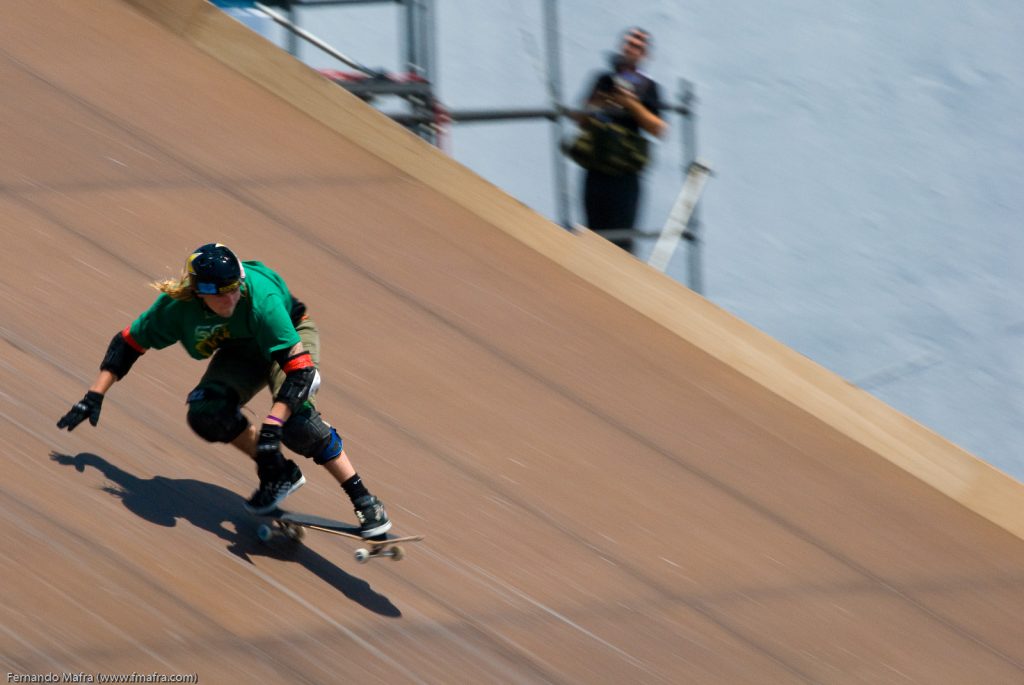
The indoor vert and the outdoor DC vert from the part left no public trace. Wooden ramps live a few years, then get torn down. That's the rule with ramps: only the footage survives.
The song: Suicidal Tendencies, then Metallica
Danny Way's part is cut in two, and each half has its track. The first runs on You Can't Bring Me Down by Suicidal Tendencies - 1990. The second, the Mega Ramp half, plays Orion by Metallica - 1986. The same instrumental opens the video.
None of it is random. Suicidal means Venice, empty pools, late-80s skate punk, the era when Danny Way started out. Orion is something else: eight minutes with no vocals, a slow build, a rolling bass line. Music for watching a guy fly, not for jumping around.
If you owned the VHS, you still link Orion to that wooden tower. Twenty years later, the riff takes you straight back to the Point X hills.
Filmer and editor: Greg Hunt in charge, 48 credits behind him
The credited director is Greg Hunt, according to SkateVideoSite. He later made Mind Field for Alien Workshop - 2009. Behind him, the production credits list 48 names. Among them: Ty Evans, who went on to make Pretty Sweet - 2012, William Strobeck, later Supreme's filmer, Russell Houghten, Ken Block and Damon Way.
The same listing files the video among those shot on 16 mm. For the Mega Ramp, you needed several angles at once: one camera can't cover a 23-meter gap. Hence the aerial shot, the ground shot, and the measuring pole in frame to prove the height.
Who held which camera on record day? The credits don't break it down shot by shot. The DVD extras show the behind-the-scenes, and that's the closest we get.

The gear: helmet, kneepads, a yellow board
On the Mega Ramp, Danny Way wears a helmet and kneepads, same as on vert. Nothing exotic. At the end, you see him with a yellow board and a DC tee. The board graphic can't be read on screen.
The real gear is the ramp. A tower to build speed, a gap for distance, a landing slope, then a quarterpipe for height. The whole record lives in that sequence. Without the speed from the roll-in, the quarterpipe is useless.
What it changed: how far can a skateboard jump go?
Back to the opening question. After 65 feet in 2002 and 75 in 2003, the next step looked obvious: 85, 95, a hundred. It never came.
On August 8, 2004, in Los Angeles, Danny Way jumped 79 feet, 24 meters, and took gold at the X Games. Guinness World Records still lists it as the longest skateboard ramp jump ever. More than twenty-two years later, nobody has beaten it.
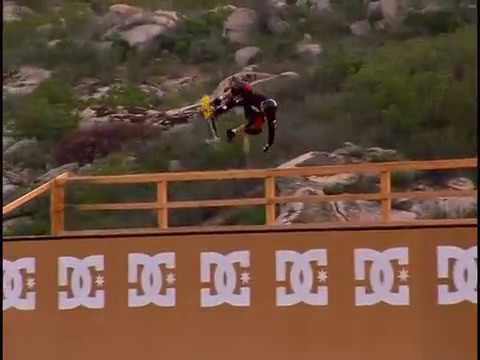
So here's the answer: a skateboard jump goes up to 24 meters, and the ceiling isn't the ramp. It's the body. The longer the gap, the higher the speed, the harder the landing hits. At the 2007 X Games, Jake Brown fell 45 feet, 14 meters, on the Mega Ramp. He got up and walked off, but the image went around the world. Building bigger, nothing stops you. Surviving it run after run is another story.
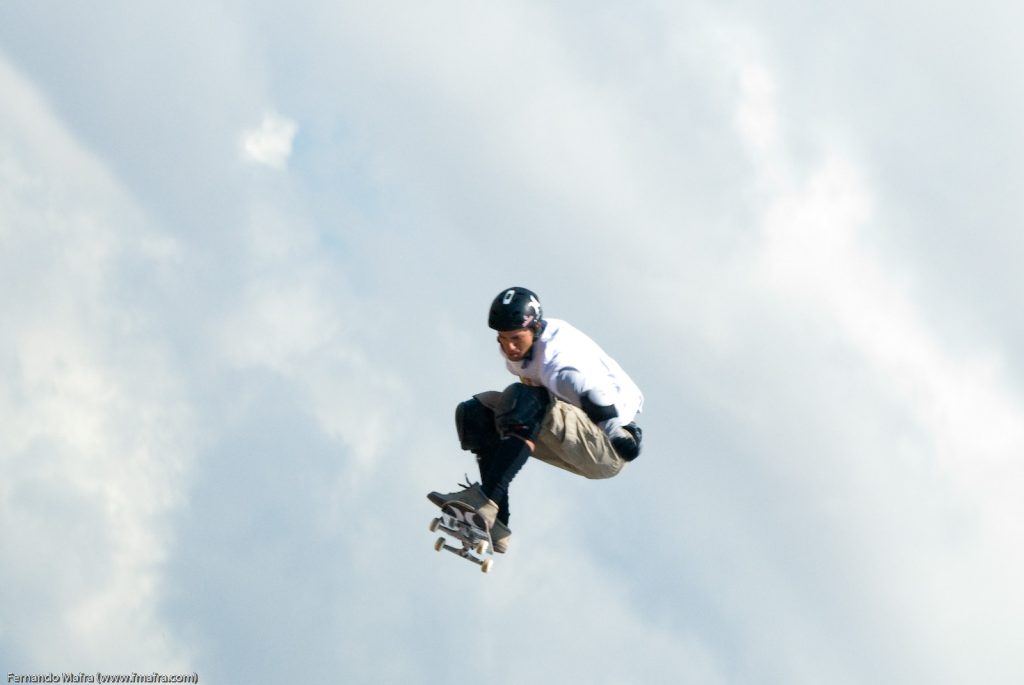
So the race changed direction. Nobody jumps farther anymore, they spin more. In March 2012, Tom Schaar landed the first 1080 in history, at 12, on a Mega Ramp. In August 2019, Mitchie Brusco landed a 1260 in Big Air. Three and a half turns in the air. Distance hit its wall, rotation hasn't yet.
Danny Way didn't stop either. He was Skater of the Year again in 2004, thirteen years after his first title. In 2005 he jumped the Great Wall of China with a broken foot. In 2006 he dropped 82 feet from the giant guitar of the Hard Rock in Las Vegas. In November 2023 he left DC, the brand he had been the first pro for.
What the 2003 part changed fits in one sentence. Before, skating was measured in tricks. Since Point X, it is also measured in feet, in meters, in seconds of airtime. Today's kids, like Sky Brown on an Olympic podium at 13, grew up in a world where the Mega Ramp already existed. Danny Way built it for them without knowing it.
The 24-meter record has stood since 2004: do you think someone will ever jump farther, or has rotation taken over for good? Tell us in the comments ↓
Follow NOSK8 where you hang out
Parts, spots, behind the scenes: it all drops on the accounts first.
Le lexique
-
1
roll-in
La pente de départ, au sommet d'une tour, qui sert à prendre de la vitesse avant le saut.
-
2
gap
Le vide à franchir entre deux modules. Sur une Mega Ramp, c'est lui qui donne la distance du saut.
-
3
quarter
Demi-rampe courbe qui renvoie le skateur vers le haut. Sur la Mega Ramp, il sert au saut en hauteur.
-
4
backside 360
Rotation complète du corps et de la planche, dos tourné vers l'avant au départ de la rotation.
-
5
Big Air
Épreuve des X Games disputée sur la Mega Ramp depuis 2004 : un saut au-dessus du gap, puis un air sur le quarter.
Shop NOSK8
Voir toute la boutique →
TEE-SHIRTS
TEE-SHIRT NOSK8® NOSKATE #NSITA
Le prix initial était : 35,00 €.29,00 €Le prix actuel est : 29,00 €.

TEE-SHIRTS
TEE-SHIRT NOSK8® P.B HEART #POLARBEAR
Le prix initial était : 35,00 €.29,00 €Le prix actuel est : 29,00 €.

TEE-SHIRTS
TEE-SHIRT NOSK8® I.L.N #ILOVEN8
Le prix initial était : 35,00 €.29,00 €Le prix actuel est : 29,00 €.

TEE-SHIRTS
TEE-SHIRT NOSK8® P.B HEART #NYC
Le prix initial était : 35,00 €.29,00 €Le prix actuel est : 29,00 €.

TEE-SHIRTS
TEE-SHIRT NOSK8® MATRICE HEART #CTRL
Le prix initial était : 35,00 €.29,00 €Le prix actuel est : 29,00 €.

CASQUETTES
CAP NOSK8® P.B #POLARBEAR
Le prix initial était : 35,00 €.25,00 €Le prix actuel est : 25,00 €.

CASQUETTES
CAP NOSK8® N8 #NOSK8
Le prix initial était : 35,00 €.25,00 €Le prix actuel est : 25,00 €.

CASQUETTES
CAP NOSK8® P.B.P #PAW
Le prix initial était : 35,00 €.25,00 €Le prix actuel est : 25,00 €.

HOODIES
HOODIE NOSK8® MATRICE HEART #ALT
Le prix initial était : 60,00 €.49,00 €Le prix actuel est : 49,00 €.

HOODIES
HOODIE NOSK8® MATRICE HEART #CTRL
Le prix initial était : 60,00 €.49,00 €Le prix actuel est : 49,00 €.

HOODIES
HOODIE NOSK8® I.L.N #ILOVEN8
Le prix initial était : 60,00 €.49,00 €Le prix actuel est : 49,00 €.
HOODIES
HOODIE NOSK8® NOSKATE #NSITA
Le prix initial était : 60,00 €.49,00 €Le prix actuel est : 49,00 €.

HOODIES
HOODIE NOSK8® P.B HEART #BARÇA
Le prix initial était : 60,00 €.49,00 €Le prix actuel est : 49,00 €.

SWEAT
SWEAT NOSK8® P.B HEART #BARÇA
Le prix initial était : 45,00 €.39,00 €Le prix actuel est : 39,00 €.
SWEAT
SWEAT NOSK8® P.B HEART #PHILI
Le prix initial était : 45,00 €.39,00 €Le prix actuel est : 39,00 €.
SWEAT
SWEAT NOSK8® P.B HEART #NYC
Le prix initial était : 45,00 €.39,00 €Le prix actuel est : 39,00 €.
SWEAT
SWEAT NOSK8® P.B HEART #PARIS
Le prix initial était : 45,00 €.39,00 €Le prix actuel est : 39,00 €.
SWEAT
SWEAT NOSK8® P.B HEART #POLARBEAR
Le prix initial était : 45,00 €.39,00 €Le prix actuel est : 39,00 €.
Continue ta lecture
TricksComment faire un heelflip : les 6 étapes — et pourquoi ton board part toujours en biais
Ton talon frappe, la planche part en biais, tu retombes à côté. Les 6 étapes du heelflip dans l'ordre, les 4 fails classiques, et la…
Commentaires (0)