

ℹ️ 🛹 Web Média Skate 🛹 ℹ️

★ Chroniques · Opinion
Marc Johnson Tribute: The Legacy of a Street Skating Legend
Marc Johnson est mort le 26 mai 2026 à 49 ans. Sa part Modus Operandi - 2000, la naissance d'enjoi, Girl, Chocolate, Lakai : ce qu'il laisse au skate de rue.
→ Pour aller plus loin : Le skate féminin a explosé en 5 ans. Pourquoi 36 Skater of the Year et zéro femme ?
We lost Marc Johnson on May 26, 2026, in San Jose. He was 49. Twenty-six years earlier, in Modus Operandi, he opened his part in a white tuxedo, staring straight down the lens, holding up a hand-written cue card: "God did not put me here to impress you." Everybody rewound that intro. Nobody realized it was a mission statement for the next twenty years.
The wave of tributes that followed the news wasn't just industry politeness. It said something very specific: Marc Johnson wasn't the most decorated skater of his generation, and he sure wasn't the loudest. He was the one other pros watched to figure out where the bar sat. And he held it there for twenty years without ever looking like he was trying.
Modus Operandi - 2000: five minutes in a white tuxedo
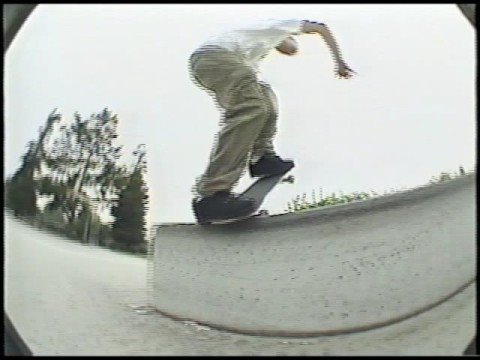
His part in Transworld Skateboarding's tenth video dropped in 2000. It opens on a white wall, a white tuxedo, and a stack of handwritten cue cards he flips one by one at the camera — the Bob Dylan nod is on purpose, and so is the weight behind it. "Pushing my beliefs." "God did not put me here to impress you." Then the edit cuts loose, Built To Spill kicks in with The Plan, and you spend five minutes realizing tech skating can be flat-out elegant.
That detail matters: he picked the music himself. He confirmed it in a 2012 interview — every part of his career, he chose the tracks. That's why his videos don't age the way other people's do. He wasn't a skater dropped on top of a soundtrack. He was a guy cutting his part like a short film.
Technically, what got you was how clean it all was. No tricks tossed off to pad the run time. Every trick got landed all the way, rolled straight, came out steady. His lines — several tricks strung together in one push — read like finished sentences. In an era when street skating was chasing "bigger, always bigger," he pushed for "better, always cleaner." And he held that line on his own.
God did not put me here to impress you. — Marc Johnson, handwritten cue card, Modus Operandi - 2000
Winston-Salem, 80 bucks, a one-way ticket to California
He was born January 6, 1977, in Winston-Salem, North Carolina. Far from everything, a long way from California. He talked openly about a rough childhood, and about skating as the thing that bent his life onto another track. At some point, his mom and a neighbor handed him 80 bucks so he could head out to the West Coast. Eighty dollars. That's what put him on the bus.
Remember that feeling? The skate shop in some mid-size town, 1996, four VHS tapes on a shelf and a sun-bleached poster on the wall. You walked out with a tape you hadn't really picked, ran it at whichever homie had the best VCR, and discovered some guy nobody had ever heard of. On Maple, Marc Johnson was exactly that: the name you learned by accident, on Rites of Passage - 1994 and then Seven Steps To Heaven - 1996, and then repeated to everyone like you'd found him yourself.
Six years after he showed up, he was one of the most respected skaters in the country. Not off a contest run. Off a stack of footage nobody could argue with.
All inspiration works kind of like a radio: everything that's ever been known or ever will be exists between the lowest frequency and the highest. You stumble onto a song by accident, or you spend your whole life looking for it. — Marc Johnson, Thrasher interview, 2007
enjoi in 2000: a panda against "manufactured" teams
The same year as Modus Operandi, he started his own brand: enjoi, backed by Rodney Mullen. Both came out of the A-Team, a Mullen and Steve Rocco project Johnson later described flat out as "a totally manufactured team, based on marketing." He called Mullen and said he was out. Everybody quit that same week without telling each other.
enjoi was the answer: a panda for a logo, graphics that took nothing seriously, a team where being funny counted as much as being good. Twenty-six years on, the brand is still here and the panda is a skate shop staple. A 23-year-old built that because he didn't like the way people around him were talking about skating.
Yeah Right! then Fully Flared: the years he never missed
He joined the Crailtap camp next — Girl, Chocolate, Lakai — and ran off the densest decade of his career. Yeah Right! - 2003, the Spike Jonze Girl video. Hot Chocolate - 2004. Fully Flared - 2007 for Lakai, where his part holds its own against an absolutely stacked lineup. Then Pretty Sweet - 2012, with 40 coming up fast and him still skating better than half the team.
If you want to gauge how big this all is, look at what Fully Flared has become over time, or at the place Girl and Chocolate carved out across thirty years of American skate history. Marc Johnson is in both stories, never top billing, always the section people rewind.
That's part of his signature too: he never needed to be the main character. In any ranking of 2000s skate videos, he shows up three or four times — never as the headliner, always as the reason the video holds up.
The Back Forty, Business & Company: giving skating a voice
Starting in 2013, he launched The Back Forty with Kenny Anderson and Chris Roberts. Not a brand — he was firm on that — a place for ideas that had nowhere else to live. The line on the project's page sums up thirty years of method: "to become the voice of what skateboarding has to say for itself."
He sat down for episode 36 of the Nine Club, Chris Roberts' podcast. Later he announced Business & Company, a new brand project, on his socials. In the photo now running on his encyclopedia page, he's wearing a white tee with the word "BUSINESS" across it. He never stopped building things.
What's left today
Today, when some 20-year-old posts a clean line where every trick rolls all the way out, no cut in the edit, no algorithm-picked song — odds are good it traces straight back to Marc Johnson without them knowing it. The taste for the finished line, the refusal to toss a trick just for views: it passed from part to part, from Modus Operandi to Instagram accounts that have never heard his name. That's probably the best legacy there is.
No cause has been shared publicly. He leaves behind a son, Avery. He was 49, with a career nobody in street skating has managed to copy cleanly — because it was never a formula, it was a character. If all you know is the name, start with the 2000 part: five minutes, a white tuxedo, a handwritten cue card. It's all already there.
Which Marc Johnson part did you rewind the most — Modus Operandi - 2000, Yeah Right! - 2003 or Fully Flared - 2007 ? Drop it in the comments ↓
Le lexique
-
1
part
Section d'une vidéo de skate consacrée à un seul skateur, montée avec sa propre musique. La carte de visite d'un pro.
-
2
footage
Les images filmées, brutes ou montées. Un skateur « a du footage » quand il a des clips exploitables en vidéo.
-
3
line
Plusieurs figures enchaînées sans poser le pied, filmées d'une seule roulade. L'inverse d'un trick isolé.
Shop NOSK8
Voir toute la boutique →
TEE-SHIRTS
TEE-SHIRT NOSK8® P.B CENTRE #RNB
Le prix initial était : 35,00 €.29,00 €Le prix actuel est : 29,00 €.
TEE-SHIRTS
TEE-SHIRT NOSK8® P.B HEART #ORIGINAL
Le prix initial était : 35,00 €.29,00 €Le prix actuel est : 29,00 €.
TEE-SHIRTS
TEE-SHIRT NOSK8® P.B CENTRE #ORIGINAL
Le prix initial était : 35,00 €.29,00 €Le prix actuel est : 29,00 €.
TEE-SHIRTS
TEE-SHIRT NOSK8® NOSKATE #NSITA
Le prix initial était : 35,00 €.29,00 €Le prix actuel est : 29,00 €.
TEE-SHIRTS
TEE-SHIRT NOSK8® P.B HEART #POLARBEAR
Le prix initial était : 35,00 €.29,00 €Le prix actuel est : 29,00 €.
CASQUETTES
CAP NOSK8® P.B #POLARBEAR
Le prix initial était : 35,00 €.25,00 €Le prix actuel est : 25,00 €.
CASQUETTES
CAP NOSK8® N8 #NOSK8
Le prix initial était : 35,00 €.25,00 €Le prix actuel est : 25,00 €.

CASQUETTES
CAP NOSK8® P.B.P #PAW
Le prix initial était : 35,00 €.25,00 €Le prix actuel est : 25,00 €.
HOODIES
HOODIE NOSK8® NOSKATE #SNC
Le prix initial était : 60,00 €.49,00 €Le prix actuel est : 49,00 €.
HOODIES
HOODIE NOSK8® P.B CENTRE #RNB
Le prix initial était : 60,00 €.49,00 €Le prix actuel est : 49,00 €.
HOODIES
HOODIE NOSK8® MATRICE HEART #ALT
Le prix initial était : 60,00 €.49,00 €Le prix actuel est : 49,00 €.
HOODIES
HOODIE NOSK8® MATRICE HEART #CTRL
Le prix initial était : 60,00 €.49,00 €Le prix actuel est : 49,00 €.
HOODIES
HOODIE NOSK8® I.L.N #ILOVEN8
Le prix initial était : 60,00 €.49,00 €Le prix actuel est : 49,00 €.
SWEAT
SWEAT NOSK8® P.B HEART #BARÇA
Le prix initial était : 45,00 €.39,00 €Le prix actuel est : 39,00 €.
SWEAT
SWEAT NOSK8® P.B HEART #PHILI
Le prix initial était : 45,00 €.39,00 €Le prix actuel est : 39,00 €.
SWEAT
SWEAT NOSK8® P.B HEART #NYC
Le prix initial était : 45,00 €.39,00 €Le prix actuel est : 39,00 €.
SWEAT
SWEAT NOSK8® P.B HEART #PARIS
Le prix initial était : 45,00 €.39,00 €Le prix actuel est : 39,00 €.
SWEAT
SWEAT NOSK8® P.B HEART #POLARBEAR
Le prix initial était : 45,00 €.39,00 €Le prix actuel est : 39,00 €.
Continue ta lecture
Chroniques5 contests ont fait le skate moderne. Le plus décisif n’a jamais eu de juges
Tampa Pro, Münster, Slam City Jam, Street League : quatre contests ont écrit l'histoire du skate. Le cinquième n'avait ni juges ni tribune — et…
Commentaires (0)