
ℹ️ 🛹 Web Média Skate 🛹 ℹ️

 Back
Tricks
Dropping In: Fear Is Fixed With a Minimum Speed, Not Courage
Why do your legs freeze at the top of the ramp? The speed waiting at the bottom, height by height, and the move that makes most beginners fall.
On May 28, 2020, in California, 11-year-old Sky Brown falls off a ramp during a training session. The damage: multiple skull fractures, and a broken left wrist and hand. One year and two months later, she stands on the Tokyo Olympic podium, bronze medal at 13.

And you, you’re at the top of the mini ramp at the skatepark, board wedged on the coping, and your legs won’t commit. You figure you’re short on guts. That’s not it. To drop in, what you’re missing is one speed, just one, that your body has never felt.
We’ll get there lower down, with the move that trips up almost everyone. First, the specs.
Level
Beginner
Time
2-6h
Prerequisites
Pumping, braking, kick turn
Surface
Mini ramp, 60 cm to 1.20 m
In this article 6 parts
- Sky Brown, skull fractured at 11: what got her back up?
- 1.83 m, 21 km/h: what your ramp has in store for you…
- The board that rolls off without you: the 4 fails of the…
- From 60 cm to 2 meters: the 6 steps so speed never…
- So where does the fear really come from, and which move makes…
- And after the mini, the Tony Hawk vert?
Sky Brown, skull fractured at 11: what got her back up?

Sky Brown didn’t grow up in a skatepark. She grew up in Takanabe, Japan, with a ramp in the backyard, because there was no park around. She knows that transition like the hallway in her own house.
After the 2020 fall, she kept at it. In July 2021, she won gold in park at the X Games. A few weeks later, in Tokyo, she wiped out on her first two runs. On her third, she scored 56.47 points and took bronze. The Guardian ran a headline on the youngest medalist in British sports history.
She didn’t come back because she has more guts than you. She came back on a transition she knows every inch of. Your problem at the top of the mini is a lot smaller than hers. And yours can be measured.
1.83 m, 21 km/h: what your ramp has in store for you at the bottom
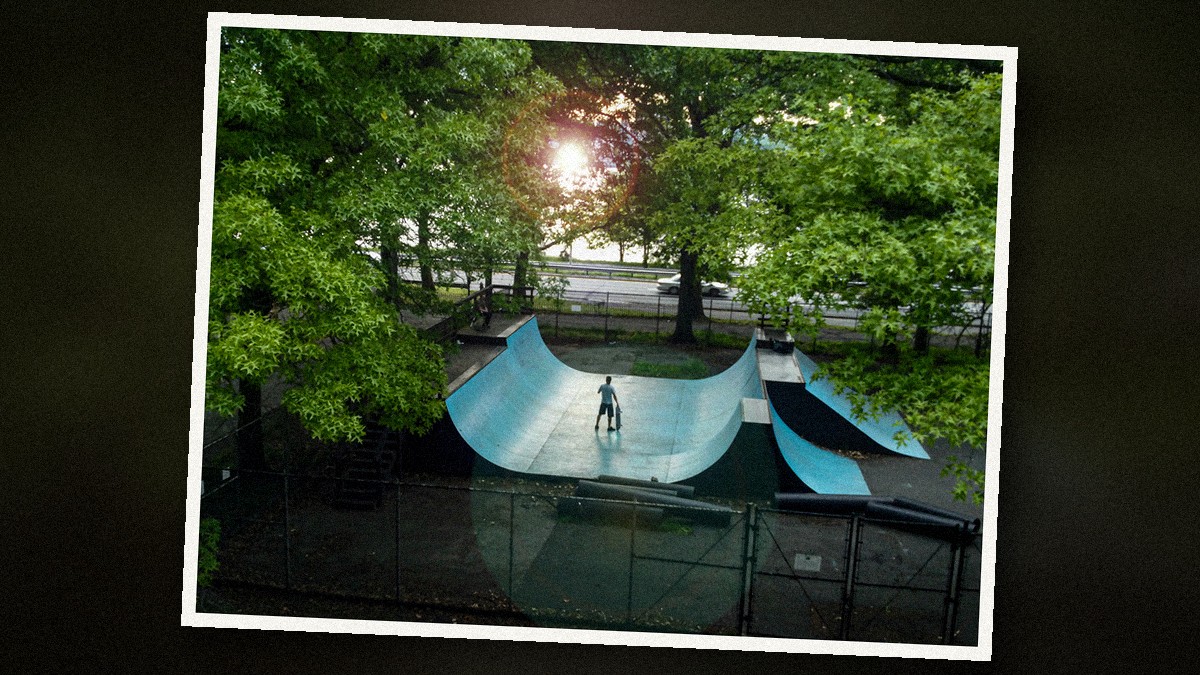
A ramp is a fall that the board turns into speed. The physics fits on one line: at the bottom, your speed is at most the square root of 2 × g × h. g is gravity, 9.81. h is the height of the coping. The wheels and the air take a little bit of it, never the other way around.
Do the math for the ramps you come across. 60 cm is 12 km/h at the bottom. 1.20 m, 17 km/h. A 6-foot mini, 21 km/h. A 3.35 m vert, 29 km/h. Doubling the height doesn’t double the speed: it climbs by about 40%.
Here’s what your legs refuse at the top. Not the drop, a speed you’ve never felt. Your brain doesn’t like rushing toward something unknown, so it hits the brakes. And that’s where it goes wrong, because a drop you brake on can’t be saved.
The board that rolls off without you: the 4 fails of the first drop
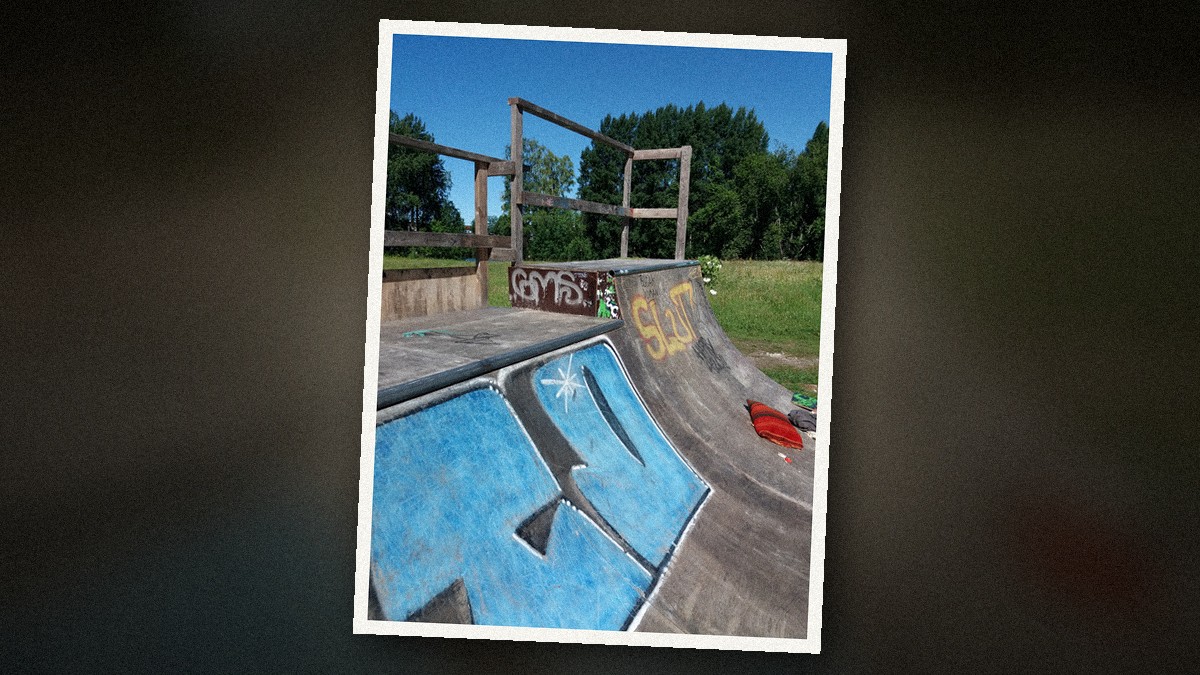
Seen from the top, the slope looks vertical. It almost is, just below the coping. Then the curve softens all the way to the flat. The same four mistakes come back at every park.
The 4 classic drop fails
- The board runs off ahead of you: your weight stayed on your back foot. The board accelerates down the slope, your body stays up top. You land on your butt or your back.
- You get stuck on the edge: you tipped halfway. The front wheels touch, the back truck hangs on the coping, and you go forward without the board.
- Your feet come off: you jumped into the ramp instead of rocking forward. The board drops back down on its own, and you land a meter ahead of it.
- Everything shakes at the bottom: legs locked, the board starts to wobble on the flat. Bend your knees, they’re your shock absorbers.
From 60 cm to 2 meters: the 6 steps so speed never catches you off guard
The idea is simple: your body has to know the arrival speed before your first drop. Braille’s video above shows the basic version. Here’s the order. Don’t skip one.
-
Speed on the flat: push until you’re really rolling, then brake. Repeat. Your body has to make that speed feel normal.
-
The ramp from the bottom: from the flat, ride up the transition, do a kick turn, drop back down. Each pass a little higher, until you’re grazing the coping. Coming back down from there, you already have the exact speed for the drop.
-
Tail on the coping: at the top, rear truck locked behind the lip, back foot on the tail, board hanging over the void.
-
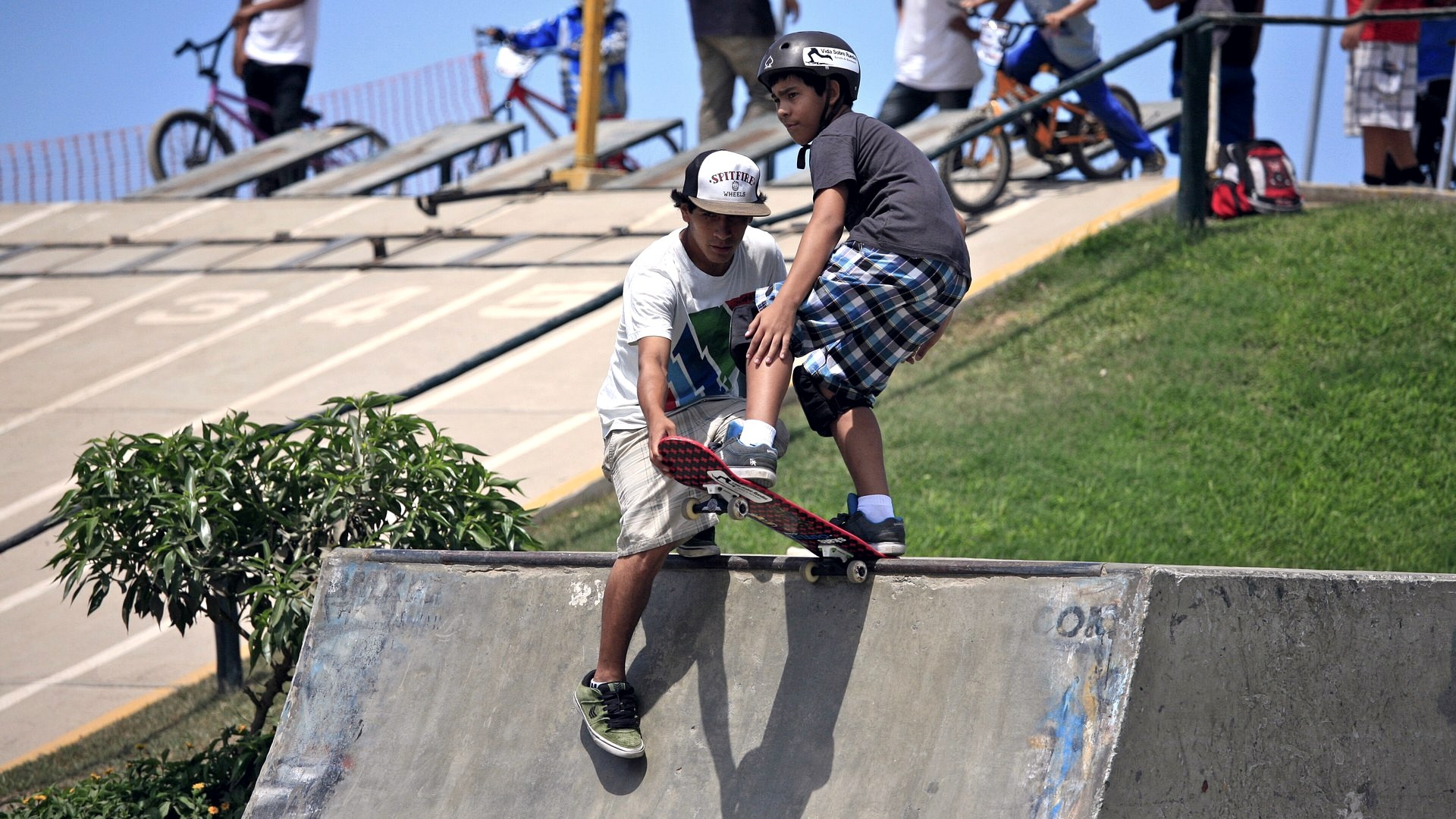
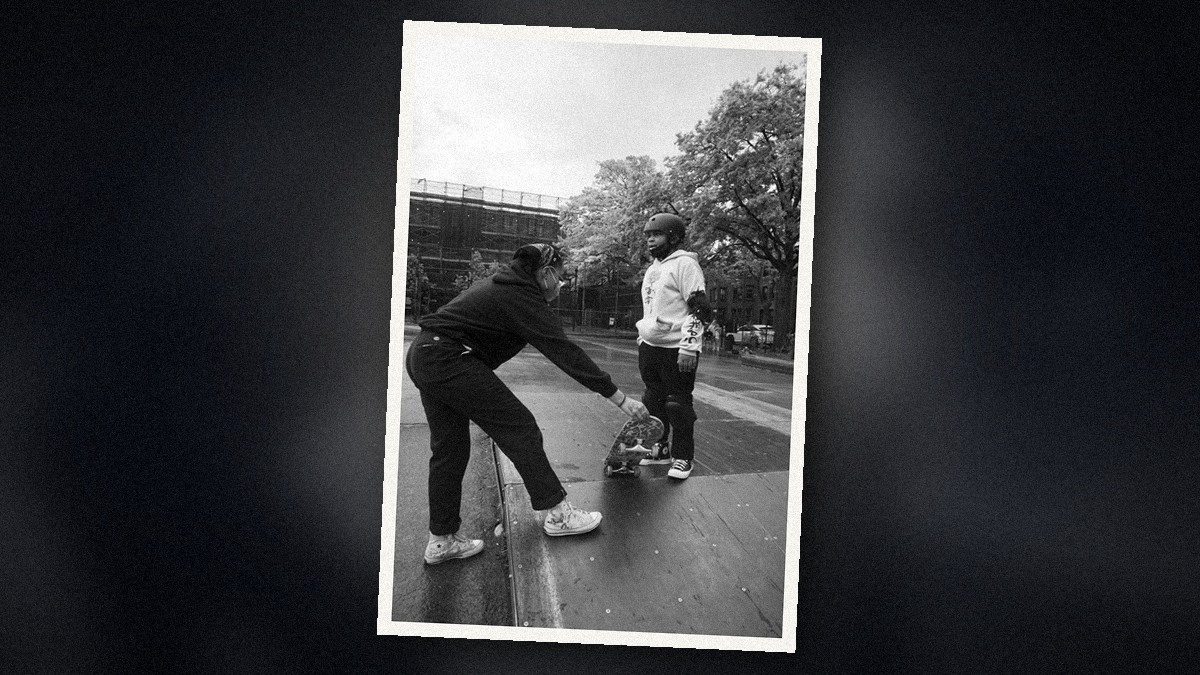
Front foot placed: on the front truck bolts, without pressing. A homie can hold your hand if you want, like in the photo.
-
The tip-over: all your weight on the front foot, shoulders over the front truck, until all four wheels touch the slope.
-
The flat, then 30 cm more: knees bent, eyes on the flat, roll all the way across. Ten clean drops in a row, and only then a taller ramp.
So where does the fear really come from, and which move makes you fall?
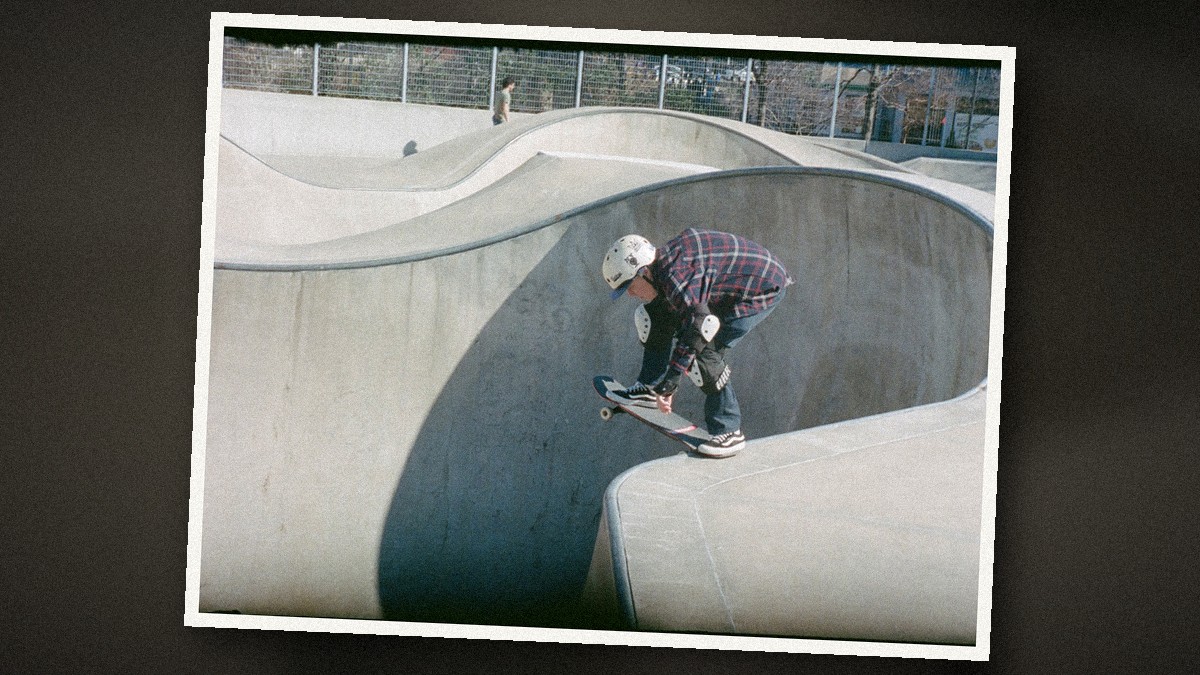
From a speed your body doesn’t know. And from what it does when it’s scared: it pulls back. All the weight goes to the back foot, shoulders stay over the deck. That move takes down the vast majority of beginners on the drop. The board dives, accelerates, and you stay back. It shoots off, you land on your back.
Physics says the opposite of your instinct. On the slope, the board is pulled down. If your body isn’t over it, it leaves without you. The cue: stay perpendicular to the ramp, not to the ground. When you tip over, it feels like you’re diving. That’s exactly what you need.
So fear doesn’t get fixed with courage. It gets fixed with minimum speed: the smallest ramp possible, and an arrival speed you’ve already felt coming up the transition from the bottom. When your body knows what’s coming, it has no reason to pull back. And without the pullback, the front foot does the work.
If it still sticks, film yourself from the side. Watch your shoulders at the moment the front wheels touch. Behind the back foot? That’s your problem. And keep the helmet: the backward fall is what it’s there for.
And after the mini, the Tony Hawk vert?
Same method, higher. A 3.35 m vert sends you close to 30 km/h on flat. Tony Hawk, who spent his life on these ramps, shows how he drops a vert in this video.

Between the two, the rock to fakie teaches you to ride the coping, on the same weight shift. On the street side, the 50-50 on a curb is worked on in parallel. And if your board acts up at speed, check out the perfect beginner setup.
Your first drop, what height was it, and how long did you stay frozen at the top ? Tell us in the comments ↓
Le lexique
-
1
Coping
Le rebord arrondi, souvent en métal, en haut d'une rampe.
-
2
Drop in
Entrer dans une rampe depuis le haut, en basculant la planche du rebord vers la pente.
-
3
Kick turn
Demi-tour sur les roues arrière, nose levé, pour repartir dans l'autre sens.
-
4
Wobble
Tremblement de la planche à vitesse, quand le corps est trop raide.

Continue ta lecture
TricksLe ollie en 6 étapes : la base que tu dois maîtriser avant tout le reste
Tu rates ton ollie depuis des semaines ? T'es pas le seul. Alan Gelfand l'a inventé en 1978, Rodney Mullen l'a adapté au flat ground…
Commentaires (0)