
ℹ️ 🛹 Web Média Skate 🛹 ℹ️

Conseils
Kids' Skateboards: The Number That Matters Isn't Their Age
Tout le monde te dit qu’il est « trop petit ». C’est la mauvaise question : un seul chiffre décide si la planche va marcher — et ce n’est pas son âge.

→ Pour aller plus loin : Skater sous la pluie : ce que ça détruit vraiment sur ta planche
Level: Beginner
A 10-year-old lands a clean kickflip on your feed, and now you're thinking you need to get one for your little brother, your son, your nephew. Except the second you start shopping, everyone hits you with the same line: "he's too young."
That's wrong, and more importantly, it's the wrong question. There's one number that actually decides whether the board will work out or end up in the garage within three weeks — and that number isn't his age.
Let's take it from the top. What a kid can do at 5, what a board that holds up actually costs, the one piece of gear you're not allowed to get wrong, and the number to measure before you pay for anything.
Dodge the classic mistake
The €25 board from the toy aisle, with the cartoon graphic and the hard plastic wheels. It doesn't roll straight, the trucks work themselves loose, and the wheels stop dead on the smallest bit of gravel. The kid falls, has no idea why, and decides he doesn't like skateboarding. The kid isn't the problem — it's a toy dressed up as a skateboard.
How Young Is Too Young? Rayssa Leal Was 6
(function(){
var VID='jrs5HQS4Fv0';
var container=document.getElementById('yt-jrs5HQS4Fv0');
var played=false;
function initPlayer(){
var player=new YT.Player(container,{
width:'100%',height:'450',videoId:VID,
playerVars:{cc_load_policy:1,cc_lang_pref:'fr',hl:'fr',mute:1,rel:0,autoplay:0,enablejsapi:1},
events:{
onReady:function(e){
try{e.target.setOption('captions','track',{'languageCode':'fr'});}catch(x){}
if('IntersectionObserver' in window){
var obs=new IntersectionObserver(function(entries){
if(entries[0].isIntersecting&&!played){played=true;e.target.playVideo();obs.disconnect();}
},{threshold:0.4});
obs.observe(container);
}
}
}
});
}
if(window.YT&&window.YT.Player){
initPlayer();
} else {
var prev=window.onYouTubeIframeAPIReady;
window.onYouTubeIframeAPIReady=function(){if(prev)prev();initPlayer();};
if(!document.querySelector('script[src*="youtube.com/iframe_api"]')){
var s=document.createElement('script');s.src='https://www.youtube.com/iframe_api';document.head.appendChild(s);
}
}
})();
Rayssa Leal got her first board for her birthday, at 6. At 7, the clip of her skating in a fairy dress was everywhere and Tony Hawk was reposting it. At 13 years and 203 days, she took Olympic silver in Tokyo. Sky Brown stepped onto the podium at 13 years and 28 days — the youngest medalist in UK history.
Those numbers don't mean you should be aiming for the Olympics. They just say one thing: a 6-year-old's body handles skateboarding without a problem. The real floor is motor skills — being able to run, stop, and fall without stiffening up. In practice, that lands somewhere between 4 and 6.
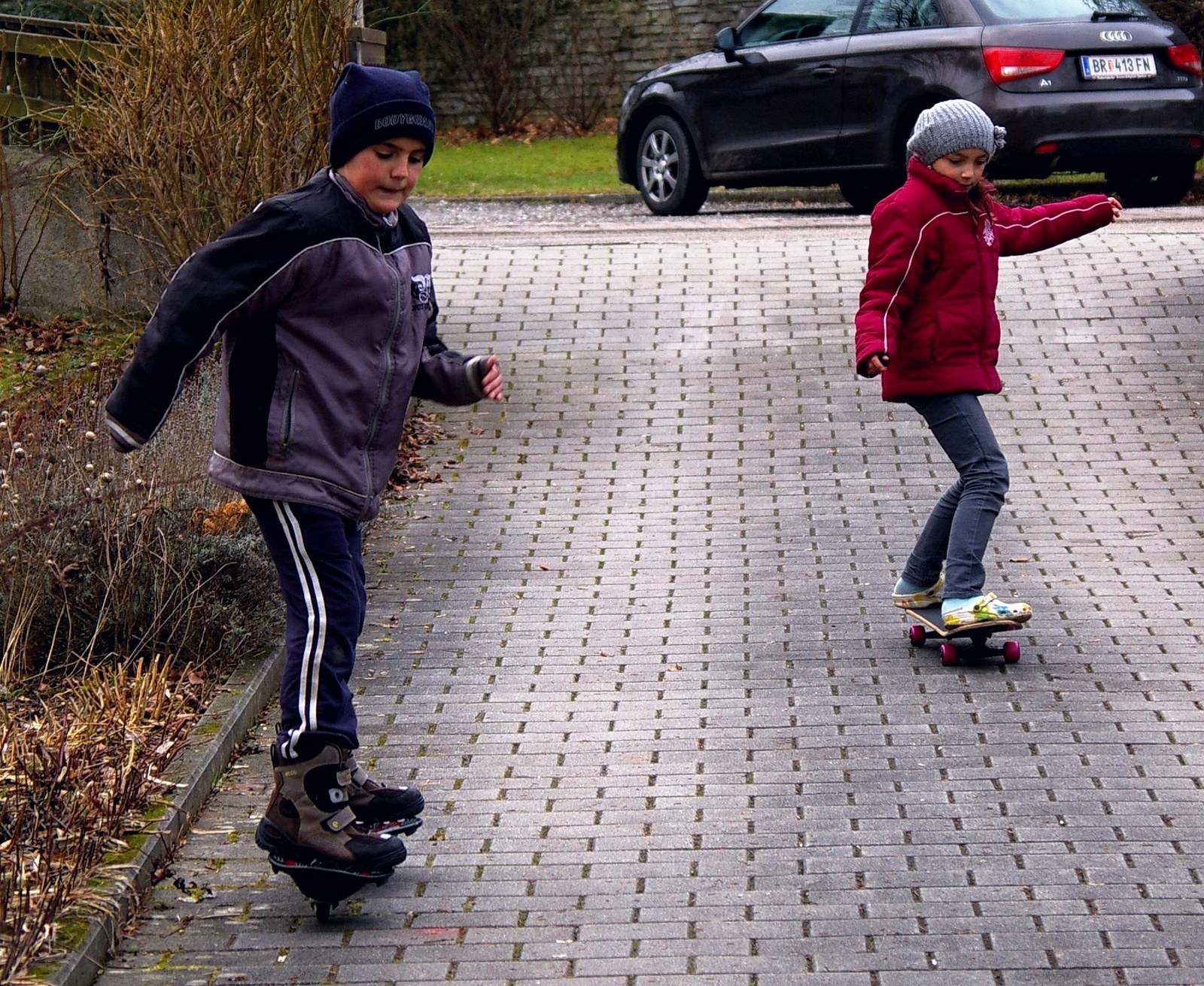
What changes everything at that age is the program. No tricks, no skatepark on day one. Push, turn, step off the board without eating it. Three twenty-minute sessions beat one full afternoon that ends in tears.
What It Really Costs: €60 That Holds Up, or €25 That Ends Up in the Garage
A complete — a factory-assembled board, ready to ride — is still the only reasonable call for a first purchase. At Decathlon, kids' models from the Oxelo line start around €40-60. On Skatedeluxe, a name-brand complete in a small size runs €80 to €110.
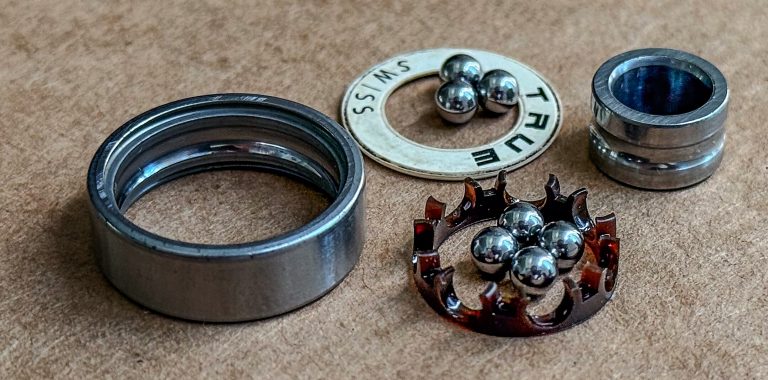
Between the two, the difference comes down to three parts: the bearings (which decide whether the board rolls or brakes on its own), the trucks (which decide whether it turns), and the wood in the deck. Tight budget? Go with the entry-level board from a real sports retailer over the mid-range option from a toy aisle.
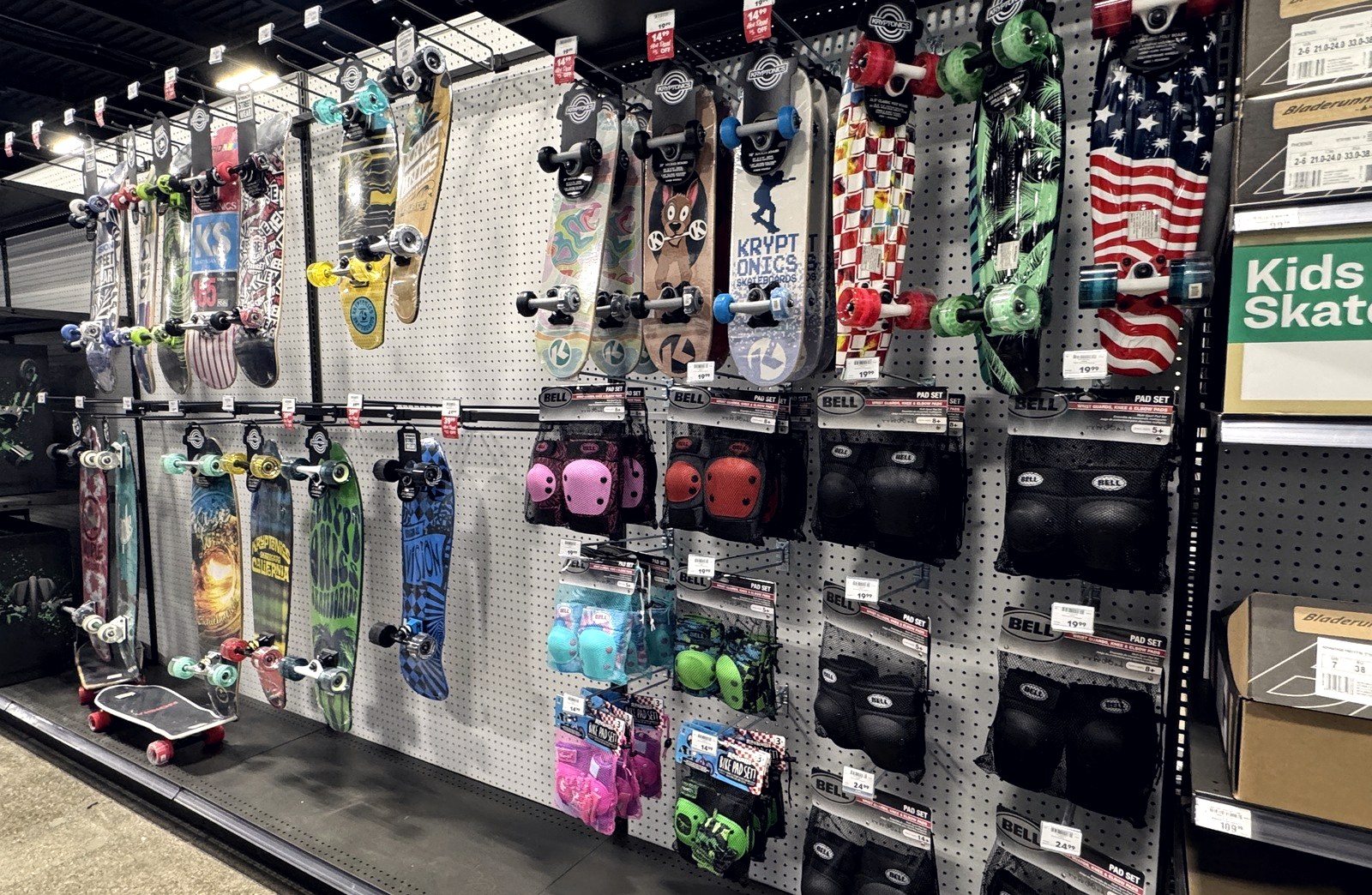
- €40-60 — entry-level kids' complete. Plenty to learn how to push and roll for a year.
- €80-110 — name-brand complete in a kids' size. Real maple, real bearings: this is where the first tricks become possible.
- + €30 to €50 — helmet and pads. Non-negotiable — more on that just below.
Building it part by part, you blow past €150 fast with no guarantee the sizes even match up. Our first skateboard guide breaks down the custom build — but for a kid, the complete wins every time.
The Helmet: The One Piece That's Not Up for Debate
A kid who's just starting out falls backward. Not sideways, not onto the hands: backward, onto the back of the skull, because the board shoots out front and the body follows. That's the only scenario that matters.
Look for the EN 1078 marking on the label — the European standard for bike, skateboard, and roller skating helmets, published in 1997. Without it, you're buying a decorative shell. Size it with a soft measuring tape around the forehead, just above the eyebrows and ears, like the Warehouse Skateboards helmet guide lays out. A helmet that shifts when the kid shakes his head is too big.
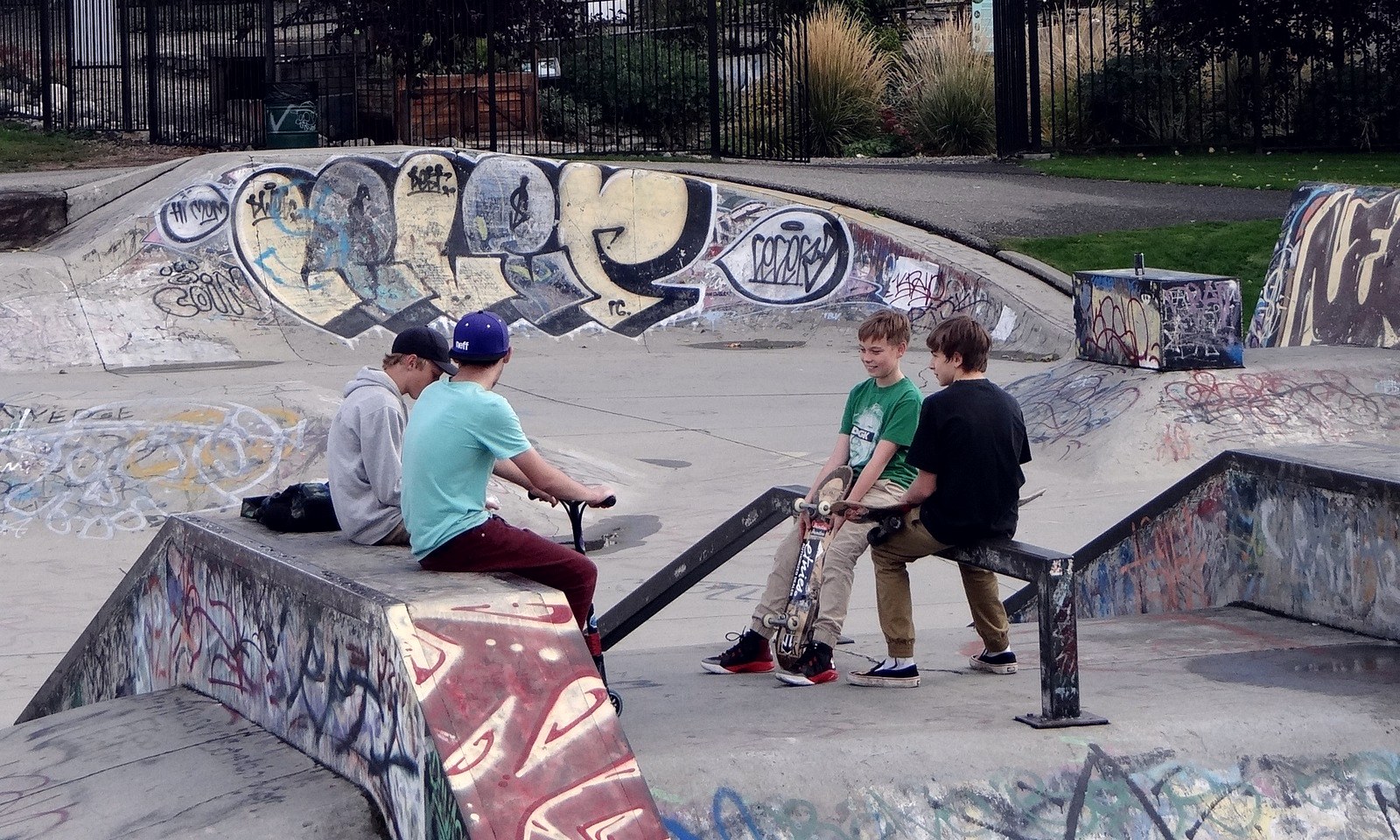
Knee and elbow pads earn their keep the first few weeks, then end up at the bottom of the bag — that's normal, they did their job. Our pads guide runs through what's actually worth the money. And with helmets, the real issue is style: a kid keeps wearing what he thinks looks cool.
The Number That Matters: His Shoe Size, Not His Age
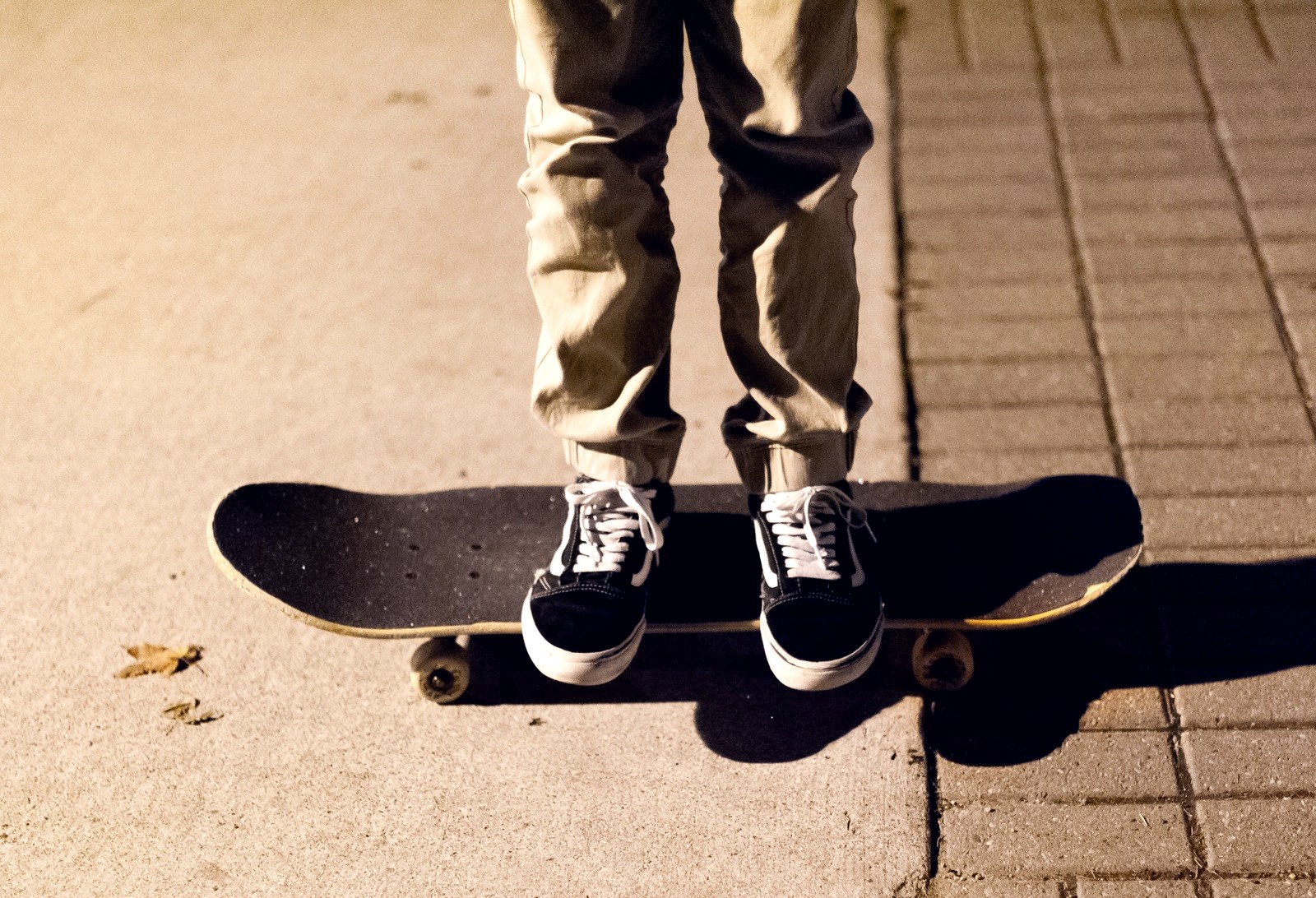
Here's the answer. Deck width gets picked off the kid's shoe size — never his age, never his height. Two 8-year-olds can wear an EU 30 and an EU 36: they do not need the same board.
The logic is pure mechanics. The foot should cover the width of the deck with barely any overhang — about half a centimeter on each side. Too wide: the kid can't get the board to pivot, he's pushing at nothing. Too narrow: the foot hangs over, slips, and the ankle rolls. Warehouse Skateboards sums it up in its deck guide: width is the only measurement that really counts — length is useless when picking a board.
- 7.0 inches — EU size 28 to 32 — The mini format, for ages 4-7. The board stays manageable, and the kid can carry it and pick it up on his own.
- 7.375 inches — EU size 33 to 35 — The in-between format, around ages 7-10. Wide enough to stand on, short enough to pivot.
- 7.5 inches — EU size 36 to 38 — The first "adult" size. From here on out, a kid can keep the same board for years.
- 8.0 inches — EU size 39 and up — The standard. At this point it's not a kids' skateboard anymore — it's a skateboard.
- The two-second test — Board standing against the leg: if the nose comes up past the sternum, it's too big.
- Never go "one size up so he can grow into it" — A board that's too wide kills the progression, and the kid quits before he ever grows into it.
The takeaway
Measure his shoe size, grab the matching width, buy an assembled complete, add an EN 1078 helmet. You just did 90% of the job. The rest — softer wheels, fresh grip, bearings — gets dialed in six months from now, once you know what's actually holding him back.
Where to Buy, in This Order
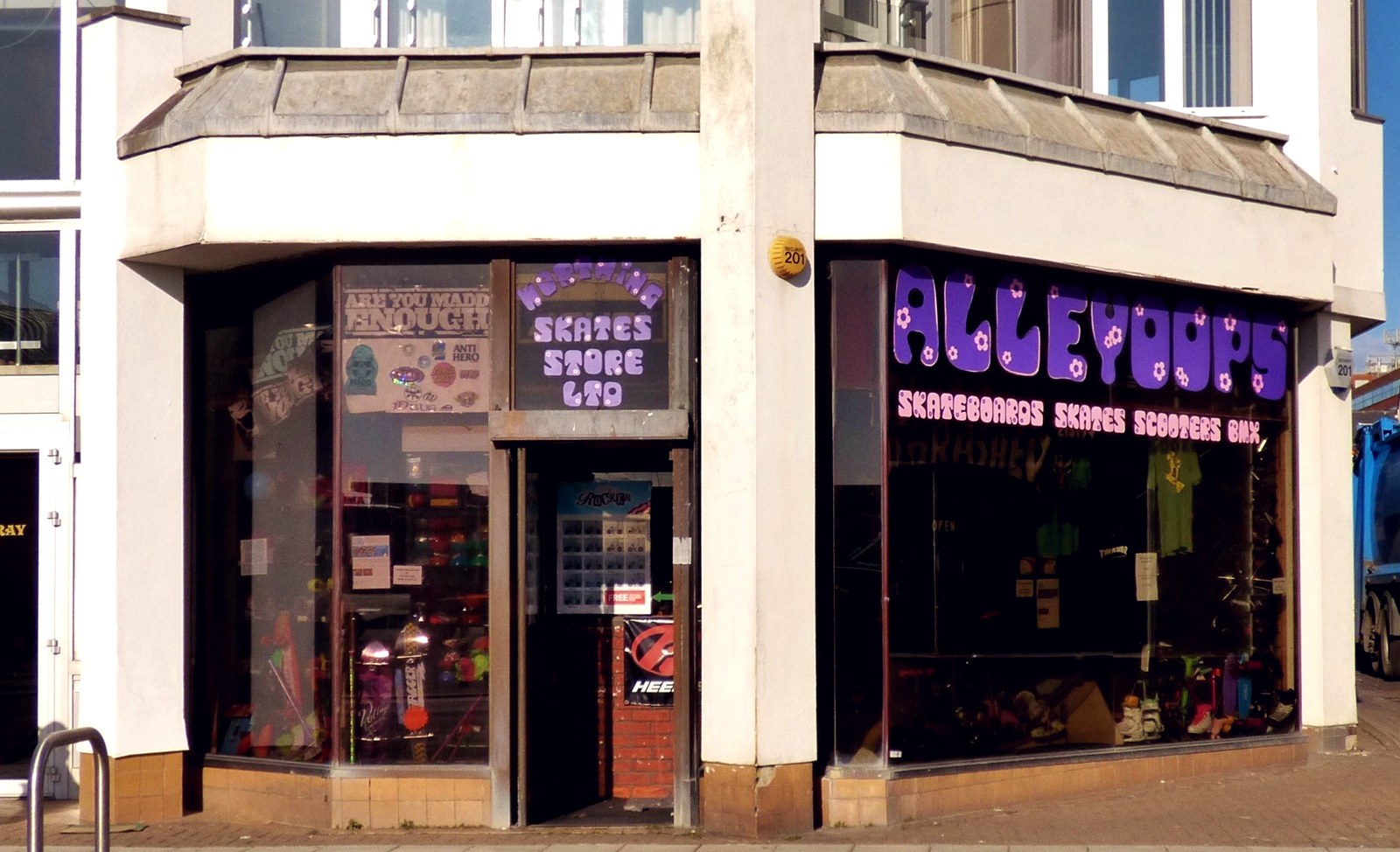
- Your local skate shop — the only place where someone can put the kid on three different boards before choosing. The trucks get tuned to his weight right there — no website will ever do that.
- Decathlon — the best price-to-reliability ratio for a first complete under €60, with the bonus of getting your hands on the product and being able to return it.
- Skatedeluxe, Titus, Skatepro — when you're stepping up in quality, or hunting a specific size you can't find in-store.
- Toy aisles and generalist marketplaces — steer clear. That's where they sell the boards that turn kids off skateboarding for good.
As for shoes, no need to invest right away: any flat-soled sneaker does the job for the first few months. Flat-soled Vans become useful once he starts scraping the grip — not before.
Frequently Asked Questions
Skateboard or plastic cruiser to start with?
Cruiser for cruising and getting around, regular skateboard for learning tricks someday. If the kid watches skate videos, get a real complete: a cruiser has no pop and he'll ditch it within a month.
He's growing fast — do I have to buy a new board every year?
No. A deck lasts two to three years, and width only becomes a limit once the shoe hangs over the board by more than a centimeter. Until then, you just swap the grip and the wheels — €25 instead of a whole new complete.
Is a used board a good idea?
A great one — as long as the deck has no cracks at the ends and the wheels spin freely when you flick them by hand. A decent used board beats a cheap brand-new complete. Skip anything that's been living outside: the wood swells and the board loses its pop.
Does a kid need softer wheels?
Yes, if he's riding in the street or on beat-up asphalt. Wheels around 92A to 95A soak up the vibration and won't lock up on gravel. On the smooth concrete of a skatepark, the stock 99As are plenty.
Grab a tape measure, measure his foot, pick the matching width. Five minutes, and you've just dodged the board that ends up buried in the garage. The rest is his to build — and it always starts with standing on the thing for two meters straight.
Enjoy the ride.
How old was the kid you gave their first board to, and what size did you go with? Drop it in the comments ↓
Follow NOSK8 where you hang out
Parts, spots, behind the scenes: it all drops on the accounts first.
Le lexique
-
1
complete
Planche vendue montée d’usine : deck, trucks, roues et roulements déjà assemblés, prête à rouler à la sortie du carton.
-
2
deck
Le plateau en bois seul, sans les roues ni les trucks. Sa largeur, en pouces, est la cote qui décide de tout.
-
3
trucks
Les deux pièces métalliques vissées sous le deck qui portent les roues et permettent de tourner en penchant le corps.
-
4
pop
La nervosité du bois quand on claque le tail au sol : c’est elle qui fait décoller la planche sur un ollie.
Shop NOSK8
Voir toute la boutique →
TEE-SHIRTS
TEE-SHIRT NOSK8® P.B CENTRE #RNB
Le prix initial était : 35,00 €.29,00 €Le prix actuel est : 29,00 €.
TEE-SHIRTS
TEE-SHIRT NOSK8® P.B HEART #ORIGINAL
Le prix initial était : 35,00 €.29,00 €Le prix actuel est : 29,00 €.
TEE-SHIRTS
TEE-SHIRT NOSK8® P.B CENTRE #ORIGINAL
Le prix initial était : 35,00 €.29,00 €Le prix actuel est : 29,00 €.
TEE-SHIRTS
TEE-SHIRT NOSK8® NOSKATE #NSITA
Le prix initial était : 35,00 €.29,00 €Le prix actuel est : 29,00 €.
TEE-SHIRTS
TEE-SHIRT NOSK8® P.B HEART #POLARBEAR
Le prix initial était : 35,00 €.29,00 €Le prix actuel est : 29,00 €.

CASQUETTES
CAP NOSK8® P.B.P #PAW
Le prix initial était : 35,00 €.25,00 €Le prix actuel est : 25,00 €.
CASQUETTES
CAP NOSK8® P.B #POLARBEAR
Le prix initial était : 35,00 €.25,00 €Le prix actuel est : 25,00 €.
CASQUETTES
CAP NOSK8® N8 #NOSK8
Le prix initial était : 35,00 €.25,00 €Le prix actuel est : 25,00 €.
HOODIES
HOODIE NOSK8® NOSKATE #SNC
Le prix initial était : 60,00 €.49,00 €Le prix actuel est : 49,00 €.
HOODIES
HOODIE NOSK8® P.B CENTRE #RNB
Le prix initial était : 60,00 €.49,00 €Le prix actuel est : 49,00 €.
HOODIES
HOODIE NOSK8® MATRICE HEART #ALT
Le prix initial était : 60,00 €.49,00 €Le prix actuel est : 49,00 €.
HOODIES
HOODIE NOSK8® MATRICE HEART #CTRL
Le prix initial était : 60,00 €.49,00 €Le prix actuel est : 49,00 €.
HOODIES
HOODIE NOSK8® I.L.N #ILOVEN8
Le prix initial était : 60,00 €.49,00 €Le prix actuel est : 49,00 €.
SWEAT
SWEAT NOSK8® P.B HEART #BARÇA
Le prix initial était : 45,00 €.39,00 €Le prix actuel est : 39,00 €.
SWEAT
SWEAT NOSK8® P.B HEART #PHILI
Le prix initial était : 45,00 €.39,00 €Le prix actuel est : 39,00 €.
SWEAT
SWEAT NOSK8® P.B HEART #NYC
Le prix initial était : 45,00 €.39,00 €Le prix actuel est : 39,00 €.
SWEAT
SWEAT NOSK8® P.B HEART #PARIS
Le prix initial était : 45,00 €.39,00 €Le prix actuel est : 39,00 €.
SWEAT
SWEAT NOSK8® P.B HEART #POLARBEAR
Le prix initial était : 45,00 €.39,00 €Le prix actuel est : 39,00 €.
Continue ta lecture
ÉvénementsSLS Tempe : la finale hommes à 1h45 du matin en France — qui vaut la nuit blanche ?
SLS Tempe Takeover, samedi 29 août : le programme complet converti en heure de Paris, la finale hommes à 1h45 du matin, les riders à…
Commentaires (0)