

ℹ️ 🛹 Web Média Skate 🛹 ℹ️

★ Conseils
Your board was a 7.75. After 10 years off, what width do you actually buy?
Ta planche faisait 7,75 pouces. Le standard de 2026 est à 8,25. Voilà ce qui a changé, pourquoi, et la largeur à commander pour reprendre le skate après dix ans d'arrêt.

→ Pour aller plus loin : Skate en hiver : 3 pièces de ton matos craignent l’eau, le reste s’en fout
Level: Coming back after a break
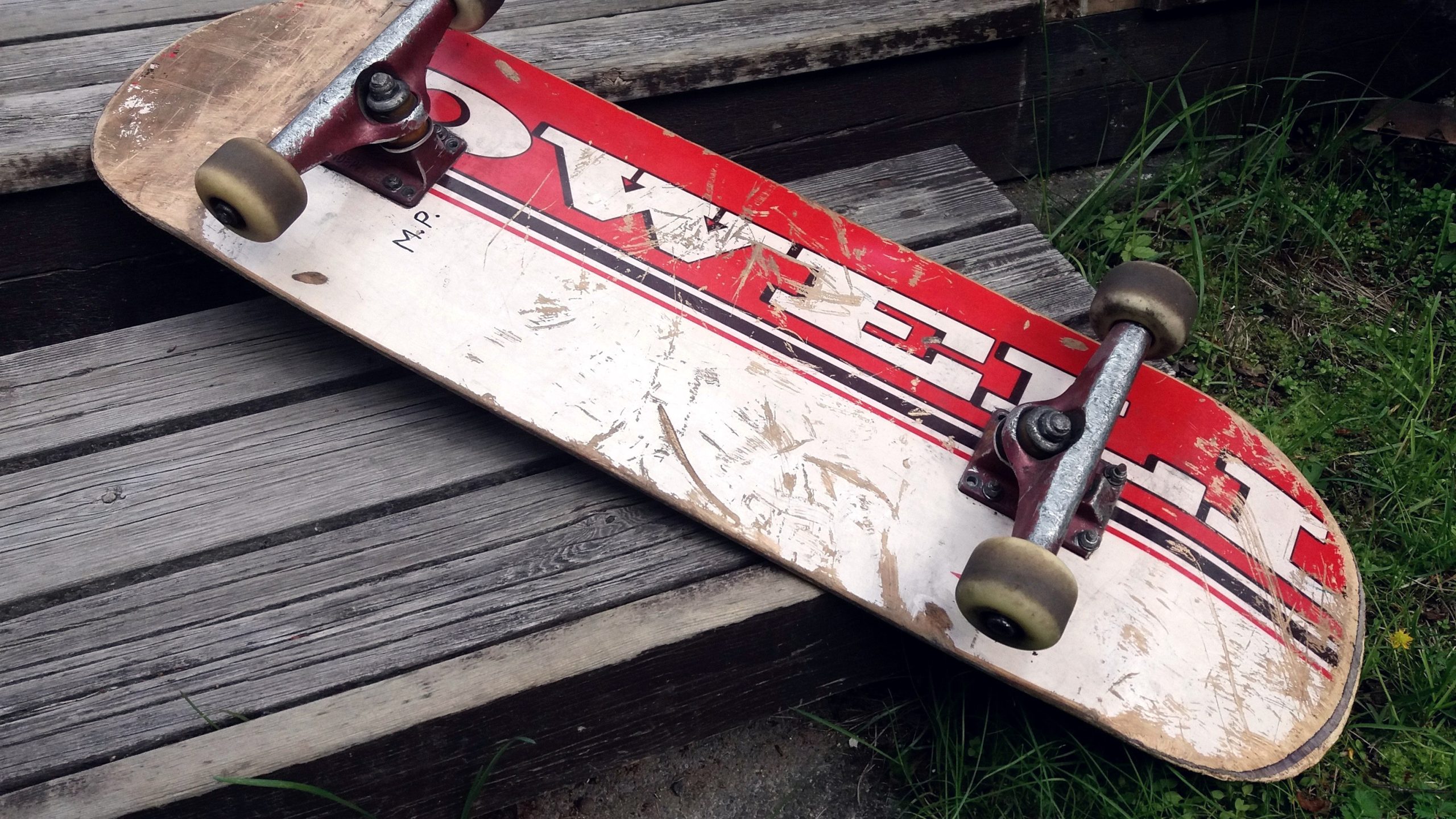
It's still in the garage. A 7.75-inch deck, polished grip, yellowed wheels worn down into squares. You pulled it out one Sunday morning, put a foot on it, and three pushes in you knew: something's off.
The reflex is to blame the body. The knees, the back, the ten years behind a desk. Except half the problem is under your feet — and it has a very concrete explanation.
While you weren't skating, boards got bigger. Not slightly: the width that was standard when you quit is now sold in the teen aisle. Here's what moved, why, and which width you should actually order for your comeback.
The mistake we see all the time
The classic: getting back on the garage board "just to see". A deck stored ten years in damp air has lost its pop — the wood softened, the glue gave up, the maple sends nothing back. The bearings are seized, the urethane has gone hard as plastic. You push twice, get no speed, blow an ollie you used to land at 20, and go home telling yourself it's over for you. It isn't. The gear gave out, not you.
What changed under your feet while you were away
The 2026 deck wall looks like the one from your teens, with one difference: the whole width scale shifted upward. Here's where it sits now, and where you fit in it.
- 7.75 inches — your old size — Still made, but sold to teens in EU 36-40. Technically snappier on flips, except you no longer have your 18-year-old feet on it. This is the format that betrays you on day one.
- 8.0 inches — the sensible floor — The minimum if you want that old feeling back without balancing on a matchstick. EU 41-42, lighter frame, tricks straight away.
- 8.25 inches — the 2026 standard — The most sold width today: the most common popsicle deck measures 8.25 inches wide by 32.475 long. Stable on the push, forgiving on sloppy landings, still flips fine.
- 8.5 inches — cruise, bowl and bigger frames — If your comeback is mostly pushing, carving and Sunday bowl sessions, you trade snap for comfort.
- Forget the "rider height" chart — Your shoe size and your program matter, not your centimetres. EU 43: 8.25. EU 45: 8.375 or 8.5.
- Don't compare lengths — Between two brands, length moves a few millimetres for the same width. The only spec that changes your ride is width.
Why boards gained half an inch in twenty years
The late 90s and early 2000s were the tech era. Small boards, small wheels, everything geared toward flips on flat. A 7.5 or a 7.75 rotated faster in the air, and that was the only criterion that counted.
What changed is what people skate. The return of heavy street, transitions, waist-high rails and concrete parks put stability back at the centre. A wide board holds a landing better when you're coming down from 80 centimetres. Common widths now sit between 7.5 and 9 inches, with most of the market clustered around 8.25.
The historic brands you know — Independent, Thunder, Spitfire — haven't gone anywhere. They just shifted their range up one notch. Your 1999 Indy 129 is now a 139 or a 149 depending on the deck you bolt it to.
Keep this
Don't try to buy back exactly what you had. Start from your real comeback program — city pushing, flat, bowl, curbs — and work back to the width. Someone riding 40 minutes on a Sunday has no reason to order a 2003 pro's setup.
Trucks, wheels, bearings — what your old setup no longer has
Trucks are chosen on axle width, not on the name. The matching rule is stable: an 8.0 deck takes a 7.75 to 8.25-inch axle, an 8.25 takes 8.0 to 8.5, an 8.5 takes 8.25 to 8.75. At Independent that means 139 for an 8.0-8.25 and 149 for an 8.25-8.5.
Wheels are where the shock is hardest. You may have been riding 50 mm. On an 8.25 today, you start at 52 to 55 mm, in 99A for decent European asphalt. Bigger diameter means fewer cracks stopping you dead — and your thirty-something body will thank you on badly resurfaced pavement.
Bearings: yours are done, no point degreasing them. A set of Bones Reds around €18 settles the question for three seasons.
And the thing nobody tells you: stock bushings are calibrated for an average frame. At 80 kilos, your trucks will feel mushy and you'll think you've lost your balance. Five euros of harder urethane fixes it in thirty seconds.
The verdict: the width to order when you come back after ten years
8.25 inches. That's the answer, and it holds for the vast majority of comebacks. Not because it's the market standard — because it's the width that offsets exactly what you lost during the break.
What you lost isn't technique: it's frequency. Your foot no longer finds the bolts without looking, your brain no longer corrects a crooked landing in 20 milliseconds. An 8.25 gives you half an inch of margin on each side. On a 7.75, that same sloppy landing puts you on the ground. On an 8.25, you roll away and go again.
That's what actually changes. Not the trick you'll land: the number of tries you can stack before your body calls it. A forgiving board means twenty attempts instead of six, and the feeling you came back for — controlling the board instead of surviving it.
The two honest exceptions: if you wear EU 41 and your comeback is 100% flat and flip, take an 8.0. If it's only bowl and carving, go up to 8.5. Outside those two cases, don't overthink it: 8.25, 149 trucks, 53 mm wheels in 99A.
What a comeback actually costs in 2026
Straight numbers:
- Assembled complete (the option that makes sense for a comeback): €100-140. Deck, trucks, wheels, bearings and grip already compatible, ready to ride the day it lands.
- Part by part: deck €60 + trucks €45 + wheels €30 + bearings €18 + grip €10, about €165. Only worth it if you already know what you want.
- Turning your old deck into a cruiser: €50 of soft wheels and new bearings, and it ends its life as a commuter instead of garage furniture.
- Protection: €30-50. At 35, a helmet and knee pads aren't up for debate — they decide whether you skate again next weekend.
On a tight budget, take the complete and keep the upgrade money for real wear. You'll replace the first part that bothers you, not the one a forum told you to change.
Where to buy when your old shop has closed
In order of preference:
- The nearest independent shop — even 40 minutes away. You get to stand on three different widths before paying, they build the setup on the spot, and the person behind the counter has already seen fifty comeback riders this year.
- Specialist sites — Skatepro or Tactics. Full range, honest spec sheets, fast delivery. The right call once you know your width.
- Used, from other skaters — a deck bought from someone upgrading often beats a cheap new complete. Just check it hasn't slept outside.
- Supermarkets and general marketplaces — avoid, exactly like in 1998.
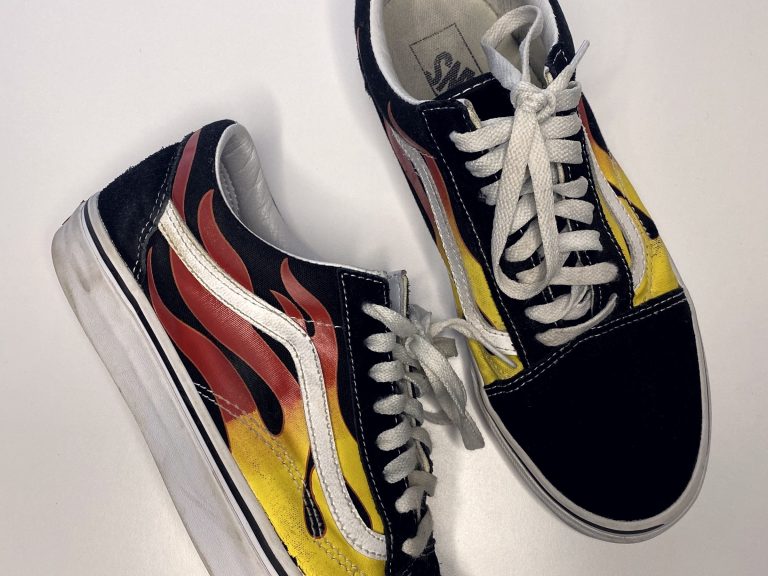
Shoes haven't moved: Vans Old Skool and Nike SB models remain the safe bets under €100. Take a slightly thicker sole than you did at 18 — your heels aren't the same.
Frequently asked
Can I keep my old deck and just swap wheels and bearings?
For rolling in a straight line, yes. For skating, no. A deck stored ten years has lost its pop: the wood no longer answers the tail, and no new wheel fixes that. Keep it as a cruiser with soft wheels, and buy a new deck for tricks.
My old Independent trucks still feel fine — can I reuse them?
The axle and hanger last a very long time, so yes. But going from a 7.75 to an 8.25, your old 129 will be too narrow: the wheels tuck under the board and you lose stability. Change the bushings either way — that urethane is twenty years old.
Does a wider board mean I can't flip anymore?
No. Pros land clean kickflips on 8.38 and tre flips on 8.5 today. Width asks for slightly more pop, that's all. Over your first three months back, stability will make you progress far faster than snap.
How long before I'm back to my old level?
Foot memory comes back fast — often two or three sessions for pushing, pumping and curbs. What takes longer is commitment: you don't throw yourself at things at 35 the way you did at 17. Good gear shortens that delay, it doesn't remove it.
So order the 8.25, build it with 149s and 53 mm wheels in 99A, and take it out on a Sunday morning. Your old board did nothing wrong — it's just twenty years old, and skateboarding moved while you were looking elsewhere.
Ride safe.
Le lexique
-
1
popsicle
La forme de planche standard depuis les années 90 : nose et tail symétriques, arrondis, comme un bâtonnet de glace.
-
2
concave
La courbure creusée du plateau entre les deux bords. Plus il est marqué, plus le pied est calé et plus les flips partent facilement.
-
3
pop
La nervosité du bois quand tu claques le tail au sol. Un deck fatigué ou humide perd son pop et ne décolle plus.
-
4
bushings
Les deux gommes du truck qui encaissent le poids quand tu tournes. Trop molles pour ton gabarit, la planche part dans tous les sens.
-
5
hanger
La pièce en aluminium du truck qui porte l'axe et frotte sur les rails et les curbs lors des grinds.
Shop NOSK8
Voir toute la boutique →
TEE-SHIRTS
TEE-SHIRT NOSK8® P.B CENTRE #RNB
Le prix initial était : 35,00 €.29,00 €Le prix actuel est : 29,00 €.
TEE-SHIRTS
TEE-SHIRT NOSK8® P.B HEART #ORIGINAL
Le prix initial était : 35,00 €.29,00 €Le prix actuel est : 29,00 €.

TEE-SHIRTS
TEE-SHIRT NOSK8® P.B CENTRE #ORIGINAL
Le prix initial était : 35,00 €.29,00 €Le prix actuel est : 29,00 €.
TEE-SHIRTS
TEE-SHIRT NOSK8® NOSKATE #NSITA
Le prix initial était : 35,00 €.29,00 €Le prix actuel est : 29,00 €.
TEE-SHIRTS
TEE-SHIRT NOSK8® P.B HEART #POLARBEAR
Le prix initial était : 35,00 €.29,00 €Le prix actuel est : 29,00 €.

CASQUETTES
CAP NOSK8® P.B #POLARBEAR
Le prix initial était : 35,00 €.25,00 €Le prix actuel est : 25,00 €.

CASQUETTES
CAP NOSK8® N8 #NOSK8
Le prix initial était : 35,00 €.25,00 €Le prix actuel est : 25,00 €.

CASQUETTES
CAP NOSK8® P.B.P #PAW
Le prix initial était : 35,00 €.25,00 €Le prix actuel est : 25,00 €.
HOODIES
HOODIE NOSK8® NOSKATE #SNC
Le prix initial était : 60,00 €.49,00 €Le prix actuel est : 49,00 €.
HOODIES
HOODIE NOSK8® P.B CENTRE #RNB
Le prix initial était : 60,00 €.49,00 €Le prix actuel est : 49,00 €.

HOODIES
HOODIE NOSK8® MATRICE HEART #ALT
Le prix initial était : 60,00 €.49,00 €Le prix actuel est : 49,00 €.

HOODIES
HOODIE NOSK8® MATRICE HEART #CTRL
Le prix initial était : 60,00 €.49,00 €Le prix actuel est : 49,00 €.

HOODIES
HOODIE NOSK8® I.L.N #ILOVEN8
Le prix initial était : 60,00 €.49,00 €Le prix actuel est : 49,00 €.

SWEAT
SWEAT NOSK8® P.B HEART #BARÇA
Le prix initial était : 45,00 €.39,00 €Le prix actuel est : 39,00 €.
SWEAT
SWEAT NOSK8® P.B HEART #PHILI
Le prix initial était : 45,00 €.39,00 €Le prix actuel est : 39,00 €.
SWEAT
SWEAT NOSK8® P.B HEART #NYC
Le prix initial était : 45,00 €.39,00 €Le prix actuel est : 39,00 €.
SWEAT
SWEAT NOSK8® P.B HEART #PARIS
Le prix initial était : 45,00 €.39,00 €Le prix actuel est : 39,00 €.
SWEAT
SWEAT NOSK8® P.B HEART #POLARBEAR
Le prix initial était : 45,00 €.39,00 €Le prix actuel est : 39,00 €.
Continue ta lecture
ConseilsReprendre le skate après 30 ans : ce ne sont pas tes genoux qui lâchent au bout de 3 sessions
Ta planche du garage te fait mal aux jambes en dix minutes et tu accuses l'âge. Ce n'est pas ça. Voilà la pièce qui décide…
Commentaires (0)