
ℹ️ 🛹 Web Média Skate 🛹 ℹ️

Conseils
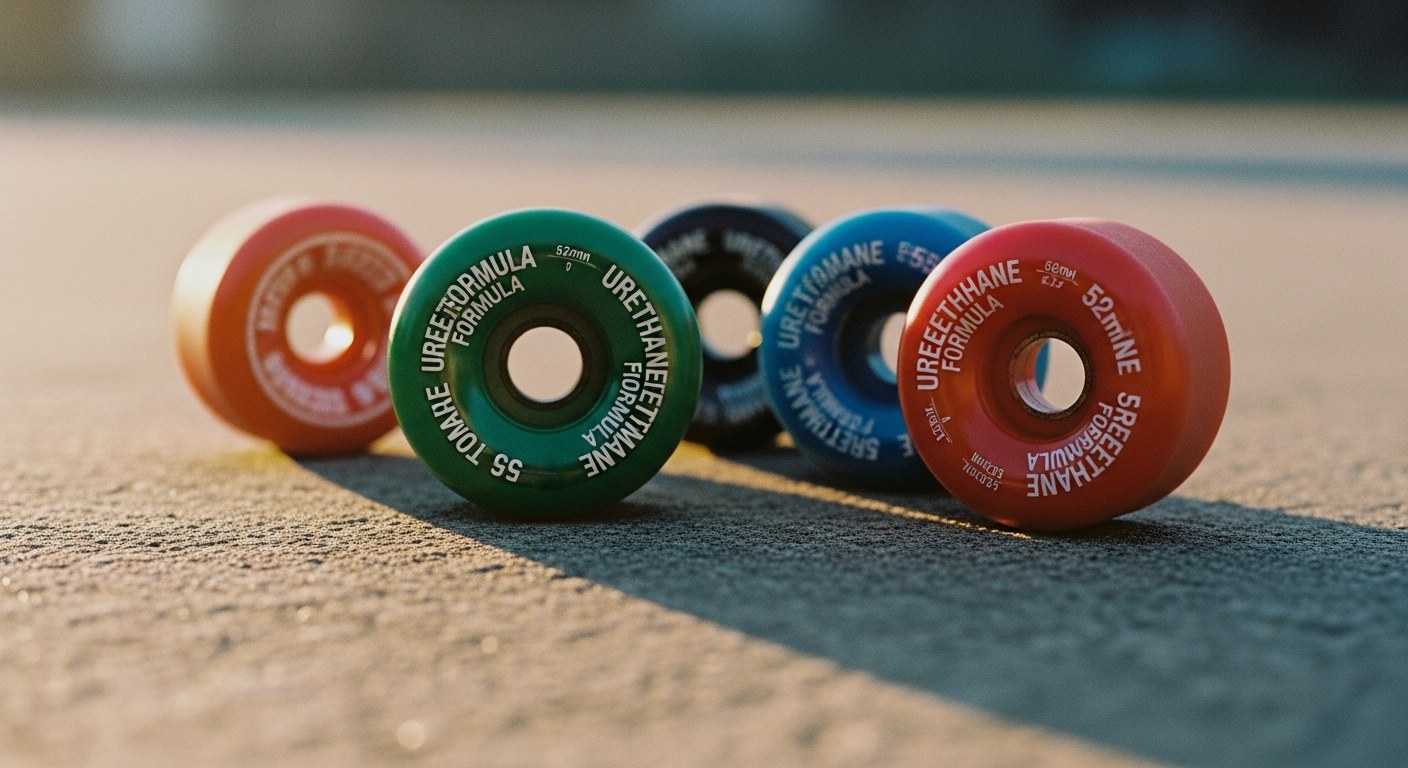
Picking Skate Wheels for Your Terrain — The No-Nonsense Guide
Asphalte, béton, carrelage : comment choisir la bonne durométrie et le bon diamètre de roues de skate selon ton terrain réel. Guide pratique pour débutants en France.

→ Pour aller plus loin : Skater sous la pluie : ce que ça détruit vraiment sur ta planche
Level: Beginner
You're rolling on gravel-covered asphalt, on the tile out front of the high school, or on the cracked concrete of your town skatepark. And you're wondering why your board hangs up, buzzes, or slides out like you've got hooves strapped to your feet.
Nine times out of ten, it's the wheels.
Not the deck. Not the trucks. The wheels. They're the only part touching the ground at all times — and the part beginners get wrong most often. This is the straight-up, no-nonsense guide to picking the right wheels for the ground you actually skate, in France, on a tight budget.
⏱ Read: 6 min
Dodge the rookie mistake
The wheels that come on a €30 big-box complete are hard plastic, 70 mm, and basically designed for scooters. On real asphalt they buzz so bad you'll ditch the board after 10 meters. Dropping €20-30 on actual wheels changes everything — even on bad ground.
Hardness (durometer) — the number that changes everything
(function(){
var VID='ufYosuwzf_o';
var container=document.getElementById('yt-ufYosuwzf_o');
var played=false;
function initPlayer(){
var player=new YT.Player(container,{
width:'100%',height:'450',videoId:VID,
playerVars:{cc_load_policy:1,cc_lang_pref:'fr',hl:'fr',mute:1,rel:0,autoplay:0,enablejsapi:1},
events:{
onReady:function(e){
try{e.target.setOption('captions','track',{'languageCode':'fr'});}catch(x){}
if('IntersectionObserver' in window){
var obs=new IntersectionObserver(function(entries){
if(entries[0].isIntersecting&&!played){played=true;e.target.playVideo();obs.disconnect();}
},{threshold:0.4});
obs.observe(container);
}
}
}
});
}
if(window.YT&&window.YT.Player){
initPlayer();
} else {
var prev=window.onYouTubeIframeAPIReady;
window.onYouTubeIframeAPIReady=function(){if(prev)prev();initPlayer();};
if(!document.querySelector('script[src*="youtube.com/iframe_api"]')){
var s=document.createElement('script');s.src='https://www.youtube.com/iframe_api';document.head.appendChild(s);
}
}
})();
Every skate wheel has a number followed by an "A" stamped on it — 99A, 101A, 78A. That's the durometer: how hard or soft the wheel is. Higher number, harder wheel. Lower number, softer wheel.
Hard = fast on smooth ground, but it buzzes like crazy on rough asphalt. Soft = soaks up the vibration on bad surfaces, but you lose speed and pop-response for tricks.
- 78A to 87A (soft) — For rough ground: cracked asphalt, cobblestone, beat-up cement paths. The wheel eats the pebbles and the bumps. Perfect if the ground you ride every day is trashed.
- 99A to 101A (hard — the street standard) — For smooth concrete parks and city street. Fast, snappy, good for tricks. What 90% of street skaters ride. If your ground is halfway decent, this is your default.
- 101A and up (extra hard) — For indoor parks with polished concrete or plastic surfaces. Crazy fast, but it'll rattle like a jackhammer on bad asphalt.
Diameter — small or big, depending on your style
Wheel diameter is measured in millimeters. The bigger the wheel, the faster it rolls and the better it clears obstacles — but it's heavier and less responsive for tricks. The smaller it is, the more control and the less weight under your feet.
The basic rule:
- 50 to 53 mm — For street and tricks: ollies, kickflips, anything that needs a light setup. What technical skaters ride. If your goal is learning tricks, stay here.
- 54 to 56 mm — The do-it-all middle ground. You cruise well through the city AND you can do tricks without fighting the weight. Ideal when you're starting out and you skate everywhere.
- 57 mm and up — For ramps, bowls, and long pushes. Not great for technical tricks.
The takeaway
If you mostly skate the street or a basic park, go 52-54 mm in 99A. That's the setup on 80% of street skaters' boards in France. It covers decent asphalt and concrete without you having to pick a side.
Terrain by terrain — what you should be riding in France
In France, especially outside the big cities, you rarely get access to an indoor park with nice polished concrete. Here's what's actually out there:
Street asphalt (the most common) — The most widespread surface in France, and the least consistent. It can be buttery on recently repaved streets, or loaded with micro-gravel and cracks. For standard asphalt:
- Hardness: 87A to 97A — not too hard (buzz), not too soft (dead feel)
- Diameter: 53 to 56 mm — big enough to roll over the small stuff
- If your asphalt is genuinely rough (backroad chipseal type): drop down to 78A-85A
Town skatepark concrete — The concrete at free parks in mid-size towns is rarely perfect. It can be grainy, worn smooth over the years, or straight-up neglected. For that kind of surface:
- Hardness: 99A to 101A — concrete is generally smooth enough to handle hard wheels
- Diameter: 52 to 54 mm — dialed for tricks on the obstacles
Tile (schoolyard, mall, covered parking garage) — Usually smooth, but with joints running through it. The joints are the enemy: they'll stop you dead or catch a small wheel.
- Hardness: 99A — the surface is smooth, a hard wheel rolls great on it
- Diameter: 54 to 56 mm — big enough to roll over the joints clean
Smooth concrete lot or fresh slab — The dream spot when you've got nothing else. Flat, clean, consistent. For covered lots or new slabs:
- Hardness: 99A to 101A — cash in on that smooth ground with hard wheels
- Diameter: 52 to 54 mm
If you bounce between a bunch of different surfaces — and that's usually the case when there's no park nearby — the 54 mm / 97A or 99A combo is your best compromise. It handles decent asphalt, park concrete, and tile without forcing you to swap wheels every session. To dig into widths and how they affect your whole setup, check our guide on skateboard deck width in 2026.
Brands you can trust under €30
Skate wheels are urethane — a technical plastic. The quality comes down to the chemical formula. Here are the brands that have proven themselves and that you can find easily in France:
- Spitfire — the gold standard, no debate. Founded in 1987, ridden by half the pros out there. Formula Four (101D) are the fastest; Classics (99A) are the smart pick to start. Price: €25-35.
- Bones — Spitfire's direct rival. The STF (Street Tech Formula) in 99A are excellent for street. The OG in 97A are perfect for slightly rough asphalt. Price: €22-32.
- OJ Wheels — an OG brand (1978), often cheaper than Spitfire and Bones. Solid option to get rolling without emptying your wallet. The Mini Combo (101A, 52 mm) are money at the park. Price: €20-28.
- Ricta Clouds — soft-wheel specialists (78A-92A) for rough surfaces. If your asphalt is truly awful, Clouds in 78A are the answer. Price: €25-35.
Wheels are only one piece of a setup that works. Your deck and trucks have to fit too — but wheels are the first thing to swap when your board feels like it's fighting you.
Total budget — what it really costs
Straight numbers:
- Quality wheels (Spitfire, Bones, OJ): €20 to €35
- Bearings (Bones Reds — the benchmark): €15 to €20
- Wheels + bearings kit: €35 to €55 all in
If you're starting out on a tight budget, put the money into wheels first. Stock bearings (the ones that come on your complete) usually hold up 6 months to a year if you skate regularly. Wheels, on the other hand, change your session from day one.
Where to buy: your local skate shop if you've got one — otherwise the specialty sites (Skatepro, Tactics). Skip the big-box stores and the general-purpose marketplaces for technical gear.
Frequently asked questions
Can I put soft wheels on my current setup?
Yeah, with one condition: make sure the wheel size won't cause wheelbite (the wheel rubbing the bottom of the deck when you turn). If your trucks sit low and you want to run 56 mm or bigger, add risers (little plastic pads under the trucks, €5-10). With 52-54 mm wheels you generally don't need risers.
What's the actual difference between 99A and 101A?
On good ground, you barely feel it. On mediocre ground, 99A soak up the micro-vibration a bit better. If you skate 80% concrete park and 20% street, go 101A. If it's 50/50, 99A are more versatile. Beginners honestly won't feel the difference for the first few months — don't overthink it, 99A does the job.
My wheels wear down fast — is that normal?
Hard wheels (99A-101A) wear faster on rough asphalt than on smooth concrete. That's normal — it's the trade-off. If you can visibly see them shrinking within a few weeks, your ground is seriously abrasive: drop the durometer (97A or 92A) so they last longer. Also: a wheel that looks clean but sounds like it's grinding after 6 months? That's the bearings, not the wheel.
Do wheels affect my ability to land tricks?
Directly, no. A kickflip comes from your feet, not your wheels. Indirectly, absolutely: the wrong wheels (too hard on a bad surface) burn you out on every push and keep you from focusing on technique. The right wheels = less resistance = more energy to learn. If you're just starting on tricks, check our guide on learning the pop shove-it.
You've got everything you need to not screw this up. The right wheel isn't the most expensive or the most hyped one — it's the one that matches your ground, your style, your budget. Now you've got the keys.
What kind of ground are you riding in your town — asphalt, park concrete, tile? And are your current wheels holding up? Drop it in the comments ↓
{
"@context": "https://schema.org",
"@type": "Article",
"headline": "Picking Skate Wheels for Your Terrain — The No-Nonsense Guide",
"author": {"@type": "Organization", "name": "Nosk8"},
"datePublished": "2026-06-30",
"description": "Asphalt, concrete, tile: how to pick the right skate wheel durometer and diameter for the ground you actually ride. A practical guide for beginners.",
"keywords": "skate wheels terrain, skateboard durometer, choosing skateboard wheels, 99A skate, wheels asphalt concrete",
"breadcrumb": {
"@type": "BreadcrumbList",
"itemListElement": [
{"@type": "ListItem", "position": 1, "name": "Nosk8", "item": "https://www.nosk8.com"},
{"@type": "ListItem", "position": 2, "name": "Advice", "item": "https://www.nosk8.com/category/conseils"},
{"@type": "ListItem", "position": 3, "name": "Picking Skate Wheels for Your Terrain — The No-Nonsense Guide"}
]
}
}
Follow NOSK8 where you hang out
Parts, spots, behind the scenes: it all drops on the accounts first.
Le lexique
-
1
durométrie
Mesure de la dureté d'une roue de skate, exprimée en chiffre suivi de A (ex: 99A). Plus le chiffre est élevé, plus la roue est dure et rapide sur sol lisse.
-
2
wheelbite
Phénomène où la roue frotte sous le deck quand le skateur tourne trop fort, provoquant un arrêt brusque. Se résout avec des risers ou des trucks plus hauts.
-
3
risers
Petites cales en plastique placées entre les trucks et le deck pour surélevez le plateau et éviter le wheelbite avec des grandes roues.
-
4
polyuréthane
Matériau technique utilisé pour fabriquer les roues de skate. Sa recette chimique détermine la dureté, l'élasticité et la longévité de la roue.
-
5
complete
Skateboard vendu entièrement monté : deck + trucks + roues + roulements + grip tape. Pratique pour débuter sans avoir à assembler les pièces.
Continue ta lecture
PortraitsJohn Cardiel, SOTY 1992 : le skateur qu’un médecin australien a condamné au fauteuil
John Cardiel, SOTY 1992 et cofondateur d'Antihero, donné pour paralysé après un accident en Australie en 2004. Il remarche 5 mois plus tard. Le portrait…
Commentaires (0)