


The Search for Animal Chin, 1987 — the film that invented the skateboarding video
You still remember it. The first time you saw those images on a scratched VHS tape. Five kids on a ramp in the middle of nowhere, to the sound of distorted guitar. In 1987, Powell Peralta released something that didn’t exist yet — and skateboarding was never the same.
⏱ Reading time: 4 min
Powell Peralta before Animal Chin
In 1978, George Powell and Stacy Peralta founded Powell Peralta in Santa Barbara. The idea: create a brand driven by the best skaters in the world. Not just boards. An identity. A movement.
The Bones Brigade took shape in the early 80s. Tony Hawk, Steve Caballero, Mike McGill, Lance Mountain, Tommy Guerrero — five radically different personalities. Five styles. One banner. The team became the model for all team riders that followed.
Powell Peralta released its first VHS videos starting in 1984. The Bones Brigade Video Show, then Future Primitive in 1985. Compilations of tricks, music, killer shots. But something was missing. A soul. A story.
Stacy Peralta had a vision. He wanted to make a film. Not a skateboarding video — a real film with a script, characters, a quest. He called this project The Search for Animal Chin. In 1986, filming began. No one knew yet what it would become.
The Hawaii Ramp and the Crazy Shoot
The story is simple and mythological at the same time. The Bones Brigade sets out in search of Won Ton “Animal” Chin — the legendary first skater, mysteriously disappeared. A quest that takes them from California to Hawaii, passing through Nevada and Mexico.
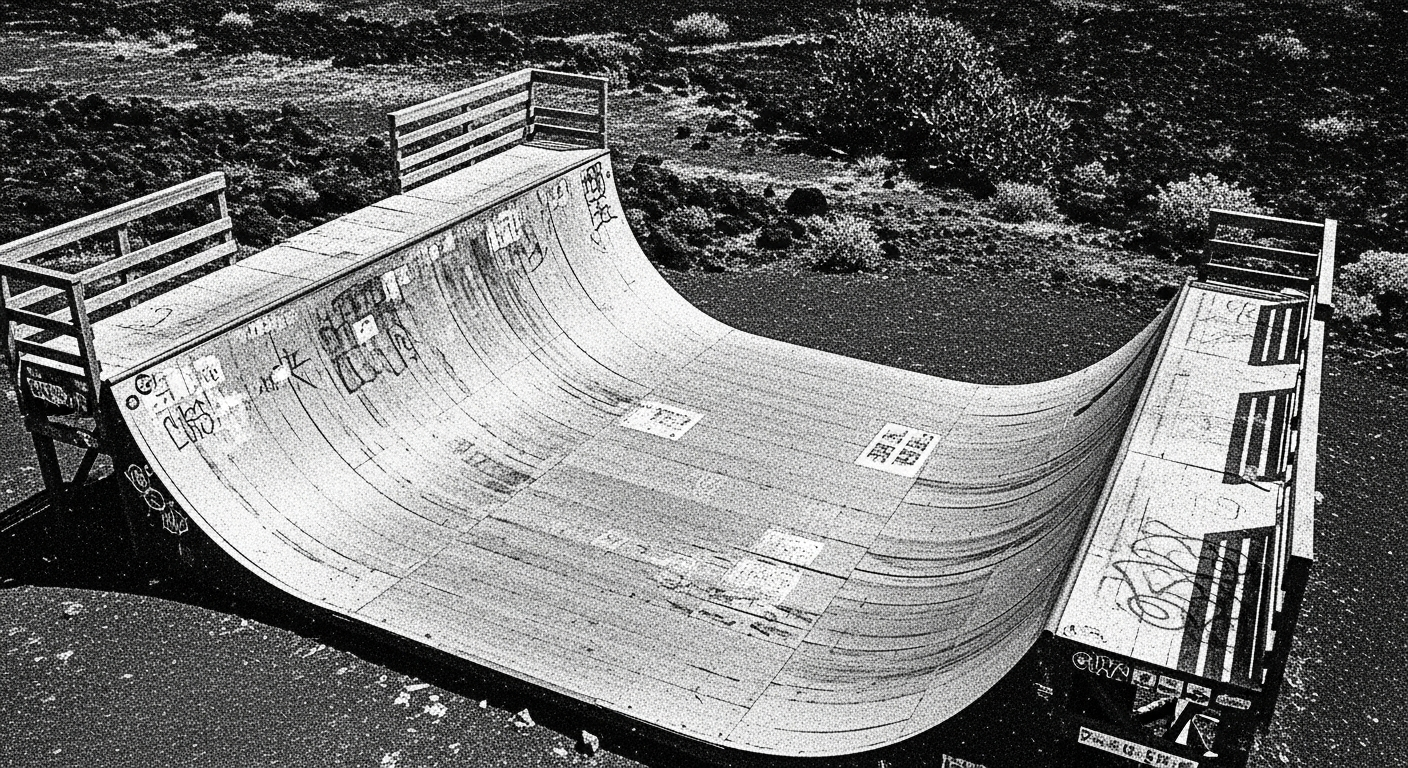
The climax: a colossal ramp built specifically for the film in Hawaii. A structure several meters high, erected in the middle of nowhere, just for those few days of filming. It would be demolished afterward. A ramp that would only exist in this film.
Tony Hawk strung together aerial tricks with surgical precision. Caballero carved turns at full speed. McGill landed 540 McTwists. Lance Mountain, meanwhile, acted with disarming naturalness. And Tommy Guerrero brought the street, the ground, the concrete — a perfect counterpoint to the vert.
Stacy Peralta filmed everything with a cinematic eye. No fixed cameras pointed at a ramp. Movement. Angles. Visual storytelling. For the first time in skateboarding history, we watched riders like we watched actors. And that changed everything.
The Impact on Global Skateboarding Culture
The release of Animal Chin in 1987 caused a shock. Tapes flew off the shelves in skate shops. Kids passed them around, watched them on repeat, copied them with camcorders. Every trick became a reference. Every scene, a model.
Animal Chin invented the format. Before, a skateboarding video was tricks set to music. After, it was a production with a narrative. Plan B would copy the formula with Questionable in 1992. Girl Records with Mouse in 1996. Every major video that followed bears Animal Chin’s imprint.
Powell Peralta sales exploded. Tony Hawk became skateboarding’s first global star. The image of the skater shifted from outcast to subculture hero. Animal Chin is the cornerstone of this legitimacy. Without this film, no X Games. No Hawk in Tony Hawk’s Pro Skater. Maybe no skateboarding in the Olympics.
The premiere took place in an old, closed cinema in Santa Monica. The audience was made up of skaters, not journalists or industry bigwigs. A community seeing itself on screen for the first time. That night, something lasting was born.
The Legacy, 40 Years Later
In 2017, for the film’s 30th anniversary, Powell Peralta rebuilt the Animal Chin ramp at Woodward West Skatepark in Tehachapi, California. The original Bones Brigade reunited. Hawk, Caballero, McGill, Mountain, Guerrero — thirty years later, on the same structure. The clip went viral worldwide in a few hours.
In 2026, the legacy remains intact. Animal Chin is available for streaming and on Archive.org — free, accessible, timeless. New generations discover it and immediately understand. No context needed. The language of skateboarding is universal. Today’s riders, born after 1990, still cite this film as a foundational reference.
The Bones Brigade era represents something irreplaceable. A time when skateboarding was still an act of pure rebellion. Where building a giant ramp in Hawaii for a film made no economic sense — but all the sense in the world. Animal Chin is proof that skateboarding’s best moments were never calculated. They were lived first, filmed second.