

Love Park Philadelphia: The Spot That Invented Modern Street Skateboarding
A granite plaza, a red sculpture, and perfect ledges. Philadelphia LOVE Park wasn’t designed for skateboarding. It became the source of street skating as we know it today.
⏱ Reading: 5 min
The Birth of a Myth (1965–1990)
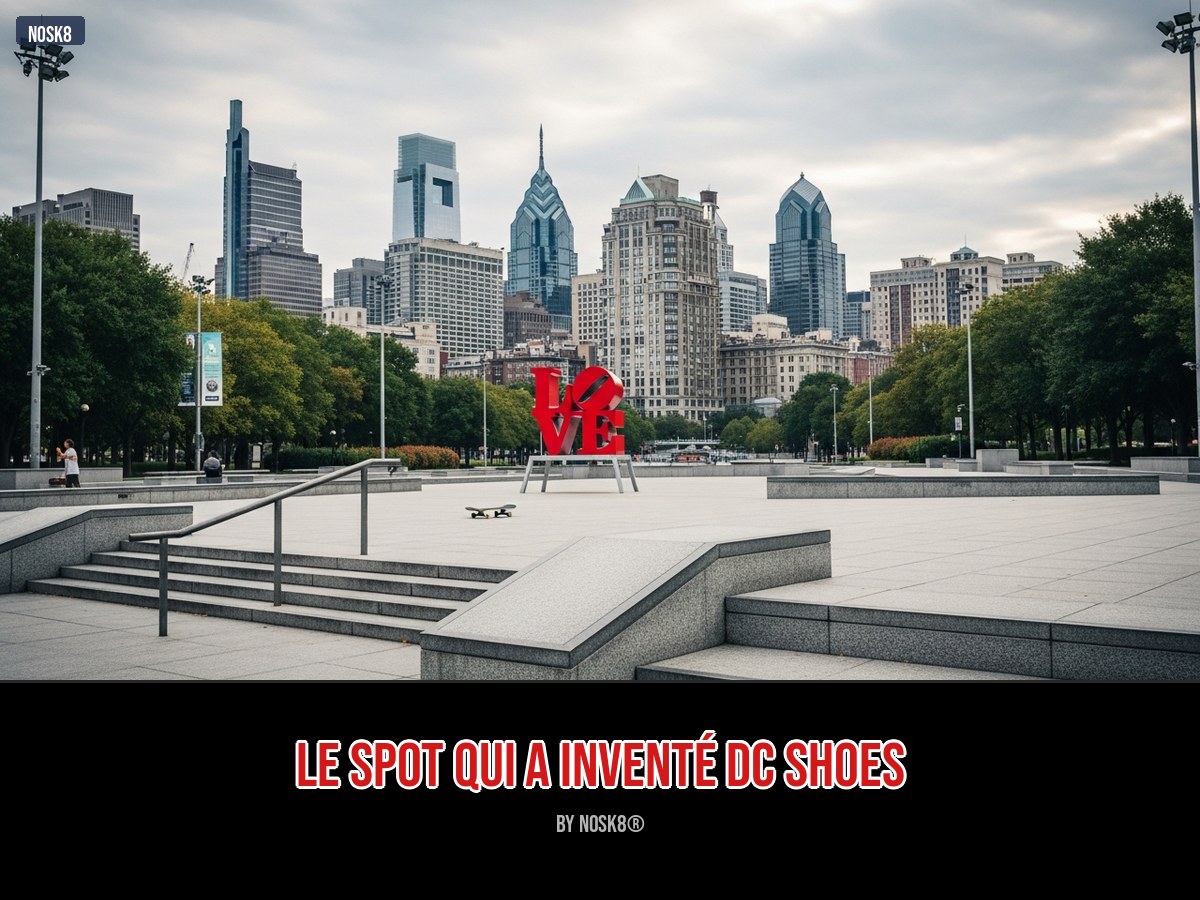
In 1965, urban planner Edmund Bacon and architect Vincent Kling inaugurated John F. Kennedy Plaza in the heart of Philadelphia. Their idea: a modern, open plaza, with dense granite ledges, gentle ramps, and a perfectly flat ground. They wanted to attract families. They attracted skaters.
Robert Indiana’s LOVE sculpture arrived in 1976. It became the visual icon of the spot. In the 80s, Philly’s first rollers started to claim the ledges. The granite took wax like no other surface. The word spread.
Philly developed its own style: aggressive, technical, no safety net. Street skateboarding as we define it today took root there. Not in Los Angeles. Not in New York. In Philadelphia, on that gray granite under fast-food neon lights.
The Golden Age: Kalis, Williams, and DC Shoes
2000. Josh Kalis settled at Love Park. He came every day, tested every ledge, invented lines that didn’t exist before. Stevie Williams joined him. Two riders at the top of their game, a perfect spot. The equation was simple.
DC Shoes sponsored them. Result: the Kalis OG sold 100,000 pairs in one year. The Stevie 1 did the same. DC broke its own sales records. Love Park is directly etched into these numbers, even if no press release mentions it.
What happened at Love Park between 2000 and 2002 was a rare convergence in skateboarding history: the right place, the right riders, the right time. Every session was filmed. Every clip went out on VHS, then on forums. The legend was built in real-time.
DC Shoes Kalis OG — The Love Park Shoe
The shoe born on these ledges. Vulcanized sole, reinforced toe cap, DC cushioning. What Kalis wore on Philly’s granite in 2000.
Fast Shipping · 30-Day Returns
Philadelphia’s Betrayal
In 2002, the city of Philadelphia officially banned skateboarding at Love Park. The same year, it hosted the X-Games Street. The contradiction was so blatant it made headlines. The two original architects, Edmund Bacon and Vincent Kling, publicly protested the ban. The sport they hadn’t foreseen had become the only true use of their plaza.
For ten years, the spot became a guerrilla zone. Skaters returned. The city council installed anti-skate bolts on the ledges. Riders ripped them off. Then in 2016, for the city’s 250th anniversary, Love Park was completely renovated. The granite ledges — the ones Kalis had waxed thousands of times — were razed.
The global skateboarding community registered the loss like a death. Not dramatic, not violent. Just the quiet end of a place that had changed everything.
The Granite Lives On in Malmö
In 2024, an unexpected story emerged. The city of Malmö, Sweden, acquired original granite blocks from Love Park. It integrated them into a new public space designed to attract skaters. Not a reconstruction. A partial resurrection, 7,000 kilometers from Philadelphia.
This is Love Park’s final lesson: one city built something accidentally perfect, destroyed it, and another recovered the debris to make something intentional. London’s South Bank had managed to fight to survive. Love Park lost, but its DNA continues to skate somewhere in Scandinavia.
Practical Info If You Go
Love Park 2026 is no longer the spot of yesteryear. The renovation smoothed the ledges, equipped them with anti-skate features, and security is present. What remains: the LOVE sculpture, the Center City vibe, and Philly’s energy. To truly skate in the city, head to FDR Skatepark or Franklin’s Paine Skatepark — two accessible street spots without repression.
For history’s sake, Love Park remains an essential address. You can put a block of wax on what’s left of the granite and feel what Kalis felt in 2000. Or almost.
We read every comment