

ℹ️ 🛹 Web Média Skate 🛹 ℹ️

★ Conseils
Your kicks are falling apart in three weeks: how to double their lifespan
Trois semaines et déjà un trou côté petit orteil ? Ce n'est ni la marque ni ton niveau. C'est une seule couche de tissu contre du papier de verre.

→ Pour aller plus loin : Roulements ABEC 7 ou ABEC 9 : ce que tu sens vraiment sous les roues
Level: Beginner
You bought them on a Saturday. Three weeks later, there's a hole on the side of the front shoe, right where the little toe is pushing. And you're wondering if you bought junk or if you're just skating wrong.
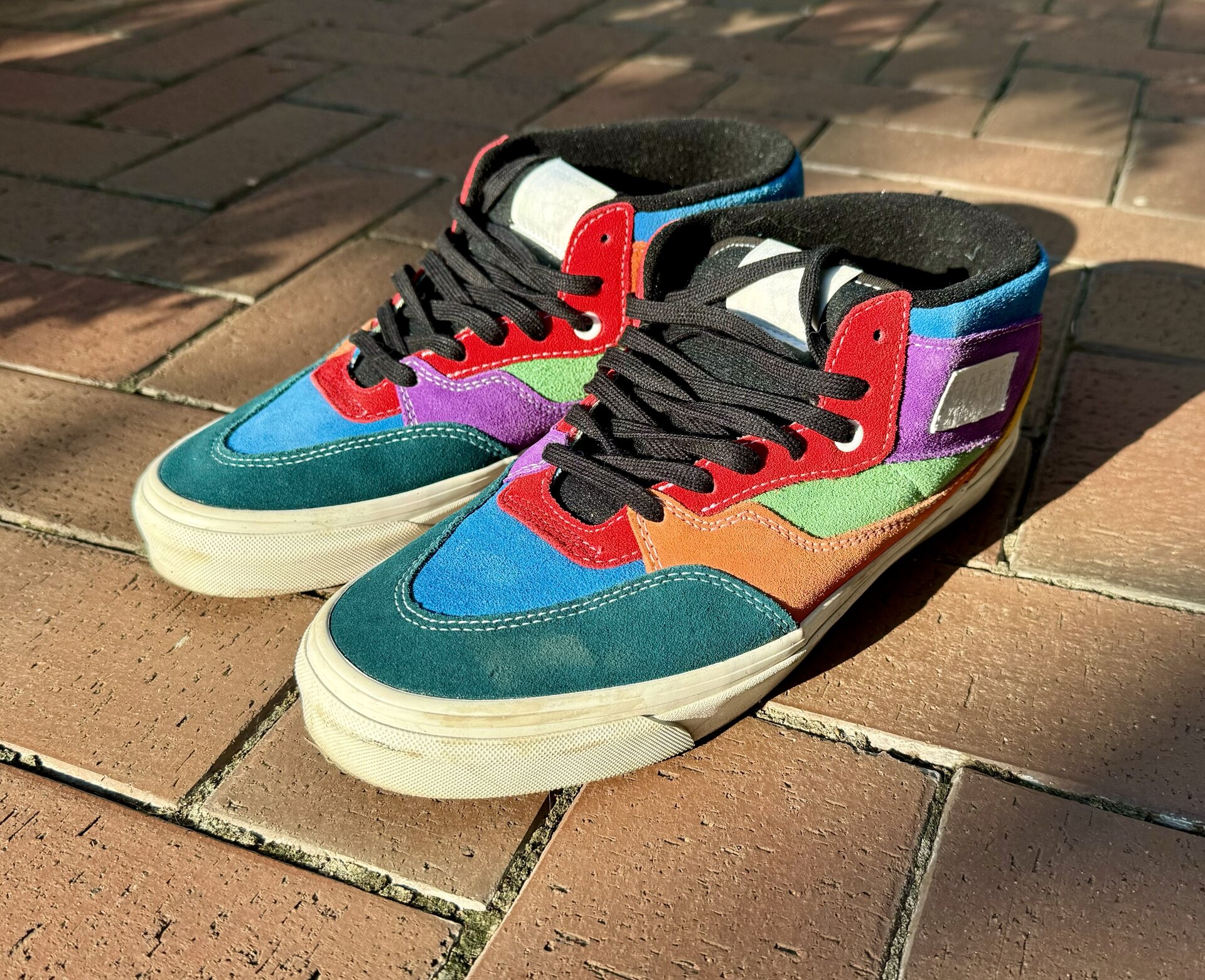
Neither. The grip on your board is sandpaper. Every ollie rubs your shoe against it. The problem's been around since the streets: back in 1992, skaters cut their Vans from Steve Caballero with a razor and glued the cut. Vans ended up making it a model, the Half Cab - 1992.
More than thirty years later, people are still gluing. Except now, someone measured how many grip rotations a shoe can hold. And that number changes how you choose, protect, and fix. We're getting there.
Avoid the classic mistake
Waiting for the hole to pop up before reacting. When you see the sock, it's too late: the canvas has slipped, the glue will only hold on the edges. Everything that makes a pair last is played out in the first ten sessions, when it's still brand new.
Ollie, kickflip, pop: the hole tells you which trick you're working on
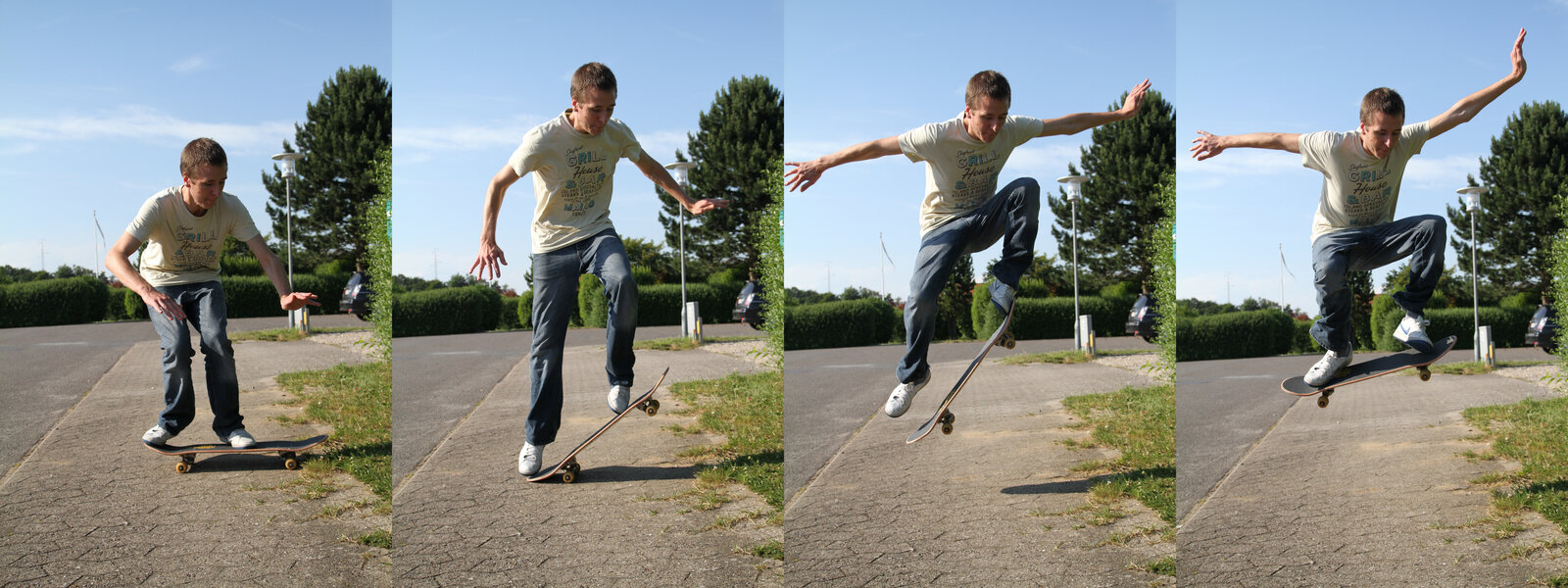
A skate shoe doesn’t wear out the same way everywhere. It wears where your foot hits the grip while you move. So every trick leaves its mark. Read your old pair like a map, and you’ll know where to protect the next one.
- The ollie: the front foot side — To lift the board, you slide your front foot toward the nose. It’s the outer side of the shoe, toward the little toe, that rubs. That’s the famous ollie hole, the first one to show up.
- The kickflip: the front foot and laces — You flick with the ball of your foot on the board’s edge. It wears the outer tip and cuts the lower laces. A lace that snaps after ten days means your kickflip’s getting stronger.
- The pop: the rear foot sole — Clacking the tail crushes the sole under the front of the rear foot. It sharpens, then it flakes off at the tip.
- Foot brake: the melting sole — You stop by putting your foot on the ground? The rear foot sole takes the hit. Asphalt wears faster than grip.
- The marker test — Before your session, draw three lines with a marker on the side and tip of your front shoe. After the session, see which one’s gone. That’s your zone. Free, ten seconds, and you’ll know exactly what to reinforce.
Canvas or suede: why canvas breaks first
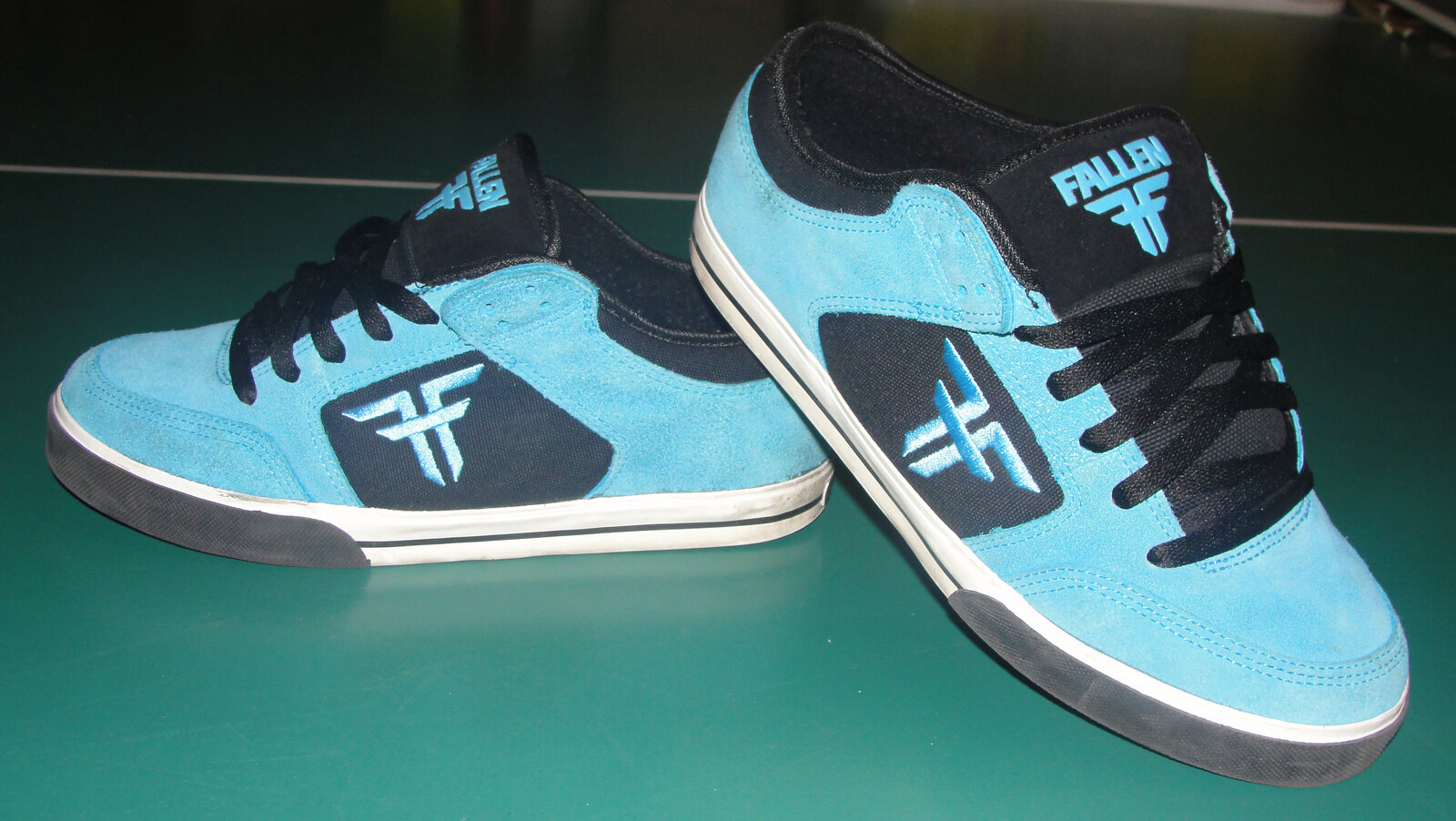
Canvas is just fabric. Interwoven threads. The grip cuts them one by one, and as soon as a row gives way, the hole pops open. That’s why a canvas pair looks brand new for fifteen days, then drops out in a session.
Suede is sanded leather. It’s thicker, and it doesn’t cut: it frays on the surface, gets all fuzzy, and holds on for a while before it punctures. You see the wear coming. You’ve got time to react.
Thickness matters more than the logo. Rose Anvil, a YouTube channel that slices shoes in half to see what’s inside, sets the bar at 1.5 mm of leather minimum for a skate shoe. Below that, it falls apart fast. You can’t measure it in a store, but you can pinch: a suede that folds like a leaf, set it aside.
Canvas still has an edge: it’s flexible from day one, and it’s cheaper. If you’re a beginner and you ride twice a week, a canvas with a side reinforcement does the job. If you’re doing ollies every day, switch to suede, no debate. And to pick a model, our skate shoe guide covers the brands.
Lining: what’s under the suede matters more than the brand
A skate shoe isn’t a single layer. Around the toe and on the side, the good models stack two layers of suede, sometimes a hidden rubber strip underneath. When the first layer drops, the second steps in. That’s a lining.
It’s not new. In 1986, French pro skater Pierre‑André Senizergues launched Etnies at a time when skate didn’t yet have its own shoes. The idea: cushion, reinforce, make it last. At Nike, the 2004 Dunk SB moved to triple stitching, which has since become a skate shoe standard.
In 2013, Etnies dropped the Marana, with a reinforced tip. Chris Joslin, who drops giant stairs, backs it up. Rose Anvil sliced the Michelin version in half, and it’s he who gives us the number we’re after. Keep that video in mind, we’ll use it later.

Takeaway
In the shop, slide your finger inside the shoe, at the little toe. If you feel extra thickness, an extra seam, or a rubber strip, there’s a lining. If it’s smooth and thin, it’s a single layer: it’ll punch through on the first ollie hole.
Glue: why your sole peels off at the tip
There are two ways to attach a sole. The vulc is a thin sole glued and baked onto the top. You feel your board, that’s why it’s popular. But everything hinges on the glue, and the tip is the spot that flexes the most.
The cupsole is a tray‑shaped sole, glued and stitched all around. Rose Anvil shows the stitch that cuts across the side: even when the glue wears out, the thread holds everything together. Less feel under the foot, way more margin.

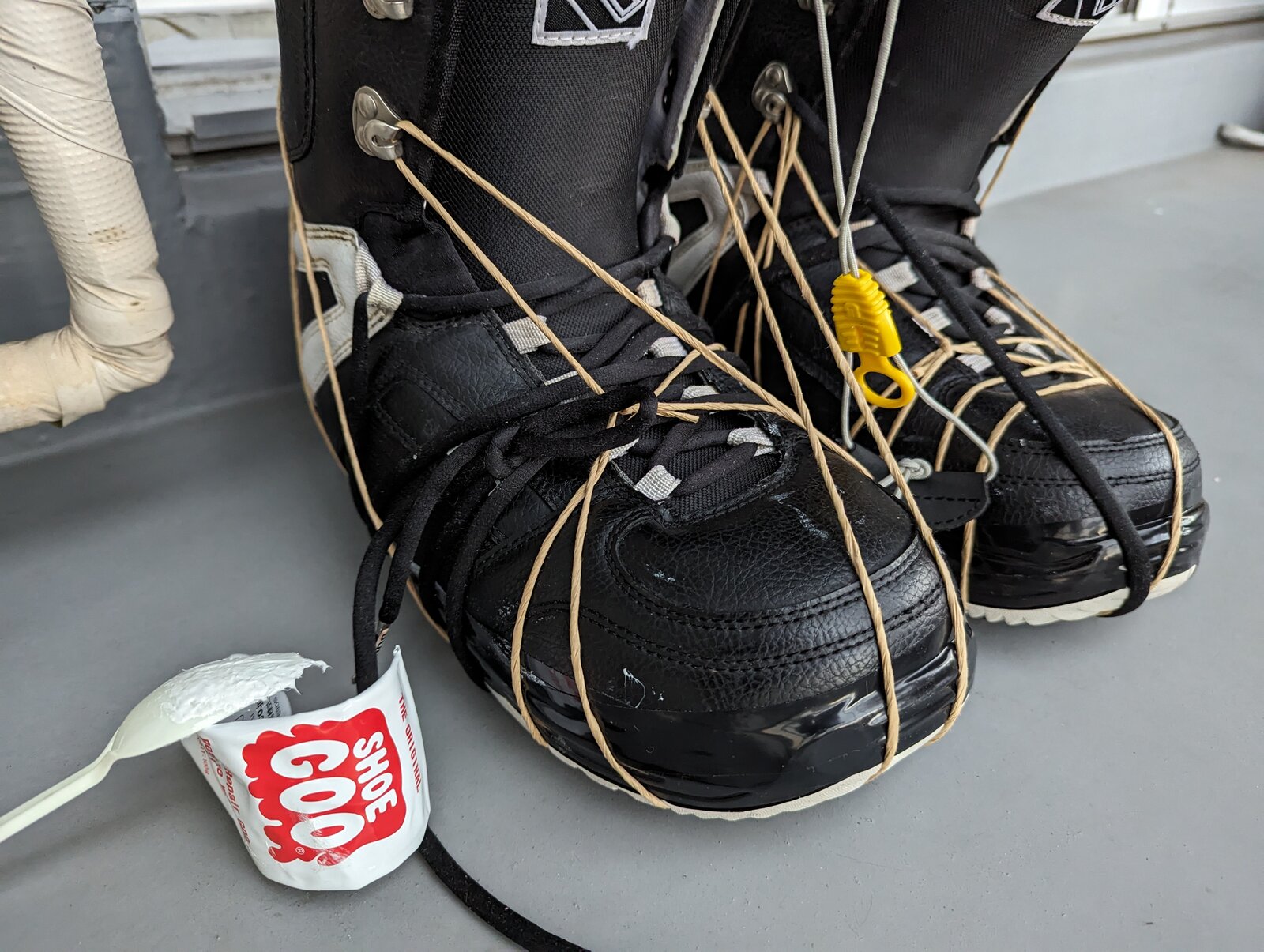
The glue also repairs, and there’s a name for it: Shoe Goo, created in 1972 by Lyman Van Vliet in California. Wikipedia spells it out: skaters use it to protect their shoes from grip, not just to fix them. That’s the nuance. For the step‑by‑step method, we’ve already covered it in our shoe goo guide.
The test: what really doubles lifespan
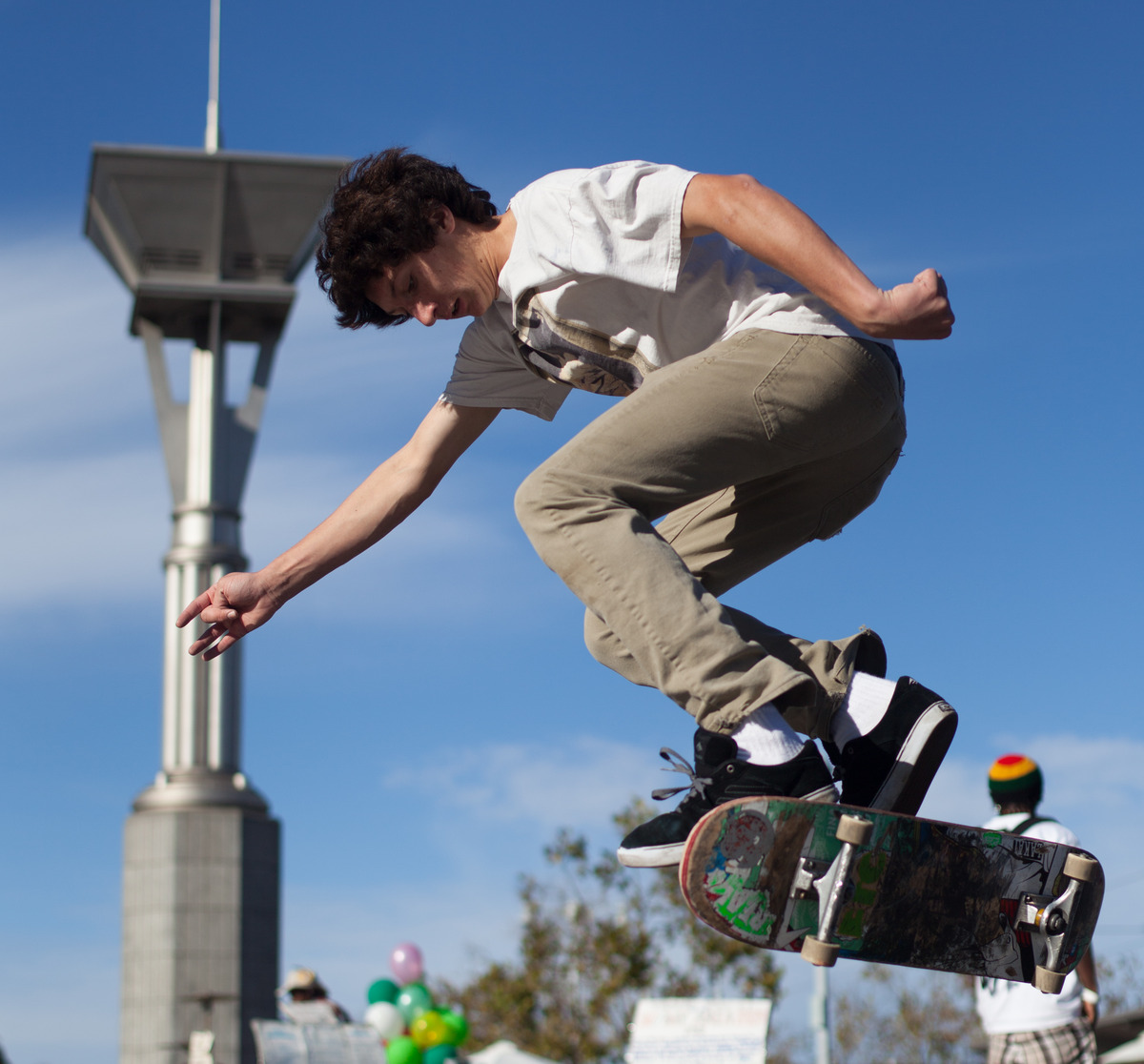
Let’s get back to the promised figure. Rose Anvil puts the Marana leather on a machine that rubs it in circles against Mob grip. Above 1 000 turns, he calls the leather solid. That one holds 858 turns. Not great.
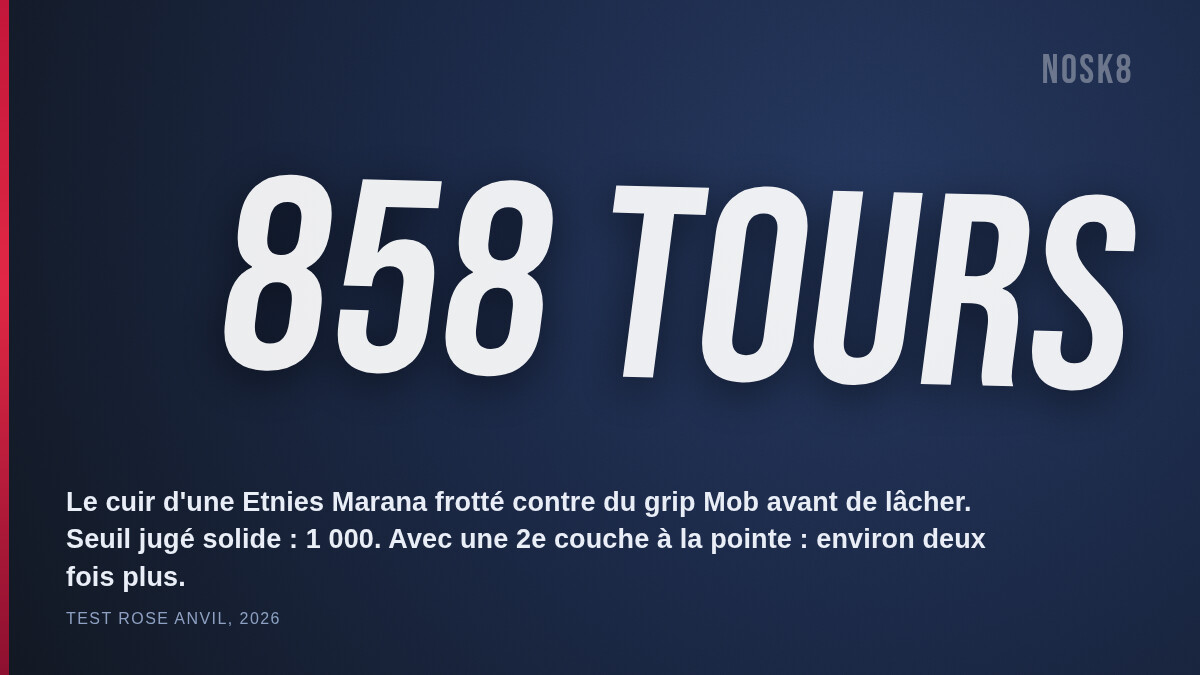
But at the tip, Etnies glued a rubber layer over the leather. Total thickness: 2.8 mm instead of 1.5. His verdict, which he calls “garage science”: this double layer lasts roughly twice as long as a single layer.
What about the rest? Etnies claims a Michelin sole three times more durable. In the sandblaster test, Rose Anvil finds it about on par with the others. The marketing promise doesn’t double anything. The second layer, yes.
So the answer is clear: you double the life of your shoes by putting two layers where YOUR trick rubs, and nowhere else. In practice:
- Do the marker test on your current pair to find your zone.
- Pick a nubuck with lining on that zone, in cupsole if you hit hard or brake with your foot.
- Apply the second layer yourself from day one: a reinforcement patch, or a thin coat of Shoe Goo on the fresh spot, let it dry 24 h.
- Reapply before it holes: as soon as the nubuck gets fuzzed, lay another layer. Never over a sock that sticks out.
As for laces, swap those out: a pair of laces is cheaper than a pair of shoes, and a lace cut mid‑kickflip is a foot that’s out.
Frequently Asked Questions
Why does my front shoe wear out faster than the back?
Because it’s the one sliding on the grip with every ollie and flip. The back shoe mainly wears on the sole, when you slap the tail. That’s normal, and that’s why we reinforce both feet differently.
Does tape on the shoe actually work?
For a session, yeah: it takes the friction off the nubuck. But it peels off and slides on the grip. It’s a quick fix, not a long‑term solution. A glued patch or Shoe Goo lasts way longer.
Does changing grip reduce shoe wear?
A finer grip rubs less, sure, but your feet also grip less. Keep your grip and protect the shoe. To compare textures, check out our Grip Tape Guide.
Can I skate in my everyday shoes?
You can, but a running sneaker has a too‑thick sole and a too‑thin canvas. You feel the board poorly and you’ll break it in a few days. Keep one pair for skating, one for walking: the sole doesn’t wear out for nothing on the sidewalk.
Three weeks isn’t a fate. It’s just what happens when one layer takes all the hits. Drop two in the right spot, and your next pair will see your first clean kickflip. Tell us in the comments how long your last pair lasted.
Good ride.
Where’s your spot: ollie side, kickflip tip, or the sole that’s melting ? Drop it in the comments ↓
Le lexique
-
1
ollie
Saut de base du skate : tu claques le tail au sol et tu fais glisser le pied avant pour faire monter la planche avec toi.
-
2
kickflip
Figure où la planche fait un tour complet sur elle-même, lancée d'un coup de pointe du pied avant sur le bord.
-
3
vulc
Semelle fine collée puis cuite avec le dessus de la chaussure. Très bonne sensation de la planche, mais tout tient à la colle.
-
4
cupsole
Semelle en forme de bac, collée et cousue tout autour de la chaussure. Plus épaisse, plus solide, un peu moins de sensation.
-
5
grip
Bande abrasive collée sur le dessus de la planche, comme du papier de verre, pour que tes pieds accrochent.
Shop NOSK8
Voir toute la boutique →
TEE-SHIRTS
TEE-SHIRT NOSK8® P.A CENTRE #PARENTALADVISORY
Le prix initial était : 35,00 €.29,00 €Le prix actuel est : 29,00 €.
TEE-SHIRTS
TEE-SHIRT NOSK8® NOSKATE #SNC
Le prix initial était : 35,00 €.29,00 €Le prix actuel est : 29,00 €.
TEE-SHIRTS
TEE-SHIRT NOSK8® MATRICE HEART #ALT
Le prix initial était : 35,00 €.29,00 €Le prix actuel est : 29,00 €.
TEE-SHIRTS
TEE-SHIRT NOSK8® P.B CENTRE #RNB
Le prix initial était : 35,00 €.29,00 €Le prix actuel est : 29,00 €.
TEE-SHIRTS
TEE-SHIRT NOSK8® P.B HEART #ORIGINAL
Le prix initial était : 35,00 €.29,00 €Le prix actuel est : 29,00 €.
CASQUETTES
CAP NOSK8® P.B #POLARBEAR
Le prix initial était : 35,00 €.25,00 €Le prix actuel est : 25,00 €.
CASQUETTES
CAP NOSK8® N8 #NOSK8
Le prix initial était : 35,00 €.25,00 €Le prix actuel est : 25,00 €.
CASQUETTES
CAP NOSK8® P.B.P #PAW
Le prix initial était : 35,00 €.25,00 €Le prix actuel est : 25,00 €.
HOODIES
HOODIE NOSK8® NOSKATE #NSITA
Le prix initial était : 60,00 €.49,00 €Le prix actuel est : 49,00 €.
HOODIES
HOODIE NOSK8® P.B HEART #BARÇA
Le prix initial était : 60,00 €.49,00 €Le prix actuel est : 49,00 €.
HOODIES
HOODIE NOSK8® P.B CENTRE #ORIGINAL
Le prix initial était : 60,00 €.49,00 €Le prix actuel est : 49,00 €.
HOODIES
HOODIE NOSK8® P.B HEART #PARIS
Le prix initial était : 60,00 €.49,00 €Le prix actuel est : 49,00 €.
HOODIES
HOODIE NOSK8® P.B HEART&BACK #ORIGINAL
Le prix initial était : 60,00 €.49,00 €Le prix actuel est : 49,00 €.
SWEAT
SWEAT NOSK8® P.B HEART #BARÇA
Le prix initial était : 45,00 €.39,00 €Le prix actuel est : 39,00 €.
SWEAT
SWEAT NOSK8® P.B HEART #PHILI
Le prix initial était : 45,00 €.39,00 €Le prix actuel est : 39,00 €.
SWEAT
SWEAT NOSK8® P.B HEART #NYC
Le prix initial était : 45,00 €.39,00 €Le prix actuel est : 39,00 €.
SWEAT
SWEAT NOSK8® P.B HEART #PARIS
Le prix initial était : 45,00 €.39,00 €Le prix actuel est : 39,00 €.
SWEAT
SWEAT NOSK8® P.B HEART #POLARBEAR
Le prix initial était : 45,00 €.39,00 €Le prix actuel est : 39,00 €.
Continue ta lecture
ConseilsVans Old Skool 36 Souvenir : à 140 €, la vraie question c’est si tu peux la skater
Le coloris Navy du pack Old Skool 36 Souvenir sort le 20 août à 140 €. Tige peinte, tweed, pin's : on regarde les matériaux…
Commentaires (0)