

In 1999, a young American in baggy white pants rolled his wheels onto the five concrete blocks of the 12th arrondissement. Andrew Reynolds kickflipped where no one had dared, photographed by Mathias Fennetaux. In one image, Paris entered the legend of global skateboarding.
⏱ Reading: 4 min
1999: The kickflip that changed everything
Before that jump, Bercy was nothing more than a skate spot under a Parisian glass roof. After, it was a myth. Andrew Reynolds, his Baker board under his feet, kickflipped over the five blocks. Mathias Fennetaux’s photo circulated worldwide. Paris joined the list of canonical spots — just like the Carlsbad stairs or the Pulaski ledges.
It wasn’t a coincidence. The upper blocks had started to be waxed around 1994 — a few kilos of skate wax secretly applied by a bunch of kids from the 12th. When the Bastille fountains were anti-skated in late 1997, the entire Parisian scene converged on Bercy. Paulo, Léo, Galak, Rico, Milouze — a constellation of names that never appear in mainstream press but that every true Parisian skater knows by heart.
That’s where the history of French skateboarding took its definitive form. A handful of teenagers under a zinc roof, a concrete slab waxed to death, and the silent ambition to do something great.
The generation that grew up there
Two decades later, the spiritual heirs of this scene are at the highest global level. Vincent Milou, French champion, SLS finalist, still skates Paris’ mythical spots as if he were repeating the same pilgrimage every time. Bercy is its epicenter. The ground there holds the memory of thousands of sessions — the impacts, the skin rips, the first real lines.
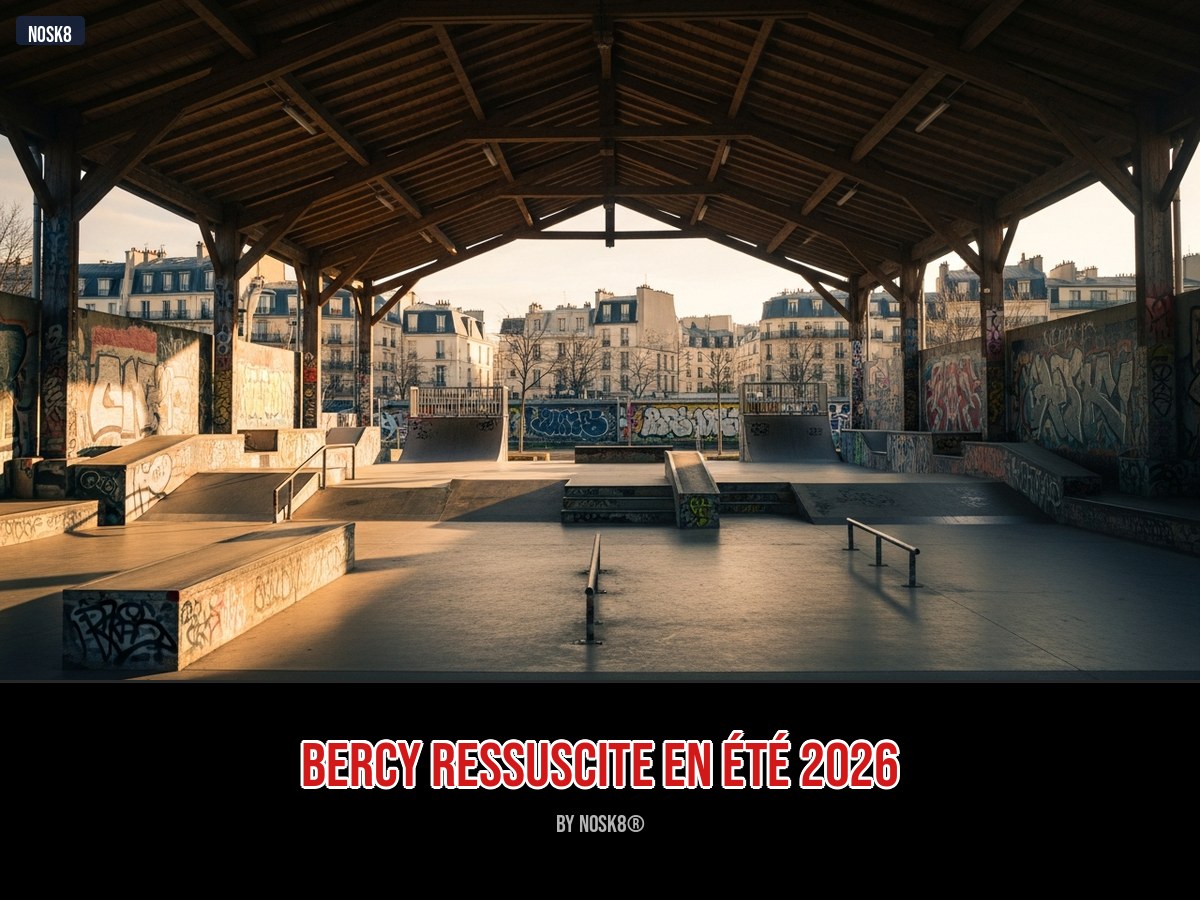
Bercy skatepark is 800 m² covered, one of the rare Parisian spots usable in all weather. It’s not just a skatepark — it’s a shelter. A place where you can spend four hours in the rain battling a trick, without looking at the sky once. This kind of place leaves lifelong marks.
Two years of silence
Spring 2024. The barriers close. Bercy skatepark is declared dilapidated, the structure deemed dangerous after thirty years of intense wear. For many Parisian skaters, it’s a silent mourning. No official communication. Just a fence and a construction sign.
September 2025: work begins. The City of Paris commits to a complete refurbishment — new slab, new modules designed with users, and an entirely rebuilt wooden roof. A rare consultation process for a public space of this nature. Local skaters were consulted on the layout of the obstacles. It’s unusual. It’s a good sign.
Nine months of construction. On the other side of the fence, the concrete is bare, the modules dismantled, memory put to sleep. But Bercy isn’t disappearing — it’s transforming.
Summer 2026 — what Bercy is becoming
The reopening is scheduled for this summer. The project includes entirely new modules, a specific area for beginners — a real novelty for Bercy, traditionally a territory for confirmed riders — and this wooden roof that will transform the acoustic atmosphere of the place. The truck impacts, the grinding bearings, the echo of falls. All of that will sound different. Better, perhaps.
For those who want to prepare for the opening, skate protections remain essential in the new beginner zone. The modules promise to be more demanding than the old configuration.
What doesn’t change is the essential. Bercy remains covered. Accessible in all weather. In the heart of Paris, a stone’s throw from the Seine quays. It’s still where you come when it rains on other spots. It’s still where you return, years later, like returning to the place where you learned something important about yourself.
In 1999, Andrew Reynolds jumped over five blocks and put Paris on the map. In 2026, the city responds: it rebuilds. The myth continues.
We read every comment