

South Bank London: The Undercroft, the Spot That Beat a Real Estate Empire
Fifty years of kickflips under raw concrete arches. In 2013, developers wanted to turn the Undercroft into luxury boutiques. The global skateboarding community said no — and it won.
⏱ Reading time: 5 min
The Mythical Concrete of the 70s
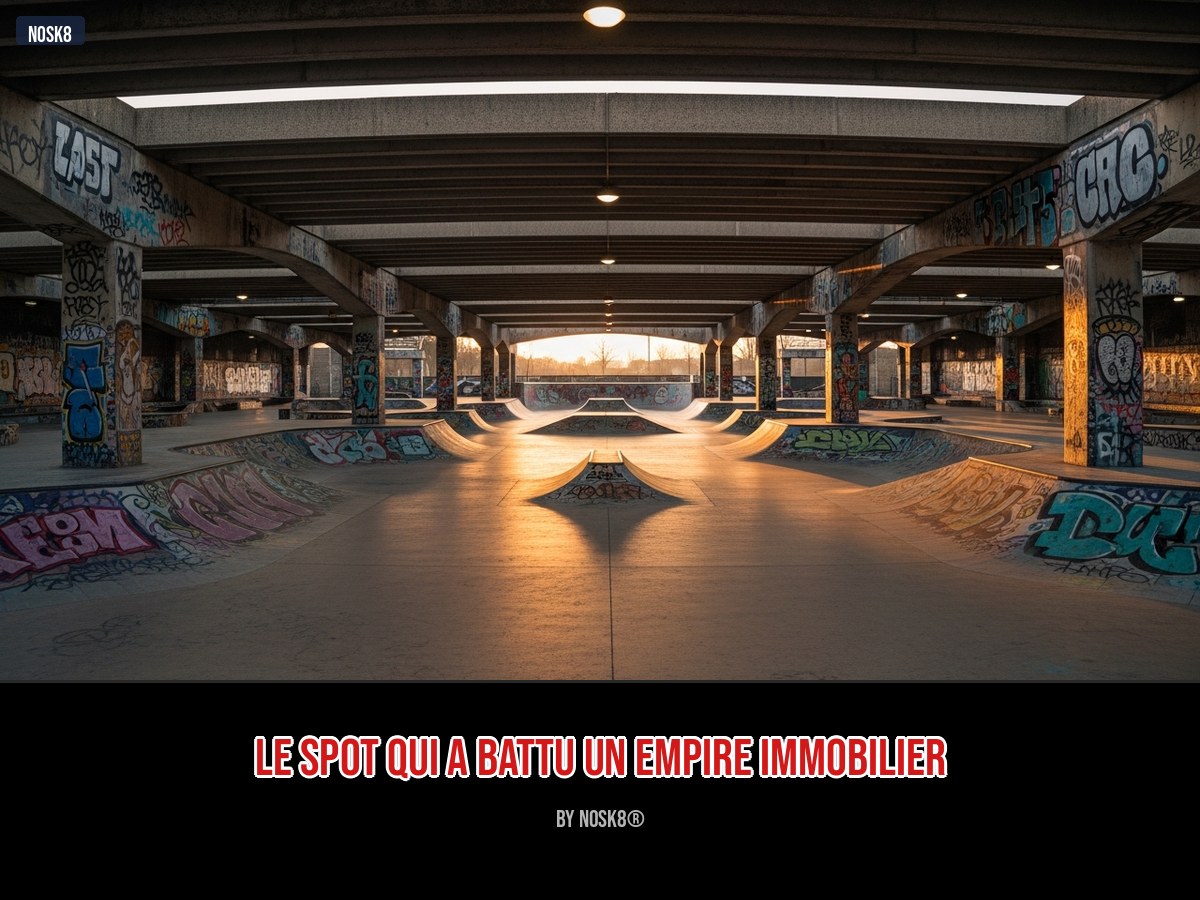
The Undercroft. The name sounds like a dungeon. It’s actually a vaulted hall under Waterloo Bridge, at the foot of the Queen Elizabeth Hall, built for the Festival of Britain in 1951. Pure brutalism. Poured concrete, massive columns, low ceiling. The city had forgotten this underground space. London skaters, however, discovered it.
It’s the early 70s. Skateboarding arrives from America, street culture looks for its headquarters. The Undercroft ticks all the boxes: covered (it rains in London, we don’t need to tell you), free, open 24/7, and that worn concrete, those improbable angles, those walls covered in graffiti accumulating decade after decade. A generational playground.
For fifty years, the best generations of British skateboarding have shaped their style in this space. Street legends have laid their wheels there. 12-year-old kids are still learning their first ollies there today. The Undercroft is the living transmission of skateboarding culture across two generations.
2013: The Real Estate Threat
In March 2013, the Southbank Centre announced a £120 million renovation project. The plans: transform the Undercroft into shops, restaurants, commercial galleries. The justification? Create an additional 6,000 m² of commercial space by « revitalizing » this « underused » space.
Underused. Fifty years of skateboarding history. Thousands of Londoners coming every week. Graffiti artists whose works have been photographed by the world’s biggest magazines. Underused.
The pill doesn’t go down. In the days following the announcement, anger rises. Not just in London. Throughout the entire skateboarding world.
Long Live Southbank: How the Community Won
The Long Live Southbank (LLSB) campaign formed in a few weeks. Objective: obtain classification of the spot as a protected cultural space, and block the real estate project. The weapons: a petition, filmed sessions, testimonials from riders worldwide.
The machine goes wild. Over 50,000 signatures in a few weeks. International skateboarding legends co-signed the movement. The Guardian covered the story. The BBC joined in. The Undercroft became the symbol of a broader battle: public spaces against gentrification, street culture against market logic.
In July 2014, the Southbank Centre backed down. The commercial project was abandoned. The Undercroft was preserved. Even better: it was officially recognized as a cultural space of public interest. A total victory. The first major collective victory for the skateboarding community against real estate speculation.
This precedent changed everything. Other threatened spots worldwide used the same strategy: classification, media coverage, community mobilization. The battle for Sants Plaza in Barcelona was directly inspired by it.
Today: Why It’s a Pilgrimage
In 2026, the Undercroft is running at full throttle. Graffiti walls accumulate five decades of layers. The smooth concrete floor bears the marks of thousands of sessions. At any hour, people are skating, filming, watching. At night, the city’s neon lights stream through the arches. It’s one of the most cinematic atmospheres in global skateboarding.
The level is high. It’s not a skatepark for beginners. The locals aren’t hostile, but they have their rhythm. Observe, respect, gradually find your place. The code is that of all mythical spots: respect is earned through skateboarding, not words.
LLSB merchandise — tees and boards in the campaign’s colors — has become a symbol worn worldwide. Owning an LLSB hoodie signals belonging to something beyond skateboarding: the defense of free spaces.
Practical Info If You Go to London
Address: Belvedere Road, London SE1 8XX — under the Queen Elizabeth Hall, South Bank of the Thames. Tube: Waterloo (Jubilee/Bakerloo/Northern) or Embankment (District/Circle), 5 min walk. Access: Free, open 24/7.
Bring a board suited for street — 8.0 or 8.25 deck, low or mid trucks, hard 99A wheels. The concrete is fast. A few ledges and rails were added after the 2014 victory — the city council invested to improve the obstacles. The ceiling remains low in the center: aerial tricks are done towards the openings, facing the Thames.
If you’re traveling in London, combine it with the general Southbank area: the booksellers at the book market, Tate Modern 10 minutes walk away, the Millennium Bridge. It’s an entire cultural district. The Undercroft is its beating, underground heart.
We read every comment