
ℹ️ 🛹 Web Média Skate 🛹 ℹ️

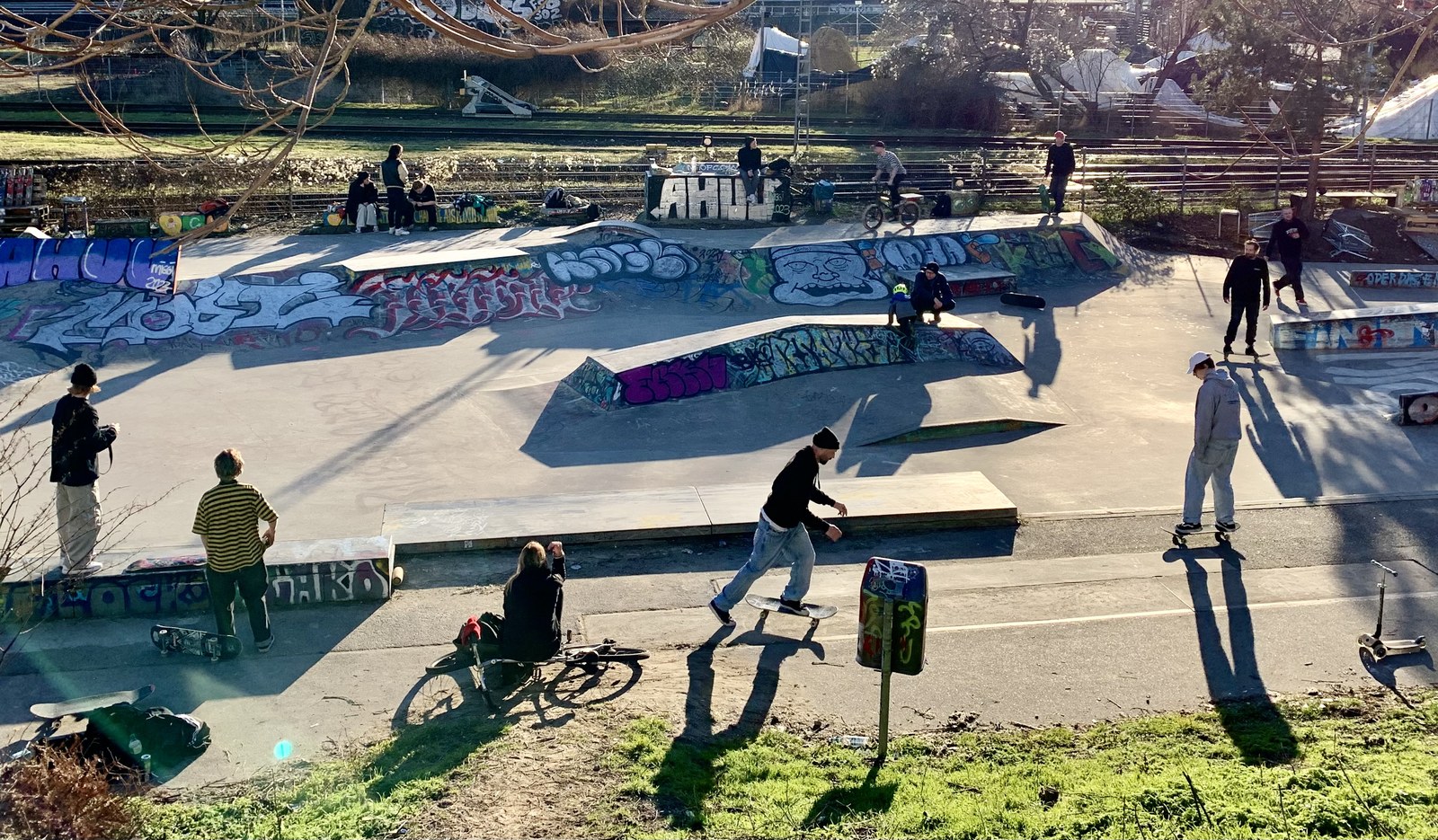
Spots
Berlin lets skaters get away with anything — except one €5,000 line
Berlin passe pour la ville la plus permissive d’Europe pour skater. Sa loi dit l’inverse : hors des surfaces désignées, jusqu’à 5 000 € d’amende. Cinq spots, et la ligne exacte.

→ Pour aller plus loin : Pourquoi Philly a refusé 1 million de dollars pour LOVE Park ?
Everybody tells you the same thing before you've even dropped your bag: in Berlin, you can skate wherever you want. Nobody whistles at you, nobody chases you down, security guards look the other way. That's the reputation the city has carried for thirty years, and on the ground it mostly holds up.
Except we went and read the actual law. And on paper, Berlin is harsher than Paris. A 1997 Berlin statute spells it out: no rolling anywhere except on surfaces expressly set aside for it, with a fine that can climb to €5,000. This isn't forum hearsay — it's written down, with a section number attached.
So how does one city end up with the toughest law in Europe and the most open streets? We went back through the five places that tell that split-screen story best, and the exact line comes at the end: the one you don't cross, the one that costs real money. If you're coming from Paris and its ten spots ranked by how much heat you'll catch, the contrast is going to mess with your head.
Five places that explain the Berlin deal
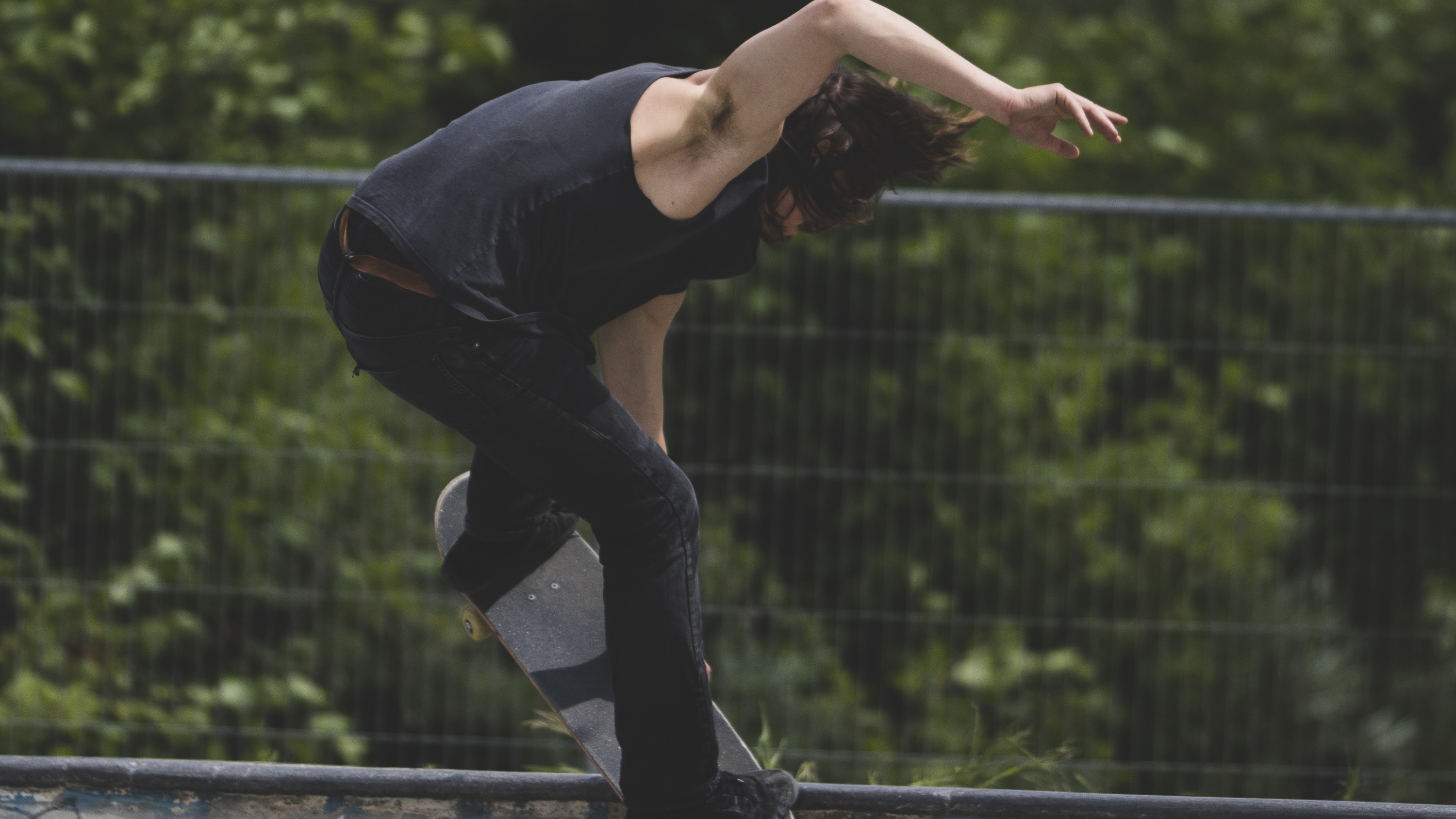 On the coping at the Dog Shit Spot: no fence, no closing time, nobody around to tell you to stop. Photo: Hector Bermudez · Wikimedia Commons (CC0)
01
Dog Shit Spot
Friedrichshain · along the S-Bahn tracks, Revaler Straße side
Intermediate
Poured concrete + DIY
Open, free, unsupervised
Poured concrete + DIY
Open, free, unsupervised
The name cracks everybody up except the neighbors. It's a ribbon of concrete wedged between the railway embankment and the empty lots of Friedrichshain, built out over the years by the people who actually skate it. Ledges, quarters, a center platform, graffiti that gets buffed and redone every month. Zero fence, zero hours, zero security — and a reputation that travels across Europe. Ten minutes here and you get why people say Berlin just lets it happen.
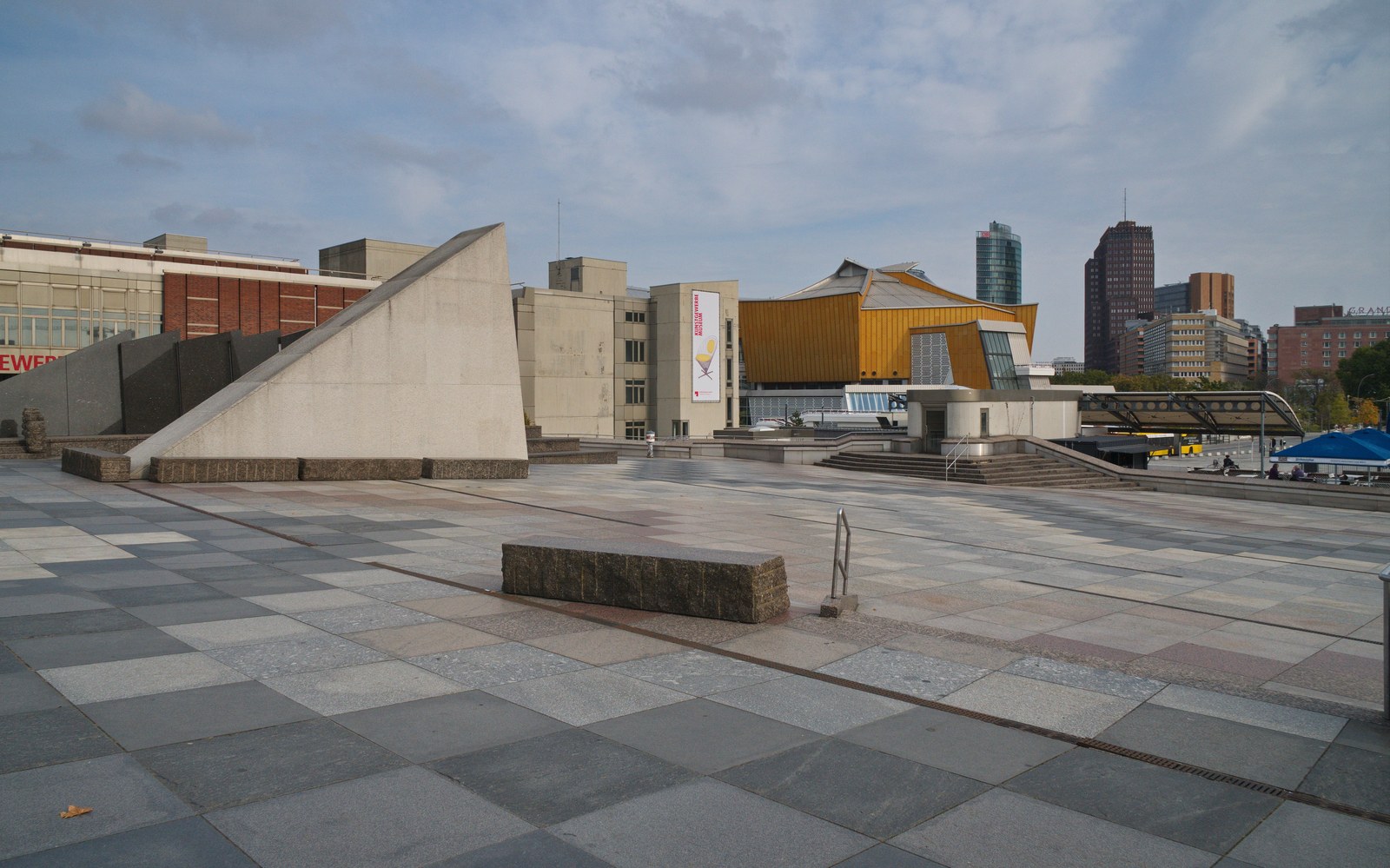 The concrete bank, the granite block sitting right in the middle, the slab running downhill: nobody drew any of it for skating, and all of it works. Photo: MenkinAlRire · Wikimedia Commons (CC BY-SA 4.0)
02
Kulturforum
Tiergarten · between the Philharmonie and the Neue Nationalgalerie
Advanced
Granite + concrete
After the museums close
Granite + concrete
After the museums close
The museum plaza, gently sloped, paved in massive granite slabs. A triangular concrete bank, stone blocks dropped there like ledges fallen out of the sky, sets of stairs. No architect was thinking about skateboarding when they drew this up in the sixties, and that's exactly why it works. The ground is fast, dry, wide open. Daytime you share it with museum tourists; at night the whole plaza is yours. This is the spot you film when you want the clip to feel like Berlin.
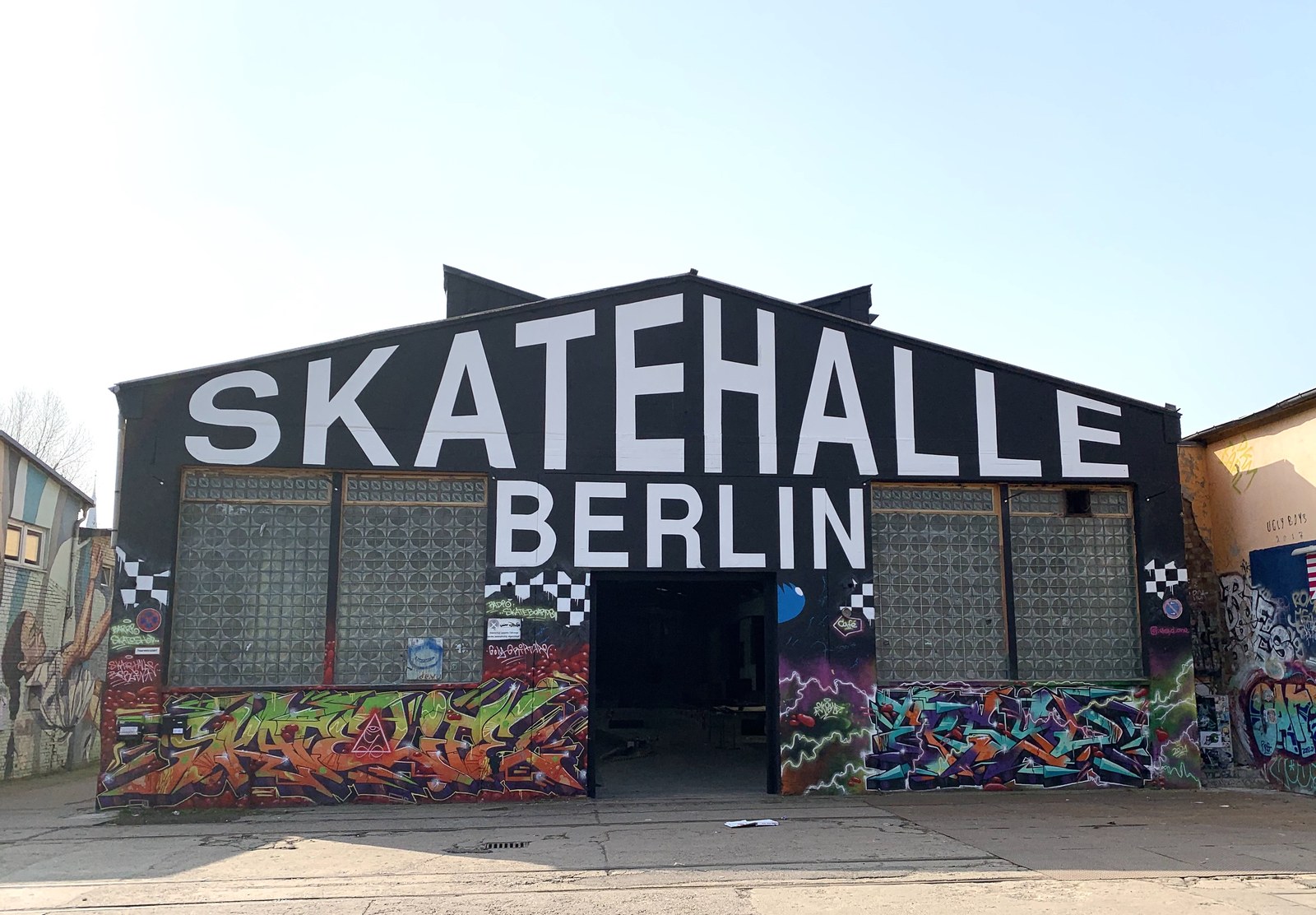 A train repair shop turned indoor park: the name is painted straight onto the wall, no logo, no sign. Photo: Lear 21 · Wikimedia Commons (CC BY-SA 4.0)
03
Skatehalle Berlin — RAW-Gelände
Friedrichshain · former rail depot, Revaler Straße
Intermediate
Indoor, wood + concrete
Paid entry, open year-round
Indoor, wood + concrete
Paid entry, open year-round
A locomotive repair hall nobody knew what to do with after reunification. Today: wooden street course, bowl, climbing wall overhead, venues all around it. The name is painted in white on the black gable end — no logo, no lit-up sign. When November hits and Berlin concrete drops below freezing, this is where the entire city retreats. The only place on this list where you pay to get in — and nobody argues about the price.

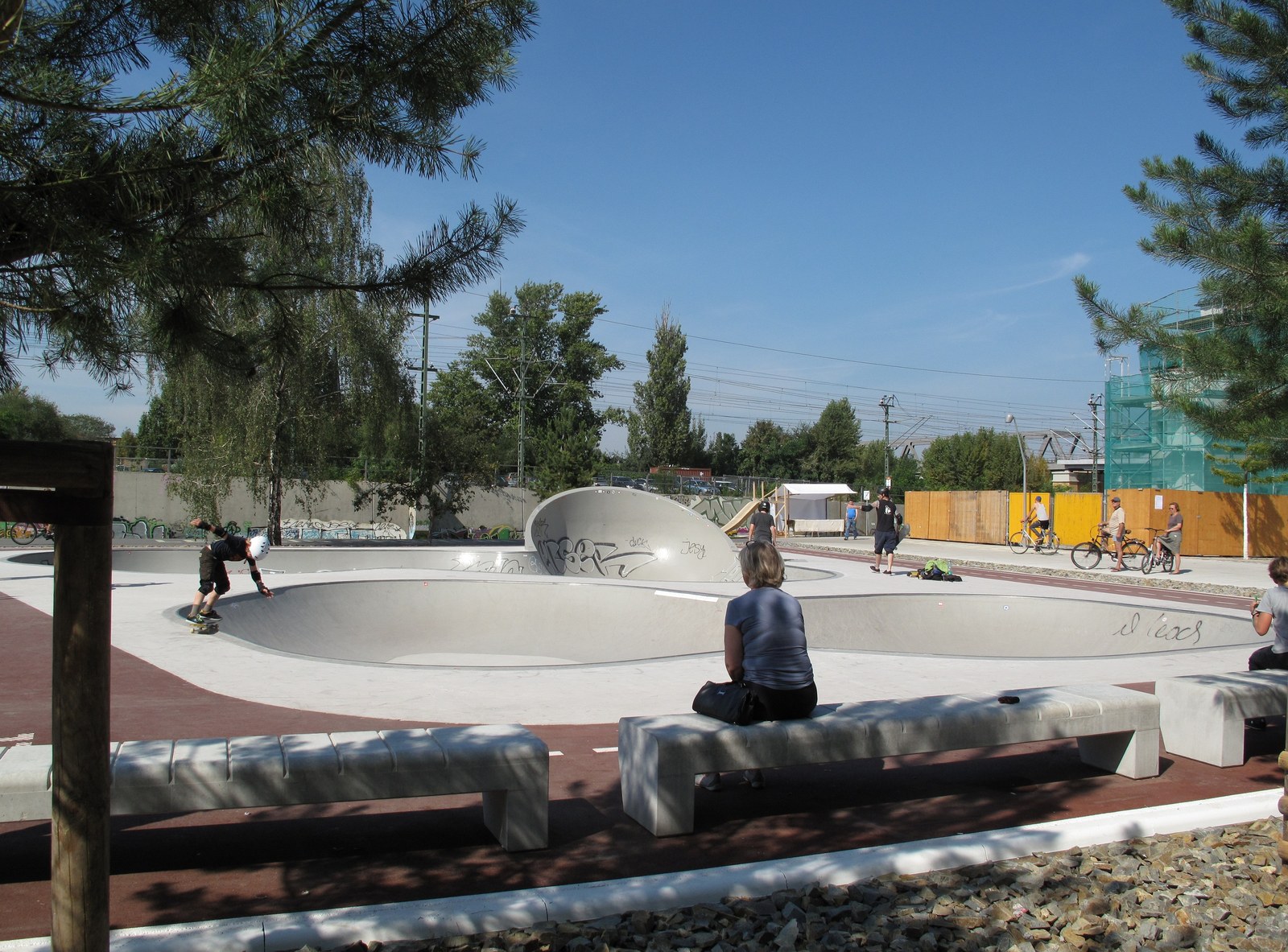 1,300 m² of concrete paid for by the city, dropped right next to the tracks: this is what the law's "expressly designated" surface actually looks like. Photo: Lienhard Schulz · Wikimedia Commons (CC BY-SA 3.0)
04
Gleisdreieck Skatepark
Kreuzberg · Park am Gleisdreieck, east section
Beginner-friendly
Smooth concrete
Berlin's biggest outdoor bowl
Smooth concrete
Berlin's biggest outdoor bowl
A 31.5-hectare railway wasteland turned park, with the eastern half opened to the public on September 2, 2011. Inside it, 1,300 m² set aside for skating on the footprint of an old signal box, including the biggest open-air bowl in the city. Smooth concrete, wide lines, people there at every hour, and a steady stream of bikes cutting through the park alongside. Bookmark this one: it's the hard proof of everything we break down below.
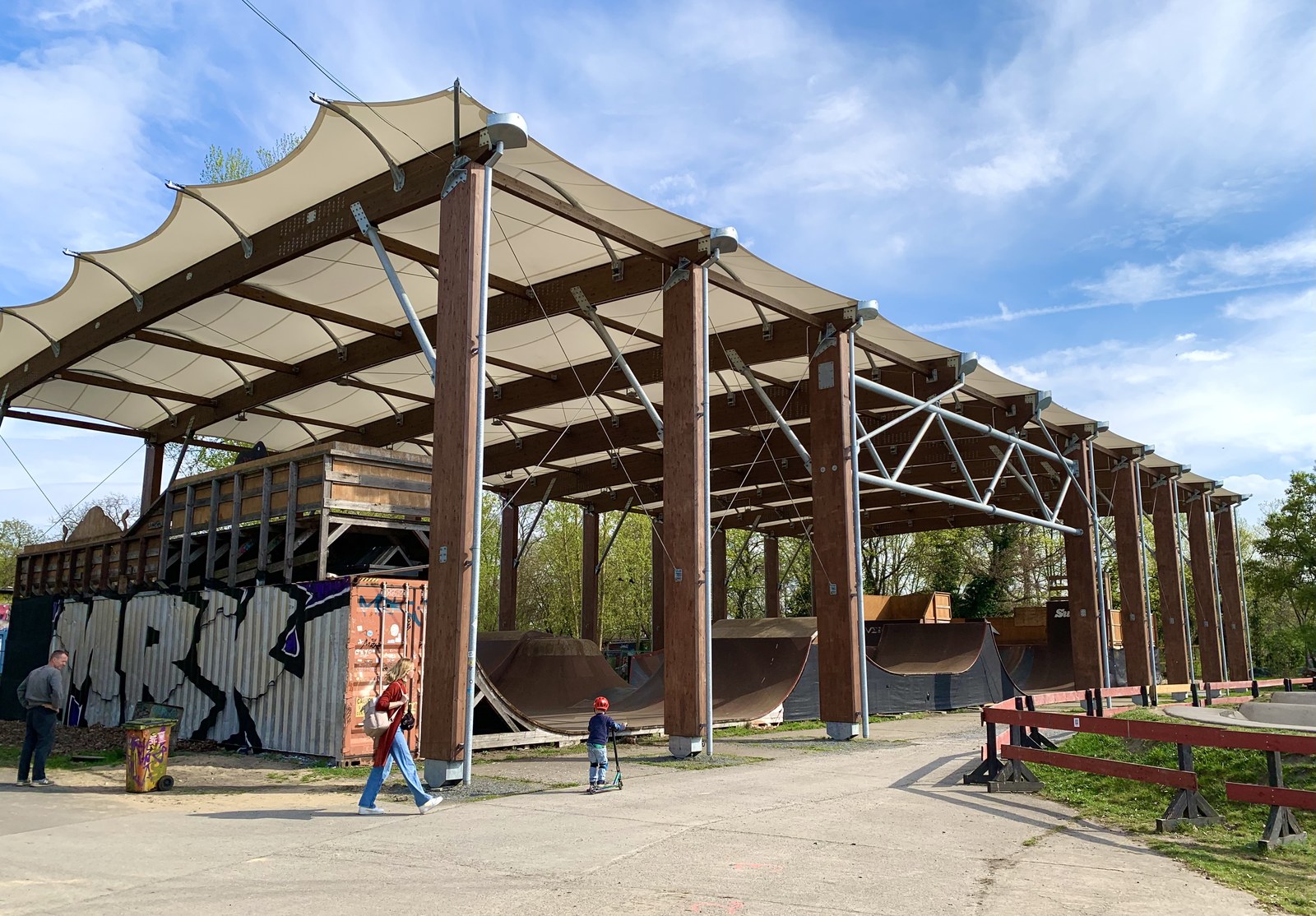 60,000 m² on the banks of the Spree, started by a crew of kids in 1999: the roof all of East Berlin skates under when it rains. Photo: Lear 21 · Wikimedia Commons (CC BY 4.0)
05
Mellowpark
Köpenick · An der Wuhlheide, on the Spree
All levels
Wood, concrete, dirt
60,000 m²
Wood, concrete, dirt
60,000 m²
Started in 1999 by a crew of kids from the East, moved in 2010, reopened in 2012 across 60,000 m² — eight soccer fields. Covered hall, ramps, pumptrack, BMX trails, basketball courts, all of it run by a nonprofit whose office fits inside a shipping container. The city youth office kicks in more than €75,000 a year; a crowdfunding campaign pulled €157,000 to expand it. It's now a national training center for freestyle BMX. Sit with that number: nobody handed this to Berlin skaters, they went out and took it.
Why nobody says anything to you
The first reason is as dumb as geography: Berlin is huge and half empty. Nine times the size of Paris, half the people per square meter. A city cut in two for twenty-eight years rebuilt itself with holes everywhere — rail yards, vacant lots, oversized plazas inherited from the East. When you're skating a plaza at 10 p.m., you're not bothering anybody, because there's nobody there. Compare that to the Trocadéro plaza and its eighty-nine-year tug of war: in Paris, every last square meter of granite is contested.
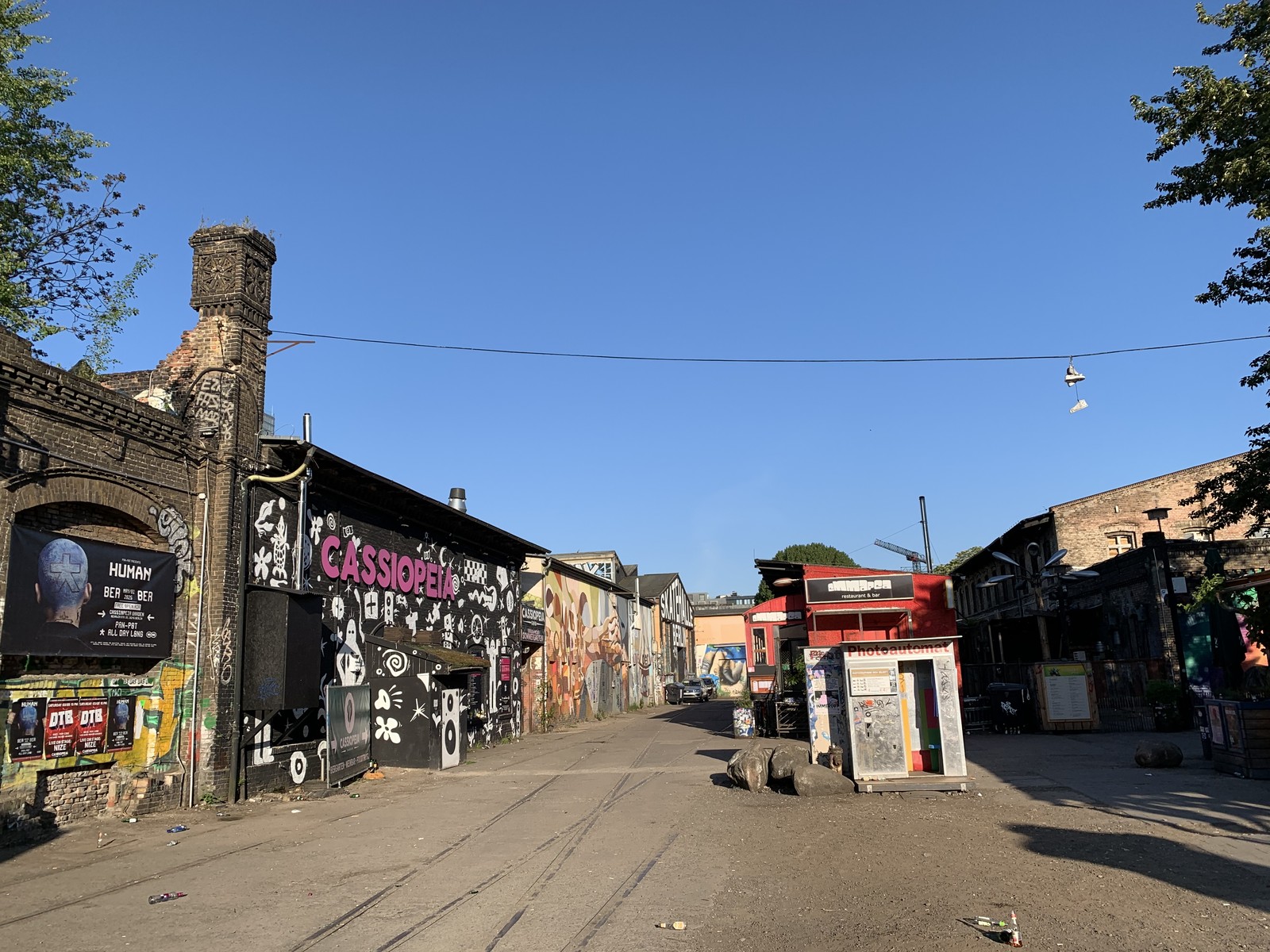 Abandoned train workshops, squatted, then made official: that's the administrative habit behind nobody asking you any questions. Photo: Lear 21 · Wikimedia Commons (CC BY-SA 4.0)
The second reason is cultural. The RAW, Mellowpark, half the places that matter here started as squats. People took over an abandoned site, made it run, and the city eventually legalized it instead of evicting. That builds an administrative reflex: you don't reach for the ticket book first. An old train shop turned skate hall shocks nobody in Berlin, when it would have been ten years of paperwork anywhere else.
The third is budgetary, and it's the least romantic: there is no city warden posted behind every slab. The Ordnungsämter, the district enforcement offices, have twelve priorities ahead of you. As long as you're not breaking anything and nobody calls, your spot doesn't exist on their rounds. Berlin tolerance is, first and foremost, a lack of resources rebranded as a way of life.
That explains the street. It doesn't explain the law. Because the law says the exact opposite.
How far it goes: the line, in three texts
Here's the answer we promised up top. In Berlin, your board falls under three different legal regimes depending on exactly where you put your wheels down. Two of them leave you alone. The third one runs up to €5,000.
On the sidewalk: you're a pedestrian, and it's legal. German traffic law files a skateboard under "special means of transport" — § 24 of the StVO, alongside scooters and roller skates. It is not a vehicle. Pedestrian rules apply: sidewalk mandatory, roadway off limits, bike lanes off limits. So pushing from one spot to the next raises no legal issue at all, as long as you stay on the sidewalk and keep it reasonable.
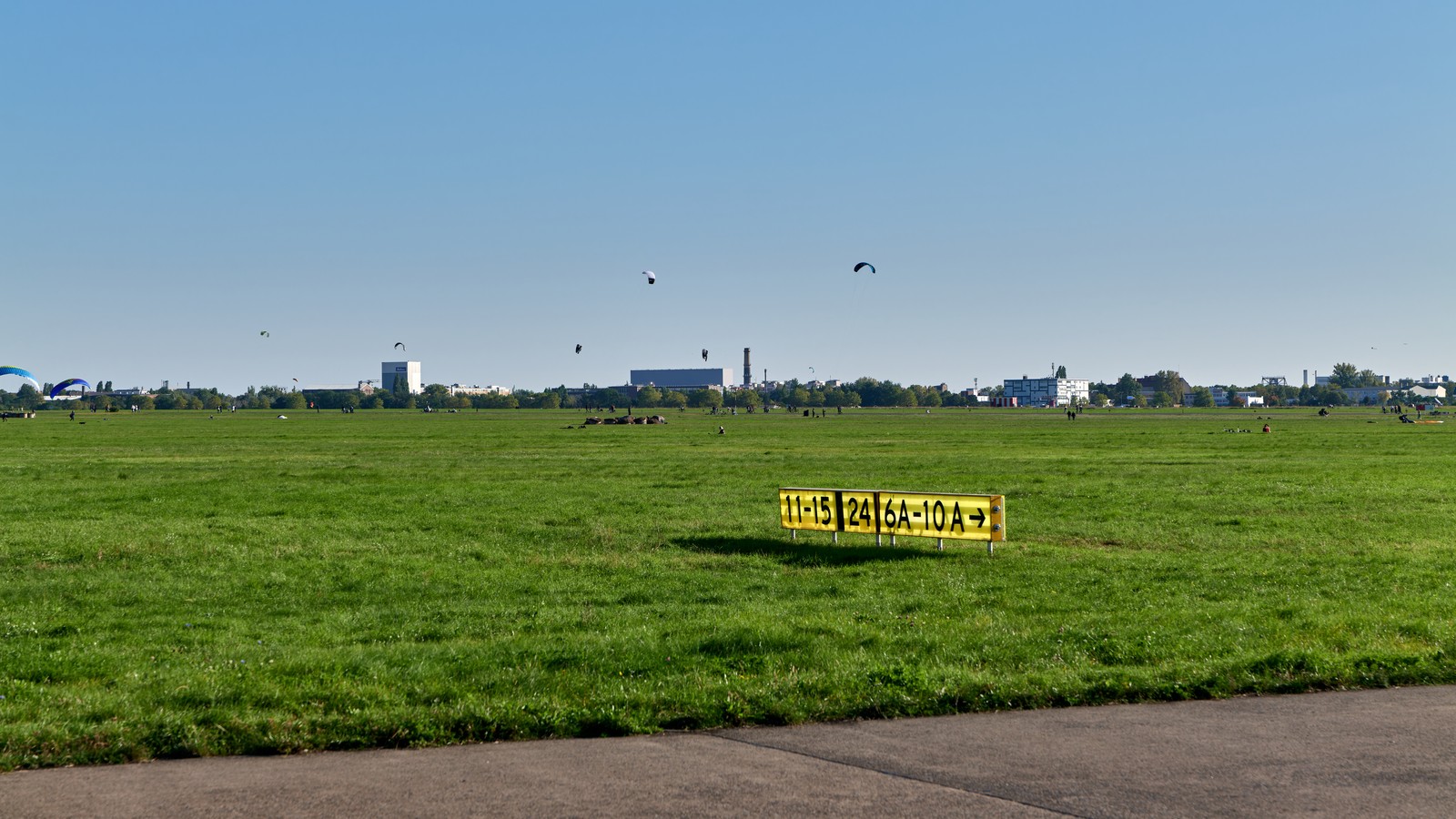 An airport turned public meadow: legally, this perfect concrete counts as a green space — so the designated-surface rule applies to it. Photo: Leonhard Lenz · Wikimedia Commons (CC0)
In a park: banned, except on designated surfaces — up to €5,000. This is the line, and it's written in black and white. Berlin's green space law, the Grünanlagengesetz of November 24, 1997, states in § 6 (2) that "activities such as cycling, skateboarding, ball games, swimming, boating, horseback riding and barbecuing are permitted only on surfaces expressly designated for them." § 7 (1) no. 7 makes it an offense, and § 7 (3) sets the ceiling: €5,000. Translation: in a Berlin public park, you have no right to skate until a sign gives it to you.
On a plaza or a forecourt: the owner decides. Kulturforum, train stations, office plazas, museum forecourts: here neither traffic law nor green space law settles it. What applies is the property owner's rights. In practice: they can ask you to leave, and you leave. Refuse to go after being told to, and you've crossed into § 123 of the German criminal code — up to a year. And if you do lasting damage to a granite ledge, that's § 303, criminal damage to property, up to two years. Wax on a landmarked block isn't a skater joke to a German prosecutor.
The detail nobody ever quotes. That same sentence in § 6 (2) keeps going, and this is where Berlin gets genuinely interesting: the districts "are required to designate surfaces for these uses to an appropriate extent." The ban comes bundled with an obligation to build. This isn't soft tolerance, it's a trade: the city closes the lawns to you and owes you concrete in exchange. Those 1,300 m² at Gleisdreieck aren't a gift — they're a statute being carried out.
So no, on paper Berlin is not the most permissive city in Europe: its law is harsher than most French municipal ordinances. It's the most permissive in practice, because almost nobody enforces the text, and because that same text forces the city to build you alternatives. The day the Ordnungsämter decide to pull out the ticket book, the Berlin street shuts in a single season. No skater here is unaware of that — which is exactly why they maintain their own spots.
So the real European model is neither Berlin nor Paris: it's the cities that stopped tolerating and started designing with skaters, the way our deep dive on twenty years of skate policy in Malmö lays out. Berlin, meanwhile, stands on a balancing act: a strict law nobody enforces, and a scene that knows full well it's all hanging by a thread.
{
"@context": "https://schema.org",
"@type": "Article",
"headline": "Berlin lets skaters get away with anything — except one €5,000 line",
"author": {"@type": "Organization", "name": "Nosk8"},
"datePublished": "2026-09-09",
"description": "Berlin has a reputation for letting skaters do whatever they want. Its law says otherwise: off designated surfaces, fines up to €5,000. The 5 spots and the exact line.",
"keywords": "skateboarding Berlin, Berlin skate spots, Kulturforum, Dog Shit Spot, Mellowpark"
}
Ever gotten kicked out of a spot in Berlin, or went ten days there without a single hassle? Tell us what happened in the comments ↓
Follow NOSK8 where you hang out
Parts, spots, behind the scenes: it all drops on the accounts first.
Le lexique
-
1
rebords
Bords de béton, de pierre ou de métal sur lesquels on fait glisser la planche ou les essieux.
-
2
quarters
Modules courbes en quart de cercle qui renvoient le skateur en l’air, à la manière d’un tremplin arrondi.
-
3
street course
Parcours intérieur qui reproduit du mobilier urbain : marches, barres, plans inclinés, rebords.
-
4
wax
Bloc de paraffine qu’on frotte sur un rebord pour le rendre glissant. Il laisse une trace grasse difficile à retirer.
-
5
pumptrack
Boucle de bosses enchaînées qu’on parcourt sans pousser, en poussant sur les jambes dans les creux.
Continue ta lecture
ChroniquesLe skate vend 1,1 milliard de dollars — et ton shop ferme : à qui la faute ?
Trois skateshops indépendants ont baissé le rideau en six mois pendant que le marché du skate signait ses meilleurs chiffres. On a lu les dossiers…
Commentaires (0)