
ℹ️ 🛹 Web Média Skate 🛹 ℹ️

★ Spots
Miyashita Park, Tokyo: A Skatepark on Top of a Shopping Mall — But Does Anyone Actually Skate It?

→ Pour aller plus loin : Wade Speyer, 1991 : comment un ledge caché de San Francisco a donné son nom à tous les « hubbas » ?
In Shibuya, there’s an address that would blow the mind of any Paris skateshop local: a skatepark, a climbing wall and a sports court, perched seventeen meters off the ground on the roof of a mall packed with 90 shops and a 240-room hotel. Downstairs: adidas, Tower Records, an underground alley of izakayas. Upstairs: fresh concrete, a skyline view, and skaters paying to ride it. On paper, it reeks of a sneaker-brand marketing stunt.
In reality, it’s more complicated than that — and older, too. This rooftop already existed once before, way before Instagram, way before Nike tried to put its name on it, and the story that leads here runs through an eviction, a lawsuit and ten years of wasteland. We’ll start with the ground under your wheels, and answer the question at the end: do people actually skate up there?
⏱ Read time: 6 min
The terrain: fresh concrete, seventeen meters up, 330 meters long
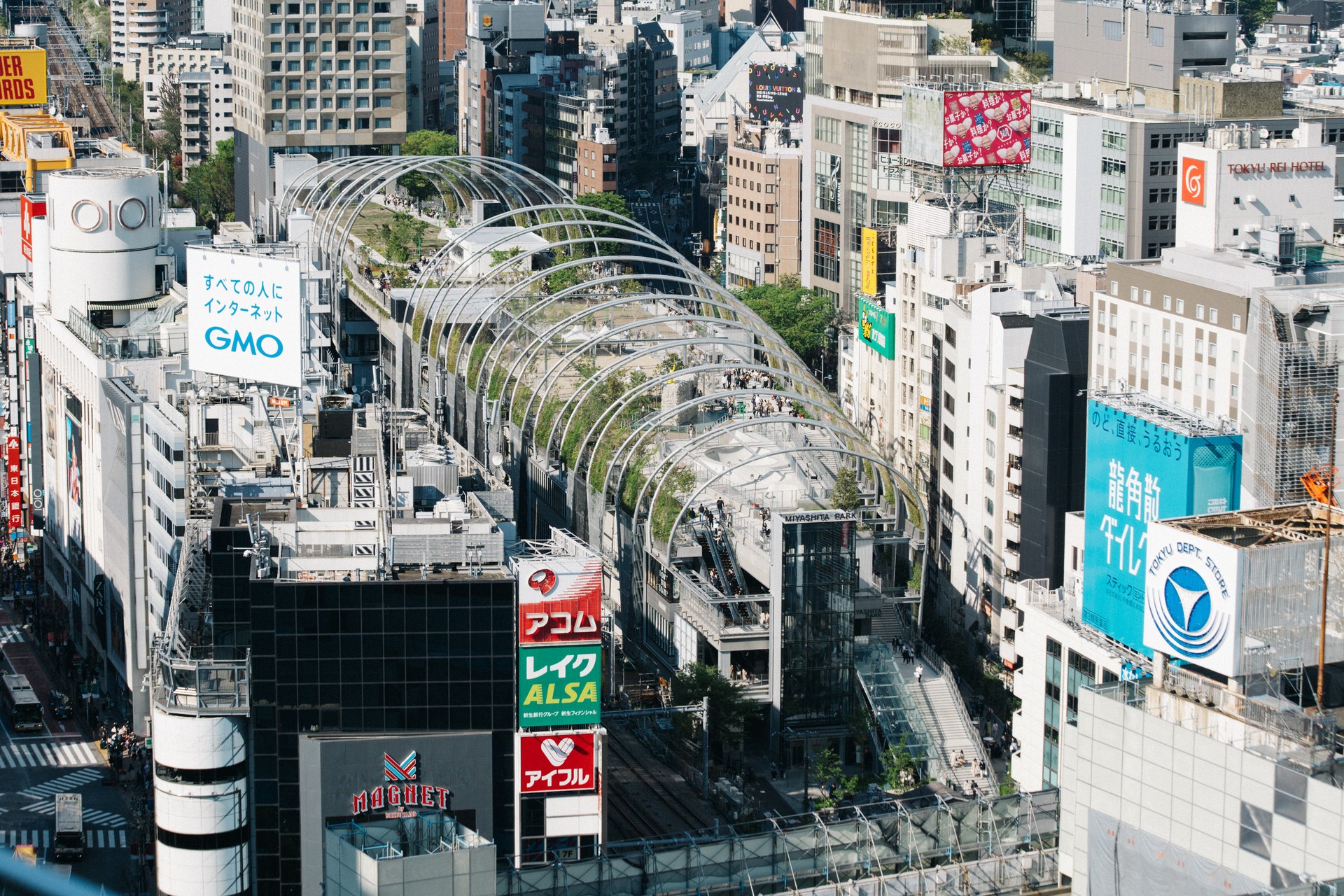
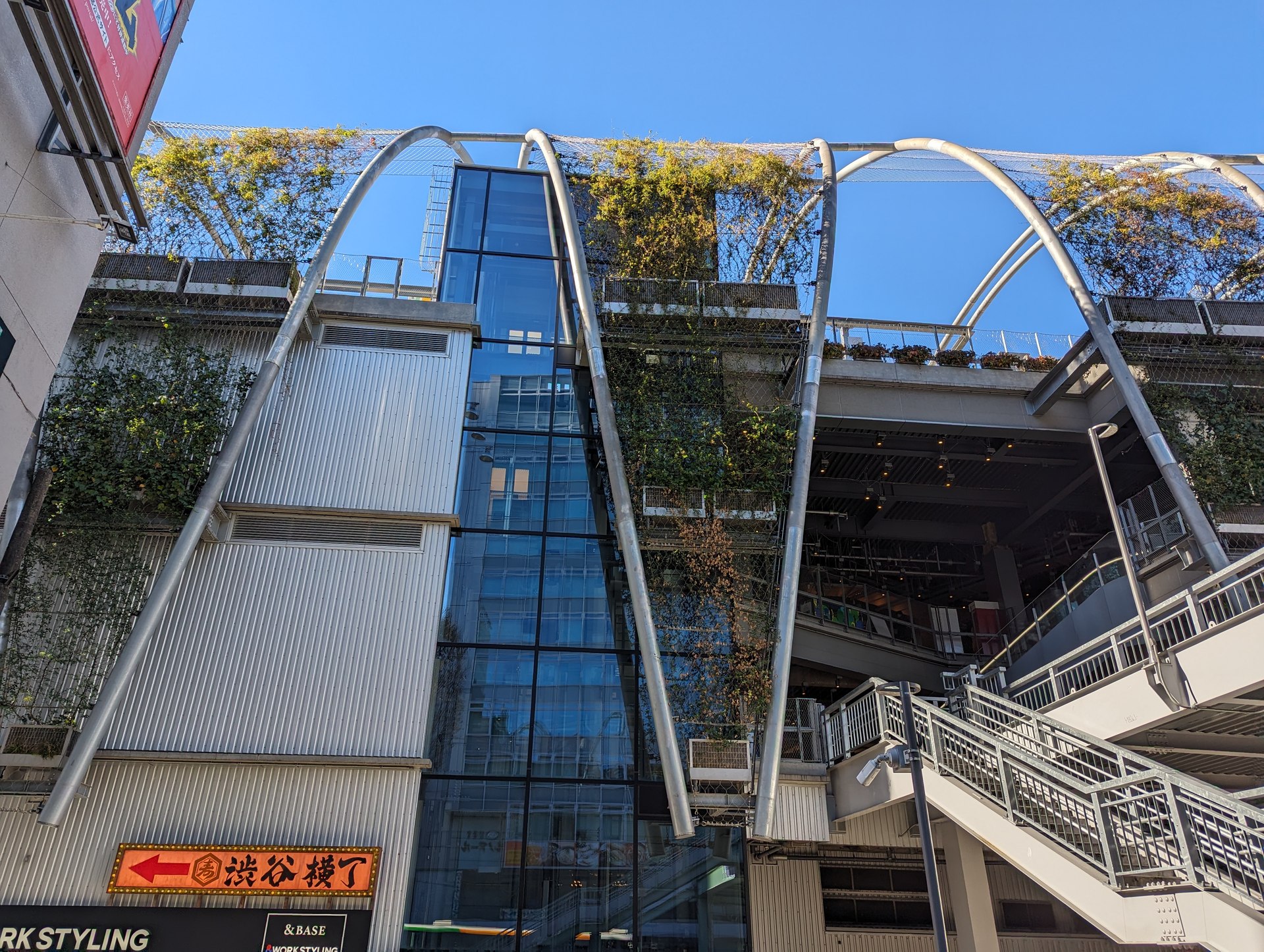
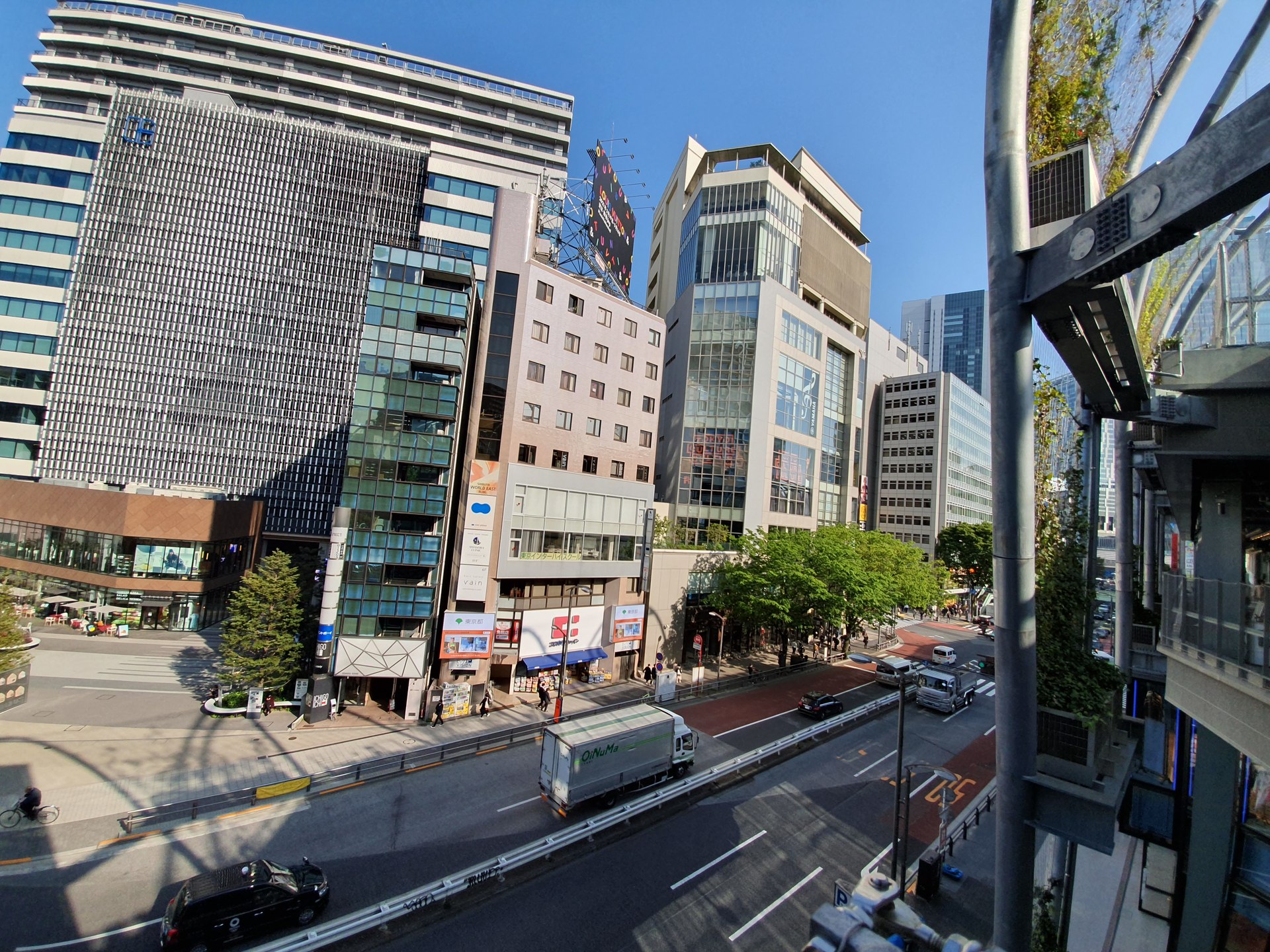
The park stretches lengthwise over three city blocks between Shibuya Station and Harajuku — 330 meters of green roof under steel arches holding up ball-stopping nets. Under your feet: seventeen meters of air, a hotel running four to eighteen stories, and a shopping arcade with 90 stores. The skate zone itself isn’t trying to compete with some mega-park: a tight space wedged between the climbing wall and the sand multi-sport court, with low, technical obstacles — the kind of compact setup you see in Japanese municipal parks everywhere. Enough to lock in precise lines, not enough to string together a contest run.
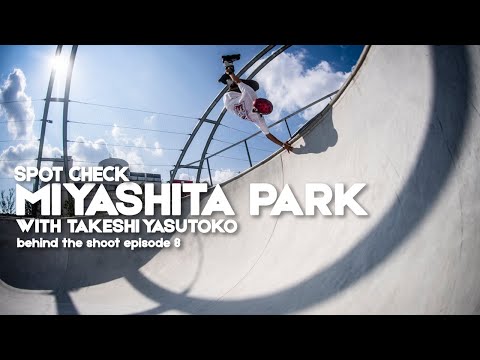
Spot check at Miyashita Park with Takeshi Yasutoko (Jason Halayko Photography, 2020)
First time out, you can’t even see the park from the street. You ride an escalator squeezed between two shops, pass a register, and all at once Shibuya opens up under your feet — the neon signs, the Yamanote line tracks, the crowd at the crossing going about its business without ever looking up. The noise of the city drifts up, muffled, through the fencing. You set your board down, push once, and the drop under the roof reminds you exactly where you are: on top of a building, not on a sidewalk.
What Miyashita Park replaced: evicted homeless residents and a Nike deal that fell apart
The first Miyashita Park opened at ground level in 1953. In 1966, riding the post-war automobile boom, the city of Shibuya rebuilt it on stilts above a parking garage: Japan’s very first “aerial park.” So this rooftop isn’t some 2020 idea — it’s the second time this patch of land has left the ground. In between, left unmaintained, the park became a refuge for a homeless community that had settled there since the 1990s.
In 2009, Shibuya negotiated selling the park’s naming rights to Nike Japan, briefly rebranding it “Miyashita Nike Park,” with a skate zone and a café as part of the deal. The project was to be funded entirely by the brand — and required clearing out the park’s residents. It blew up into a scandal: artists and citizen collectives pushed back against a public space being privatized into a billboard. On September 24, 2010, city hall had the tents forcibly removed. In 2015, a court ruled the eviction “partially illegal” and ordered Shibuya to pay 110,000 yen in damages. The park reopened on April 30, 2011, with a pay-to-skate zone already in place — the very one we’re talking about here, with a longer history than the mall it now sits on.
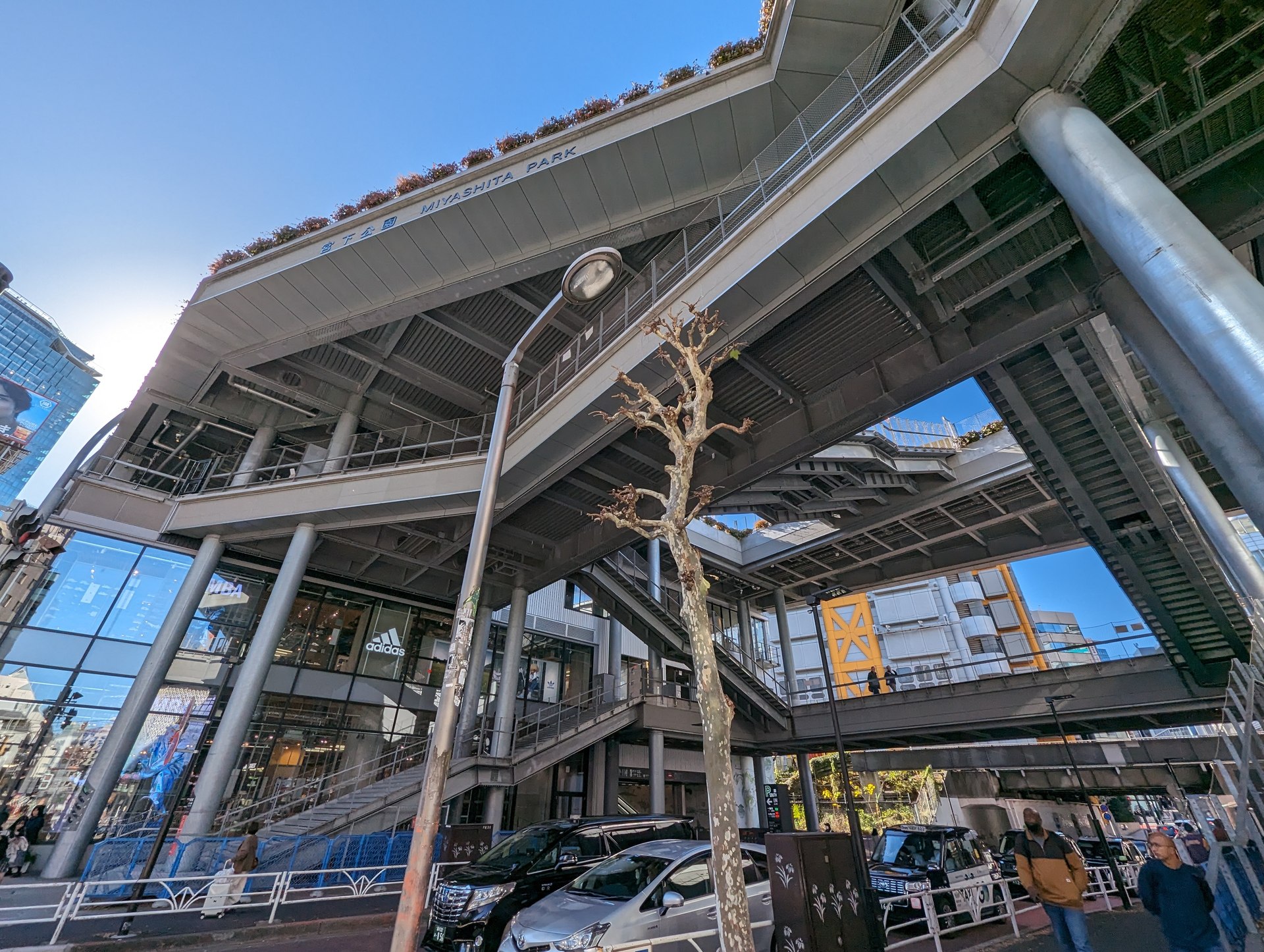
In 2014, Shibuya finally picked Mitsui Fudosan for a project ten times bigger: not just a park, an entire complex. The site closed in 2017, Takenaka Corporation spent three years building, and RAYARD MIYASHITA PARK reopened in summer 2020 — the Sequence hotel, 90 shops, the underground Shibuya Yokocho alley, and the park bumped up one more level, twice as big as before. The skatepark itself never left the premises after 2011: it just moved its address a few meters straight up.
Paid, timed, supervised: the price of putting your wheels down
Nobody skates here for free. The park itself is open from 8 a.m. to 11 p.m., but the sports facilities — skate, climbing, multi-sport court — run from 9 a.m. to 10 p.m., managed like any other municipal facility in Shibuya ward. The rate runs around 500 yen for a two-hour slot if you’re a Shibuya resident, double that for everyone else — tourists, skaters from Yokohama, or pros on a spot check. A reduced kids’ rate exists for residents. No wax living year-round on a ledge, no session spilling over past midnight: you pay for your block of time, you skate it, and you get back in line if you want another go.
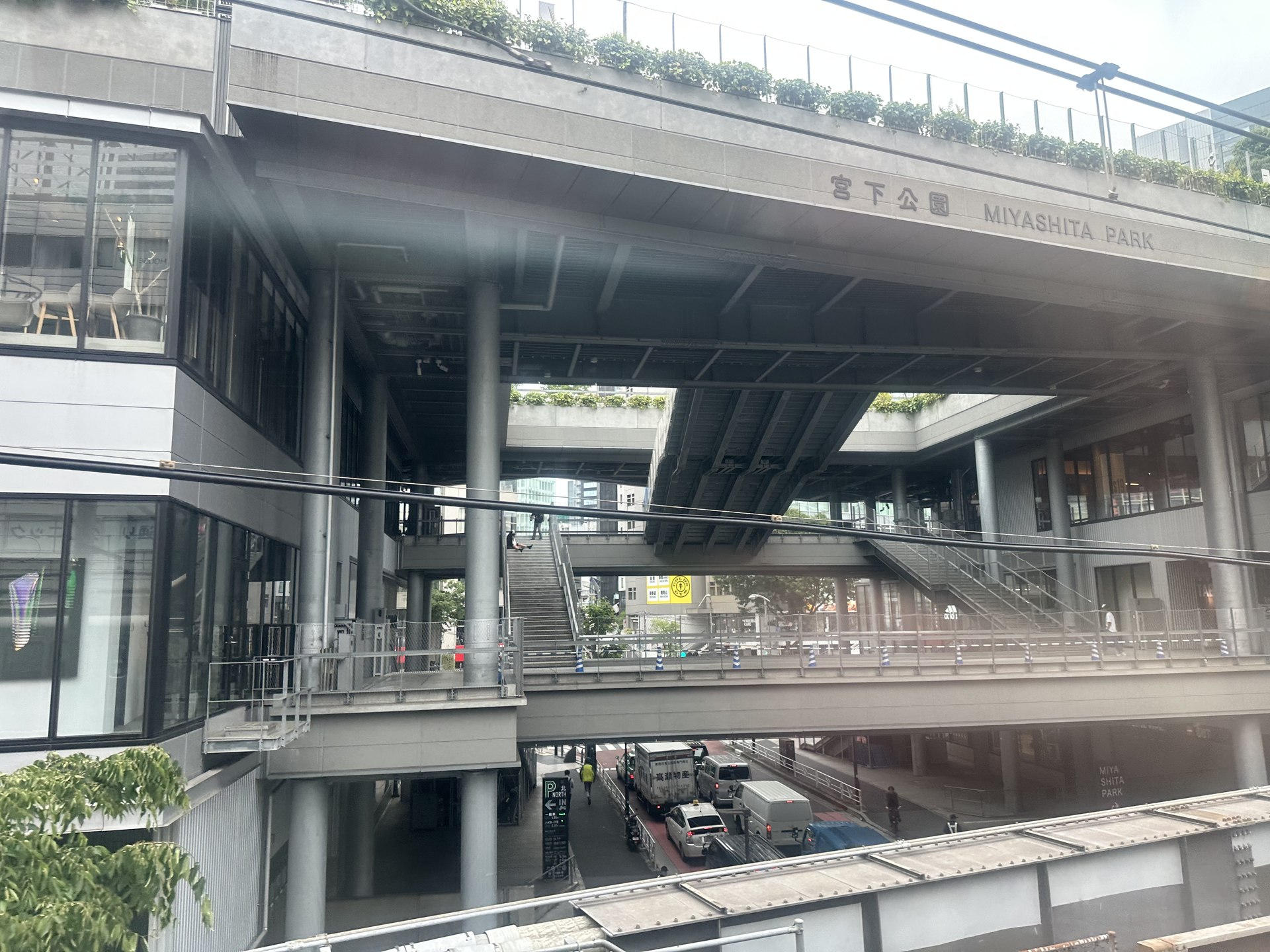
It’s the exact opposite of a busted Paris-style spot where you’re watching for security between tricks. Here, surveillance isn’t a problem to dodge: it’s the service you’re paying for. That changes the nature of the session — closer to booking a basketball court than to a line built up over months on a downtown ledge.
So, do people actually skate it? Here’s the answer
Yes — and it’s a real, working skatepark, not a photo-op backdrop. The skate surface is official, maintained and ridden daily, with pros coming through to test it on spot checks for actual video channels, not for a Nike shoot. What separates it from a classic street spot is the format: it’s not a loose session with your crew stretching into the night, it’s a two-hour slot, paid up front, supervised by park staff. You don’t squat Miyashita Park the way you squat a suburban parking lot — you rent it, by the hour, like a tennis court.
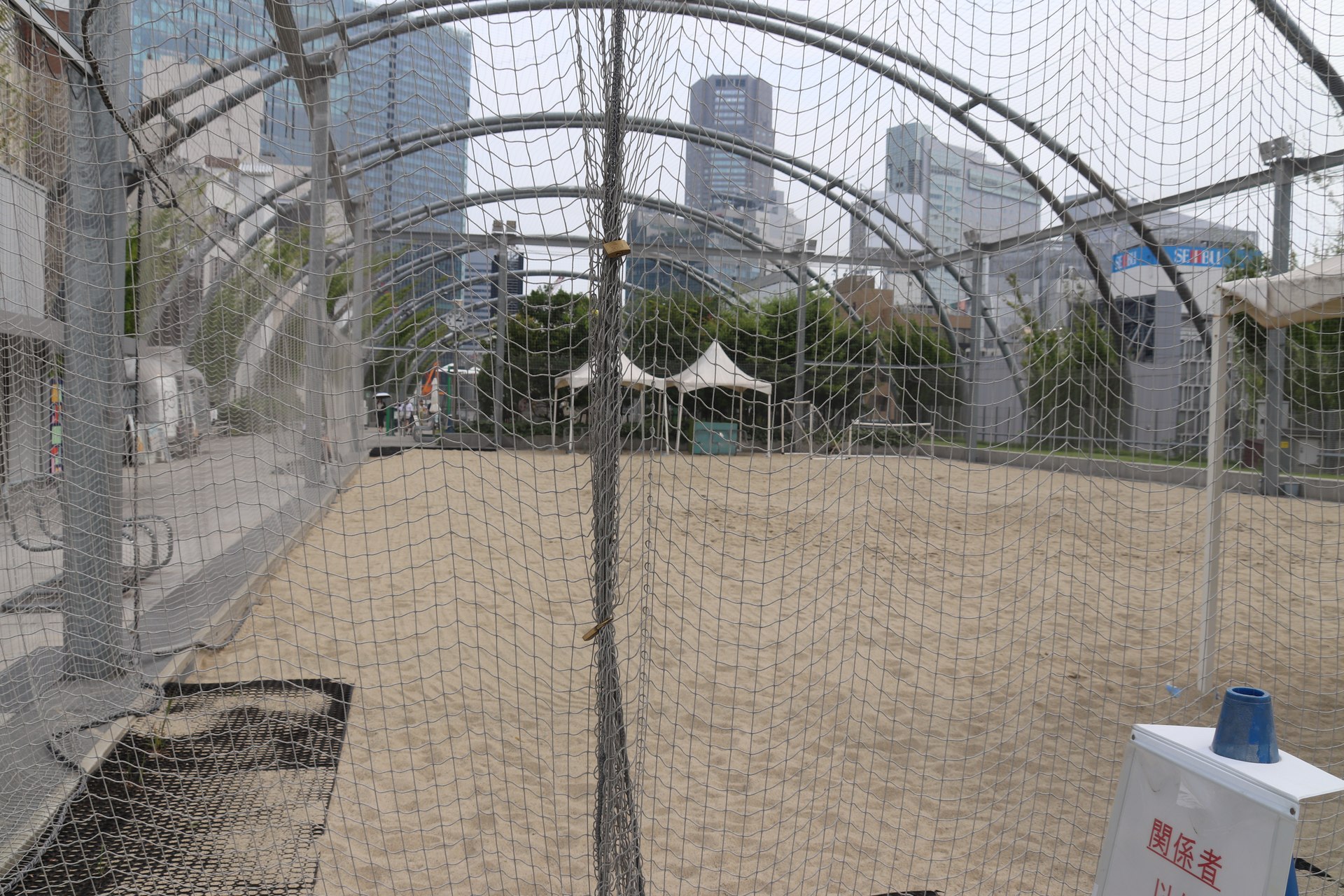
These days, the people skating up there are a specific mix: Shibuya high schoolers and thirty-somethings grabbing their two-hour slot after class or work, traveling skaters checking off the most photographed address in Japanese skateboarding, and pros like Takeshi Yasutoko, who came to film a spot check as soon as it opened in 2020. The community doesn’t form on the ledge, like at République or the Vieux-Port — it forms in the line, between slots, while everyone compares what they just tried.
Miyashita Park didn’t take the Trocadéro path — that monument skateboarding will never get to own. It didn’t copy Praça Roosevelt in São Paulo either, designed from day one as a space open to skaters. It invented a third way: a real skatepark, sitting on a real shopping mall, that you don’t squat but reserve. Not busted, not free — rented by the hour, seventeen meters above Shibuya.
{
"@context": "https://schema.org",
"@type": "Article",
"headline": "Miyashita Park, Tokyo : un skatepark posé sur un centre commercial, on y roule vraiment ?",
"author": {"@type": "Organization", "name": "Nosk8"},
"datePublished": "2026-08-24",
"description": "Miyashita Park à Shibuya : le skatepark posé à 17 mètres au-dessus d'un centre commercial de 90 boutiques. Histoire, expulsion, tarifs, horaires — et si on y roule vraiment.",
"keywords": "Miyashita Park skate, spot skate Tokyo, skatepark Shibuya, spots skate Japon"
}
A skatepark rented by the hour on a mall rooftop: is that still skateboarding to you, or already something else? Drop it in the comments ↓
Shop NOSK8
Voir toute la boutique →
TEE-SHIRTS
TEE-SHIRT NOSK8® P.A CENTRE #PARENTALADVISORY
Le prix initial était : 35,00 €.29,00 €Le prix actuel est : 29,00 €.
TEE-SHIRTS
TEE-SHIRT NOSK8® NOSKATE #SNC
Le prix initial était : 35,00 €.29,00 €Le prix actuel est : 29,00 €.
TEE-SHIRTS
TEE-SHIRT NOSK8® MATRICE HEART #ALT
Le prix initial était : 35,00 €.29,00 €Le prix actuel est : 29,00 €.
TEE-SHIRTS
TEE-SHIRT NOSK8® P.B CENTRE #RNB
Le prix initial était : 35,00 €.29,00 €Le prix actuel est : 29,00 €.
TEE-SHIRTS
TEE-SHIRT NOSK8® P.B HEART #ORIGINAL
Le prix initial était : 35,00 €.29,00 €Le prix actuel est : 29,00 €.
CASQUETTES
CAP NOSK8® P.B.P #PAW
Le prix initial était : 35,00 €.25,00 €Le prix actuel est : 25,00 €.
CASQUETTES
CAP NOSK8® P.B #POLARBEAR
Le prix initial était : 35,00 €.25,00 €Le prix actuel est : 25,00 €.
CASQUETTES
CAP NOSK8® N8 #NOSK8
Le prix initial était : 35,00 €.25,00 €Le prix actuel est : 25,00 €.
HOODIES
HOODIE NOSK8® P.B HEART #NYC
Le prix initial était : 60,00 €.49,00 €Le prix actuel est : 49,00 €.
HOODIES
HOODIE NOSK8® P.B HEART #ORIGINAL
Le prix initial était : 60,00 €.49,00 €Le prix actuel est : 49,00 €.
HOODIES
HOODIE NOSK8® P.B HEART #PHILI
Le prix initial était : 60,00 €.49,00 €Le prix actuel est : 49,00 €.
HOODIES
HOODIE NOSK8® MATRICE HEART #CMD
Le prix initial était : 60,00 €.49,00 €Le prix actuel est : 49,00 €.
HOODIES
HOODIE NOSK8® P.B HEART #POLARBEAR
Le prix initial était : 60,00 €.49,00 €Le prix actuel est : 49,00 €.
SWEAT
SWEAT NOSK8® P.B HEART #BARÇA
Le prix initial était : 45,00 €.39,00 €Le prix actuel est : 39,00 €.
SWEAT
SWEAT NOSK8® P.B HEART #PHILI
Le prix initial était : 45,00 €.39,00 €Le prix actuel est : 39,00 €.
SWEAT
SWEAT NOSK8® P.B HEART #NYC
Le prix initial était : 45,00 €.39,00 €Le prix actuel est : 39,00 €.
SWEAT
SWEAT NOSK8® P.B HEART #PARIS
Le prix initial était : 45,00 €.39,00 €Le prix actuel est : 39,00 €.
SWEAT
SWEAT NOSK8® P.B HEART #POLARBEAR
Le prix initial était : 45,00 €.39,00 €Le prix actuel est : 39,00 €.
Continue ta lecture
ConseilsKickflip backside : 180° et un flip d’un coup — lequel des deux part en premier ?
Ton kickflip sort propre mais le backside flip part en biais ? Le problème n'est pas ton flick : c'est l'ordre dans lequel tu déclenches…
Commentaires (0)