
ℹ️ 🛹 Web Média Skate 🛹 ℹ️

Spots
Copenhagen designs its plazas with skaters: why does France stop at 666 m² of asphalt?
3 351 skateparks en France, 666 m² de surface moyenne, 69 % en bitume. Copenhague construit autre chose. Les 3 raisons concrètes du blocage français, chiffres officiels à l'appui.

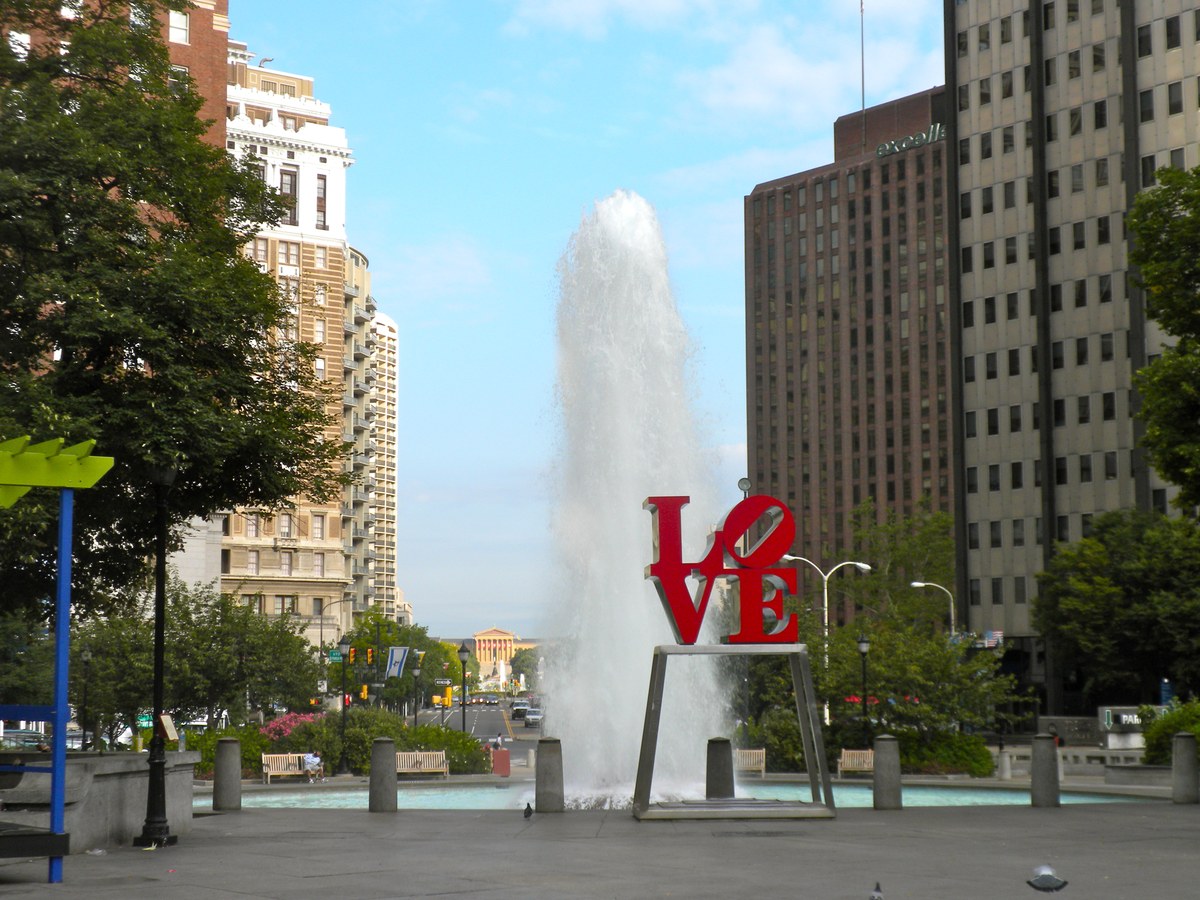
→ Pour aller plus loin : Pourquoi Philly a refusé 1 million de dollars pour LOVE Park ?
Two metal obstacles, a slab of asphalt, a green chain-link fence, and the football pitch right next door. If that's your skatepark, tough luck: you've got the French average. The government counts 3,351 of them nationwide, averaging 666 m² each. In Copenhagen, a single park runs 4,500. And that's not even the real difference.
Denmark doesn't build better skateparks than we do. It builds something else entirely. And by the end of this article, you'll know exactly what's jamming things up over here — three concrete reasons, backed by numbers, and not one of them is "we're broke."
⏱ Read: 10 min
4 Danish spots that look nothing like a skatepark
Take a good look at them. Not one of the four was conceived as "a space for the kids who skate." Three out of four are ordinary chunks of city — a plaza, a park, a neighborhood — that just happen to have ground good enough to roll on. The fourth was drawn up by a pro skater.
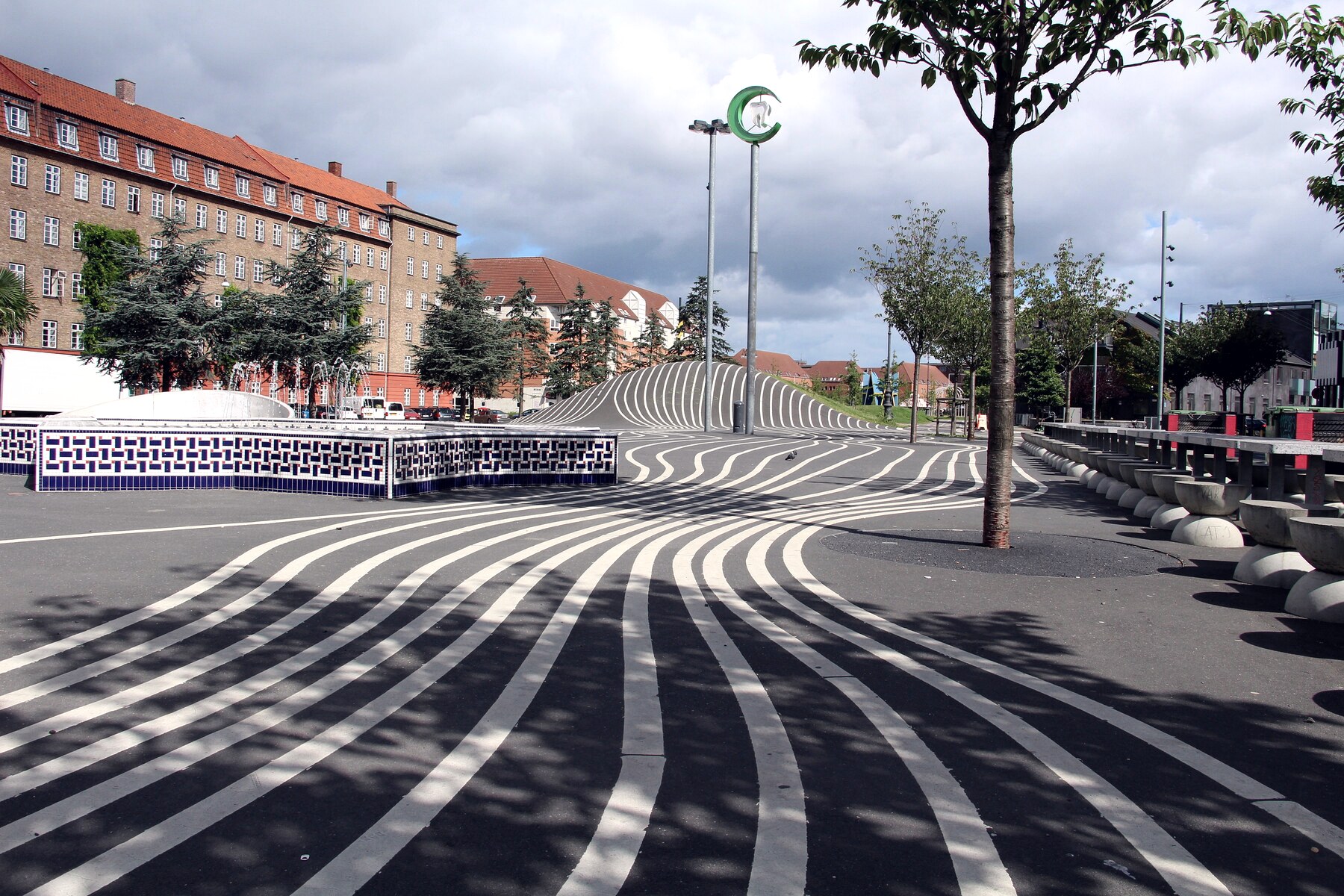 Photo: Fred Romero · Wikimedia Commons (CC BY 2.0)
01
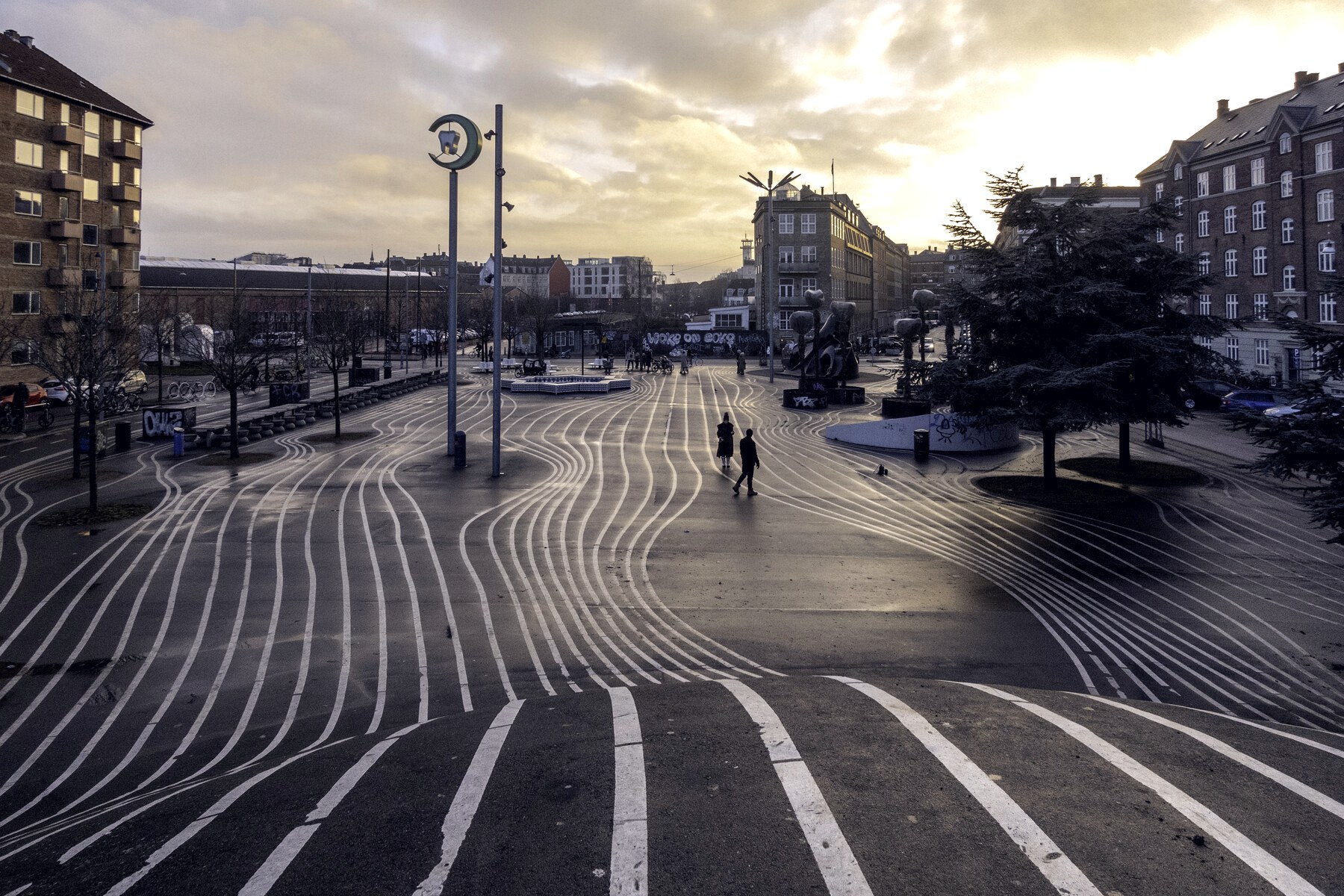
Superkilen — the black plaza
Copenhagen, Nørrebro district · opened June 2012
Open to everyone
Smooth concrete
1 km long
Smooth concrete
1 km long
A kilometer of city reworked by the architects at BIG, German landscape firm Topotek 1 and artist collective Superflex. The black section is one massive slab streaked with white lines, with humps, low benches and crisp edges. Officially it's a neighborhood plaza meant to get people mixing who never used to talk to each other. In practice, people skate it from morning to night, and nobody has ever thought to bolt anything onto it to stop them.
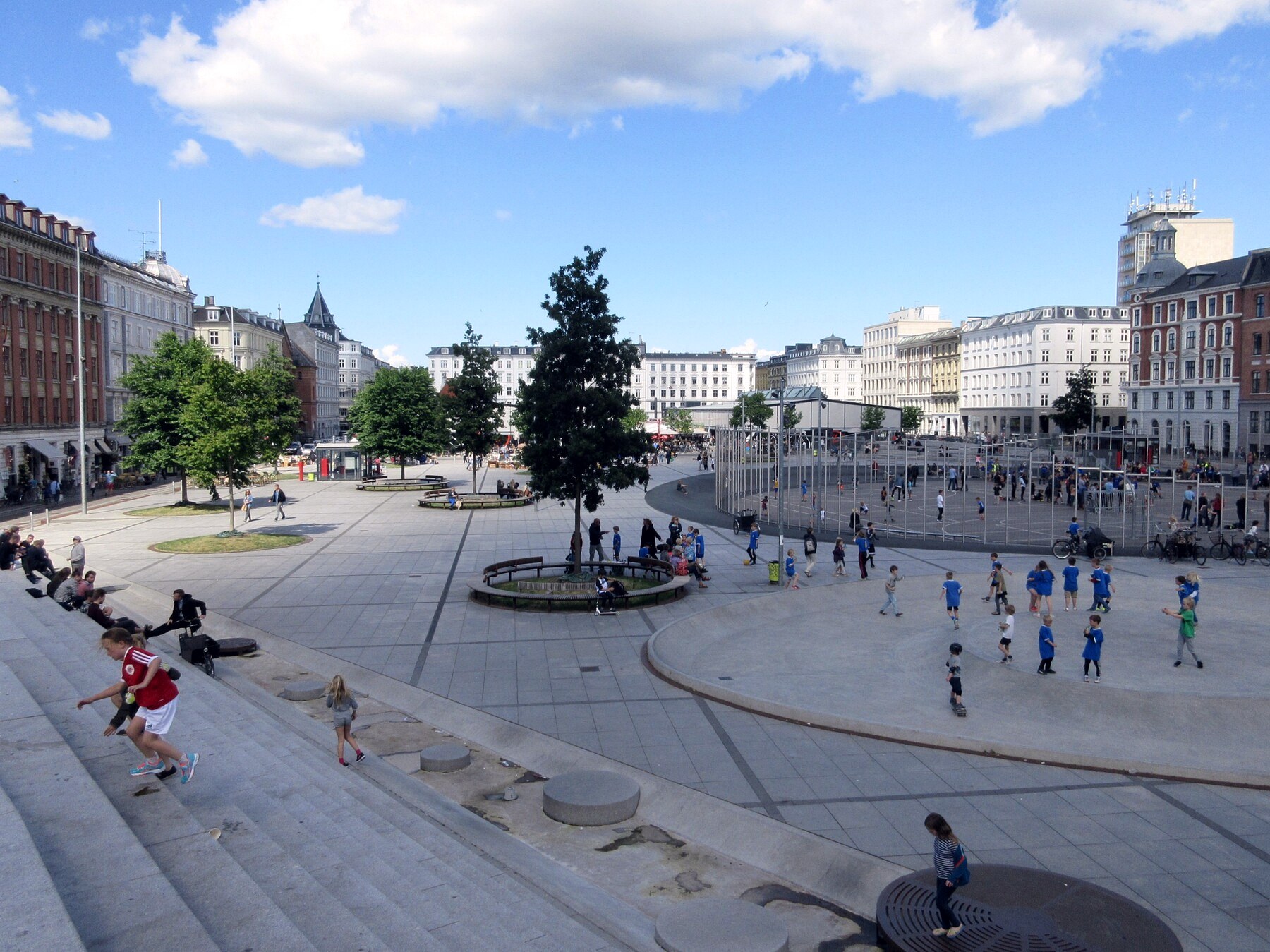 Photo: Ramblersen · Wikimedia Commons (CC BY-SA 4.0)
02
Israels Plads — the downtown plaza
Copenhagen, next to Nørreport station · renovated 2013-2014
Busy
Wide steps
Dead center
Wide steps
Dead center
An old market square turned into one big raised concrete platform, with bleacher steps, sharp ledges and a wide-open deck. Price tag: roughly 60 million Danish kroner, about 8 million euros, split fifty-fifty between a private foundation and the city. It wasn't built "for skating." It was simply built out of a material that rolls, and the city never went looking for ways to run off the people rolling on it.
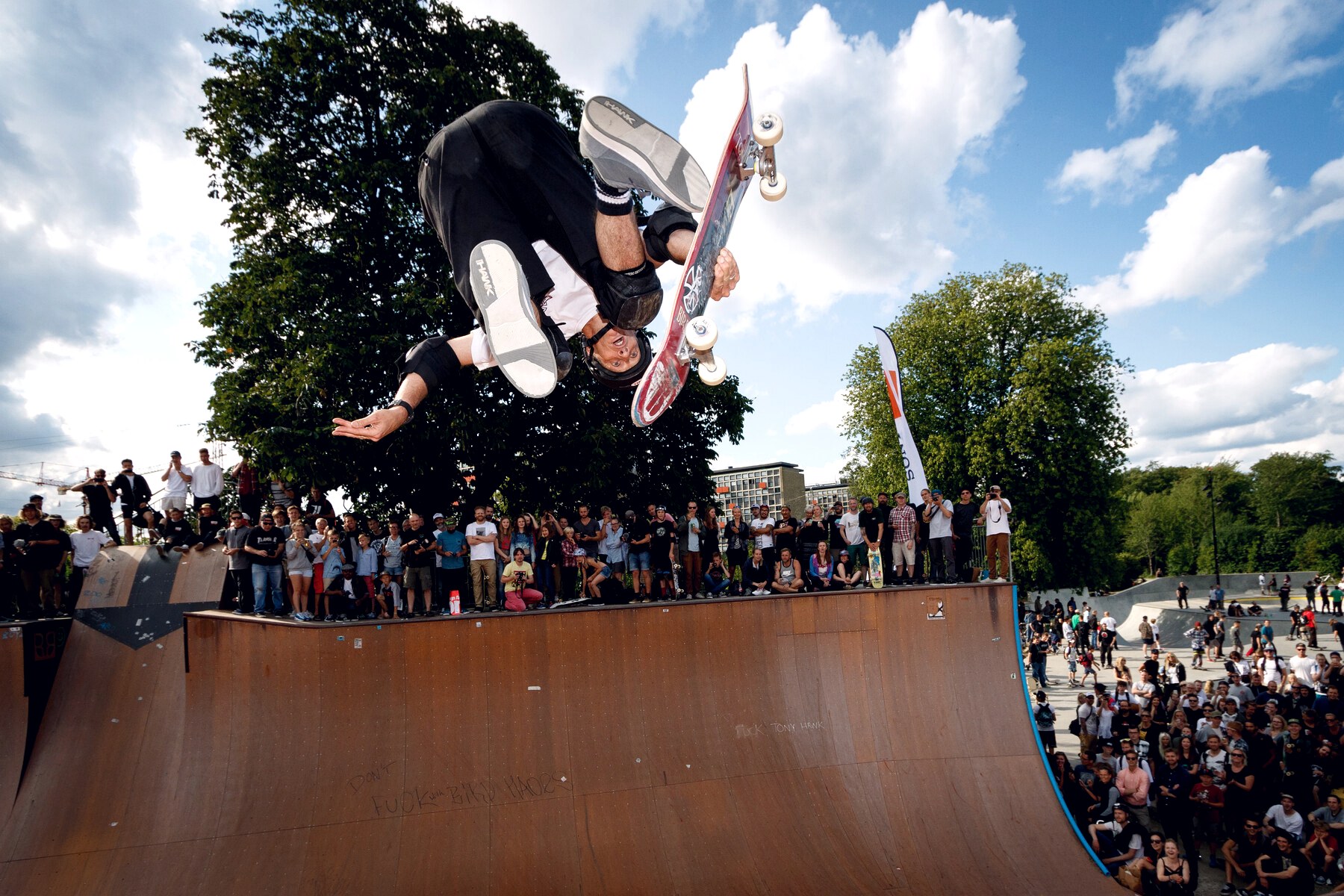 Photo: Stig Nygaard · Wikimedia Commons (CC BY 2.0)
03
Fælledparken — 4,500 m²
Copenhagen, inside the city's largest park · opened 2011
All levels
4,500 m²
Bowls + street + ramps
4,500 m²
Bowls + street + ramps
One of the biggest in Northern Europe: 4,500 m² all in one piece, with bowls, ramps and a street section with stairs and ledges. It replaced a 1988 setup back in 2011 — instead of patching up the old one, the city rebuilt the whole thing, big, right in its central park. Not out on the edge of town, not behind the stadium: in the park where everyone goes to picnic on Sundays.
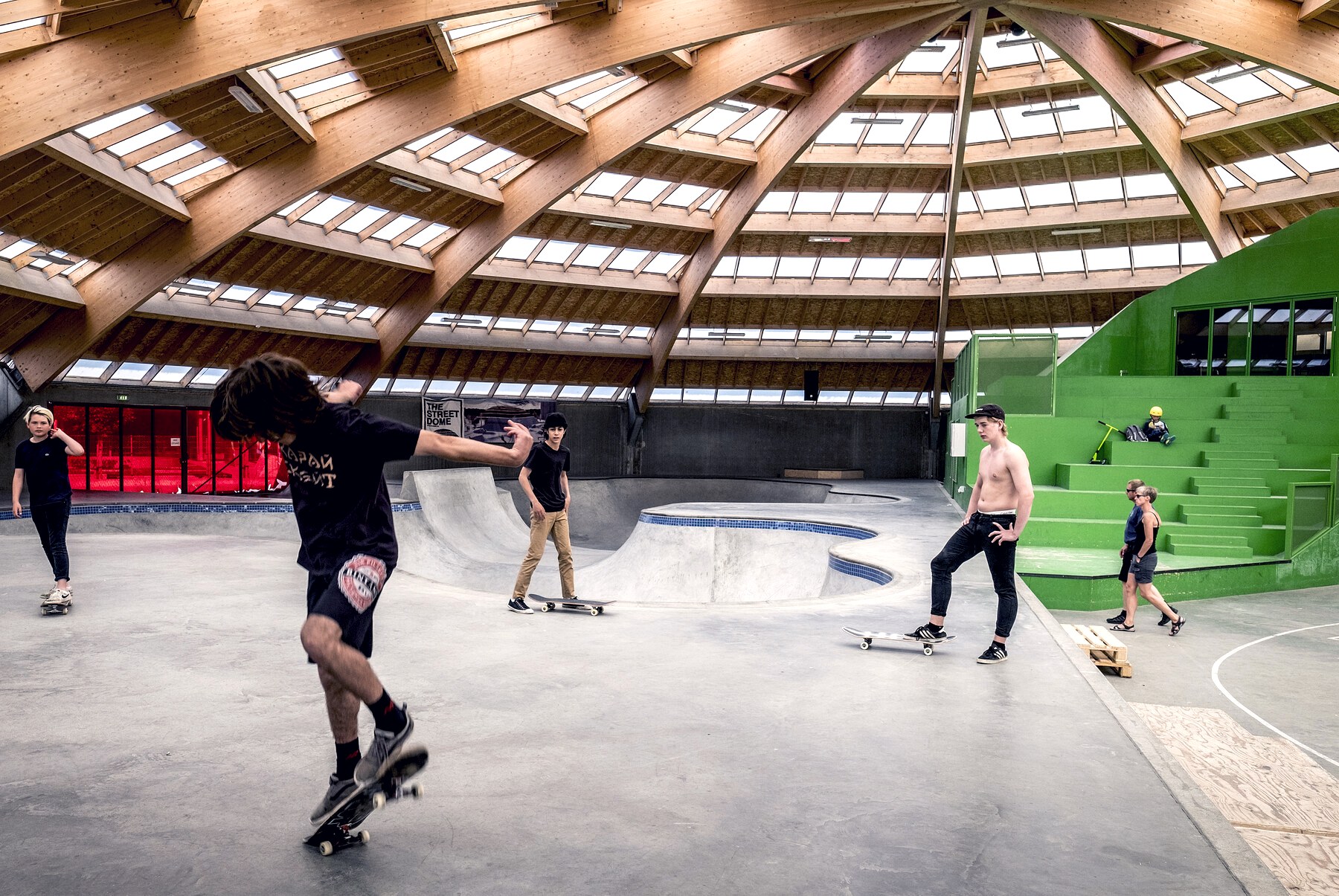 Photo: Johan Wessman / News Øresund · Wikimedia Commons (CC BY 2.0)
04
Streetdome — drawn up by a skater
Haderslev, southern Denmark · a 3-hour drive from Copenhagen
All levels
Covered
Open in winter
Covered
Open in winter
A wooden dome dropped over a concrete bowl, skateable in the rain and in a freeze. The name on the project: Glifberg+Lykke — a firm founded in Copenhagen in 2009 by Rune Glifberg, Danish pro skater, and architect Ebbe Lykke. Same duo behind the Oslo indoor park, Eller park in Düsseldorf and Amsterdam's Urban Sport Zone. Here's the line worth holding onto: in Denmark, the skater doesn't get to "share his thoughts" in a meeting — he's holding the pencil.

The first time you land over there, what hits you is how quiet it is under your wheels. No buzz through your legs, none of that gravel rattle we all know. The ground is continuous. You can cross an entire plaza without picking up your board once, roll from one ledge to the next, link it all together. And nobody turns around to look. You're not "the kid on the skateboard": you're just someone crossing a plaza, like everybody else.
3,351 skateparks in France: what the official numbers say
The French sports ministry keeps a public registry of every sports facility in the country. Anyone can query it, line by line. Here's what it spits out for the word "skatepark," in the version updated May 29, 2026.
3,351 skateparks on the books. That's a lot. France doesn't have a quantity problem — there are skateparks everywhere, including in towns of 3,000 people. That's not where it breaks down.
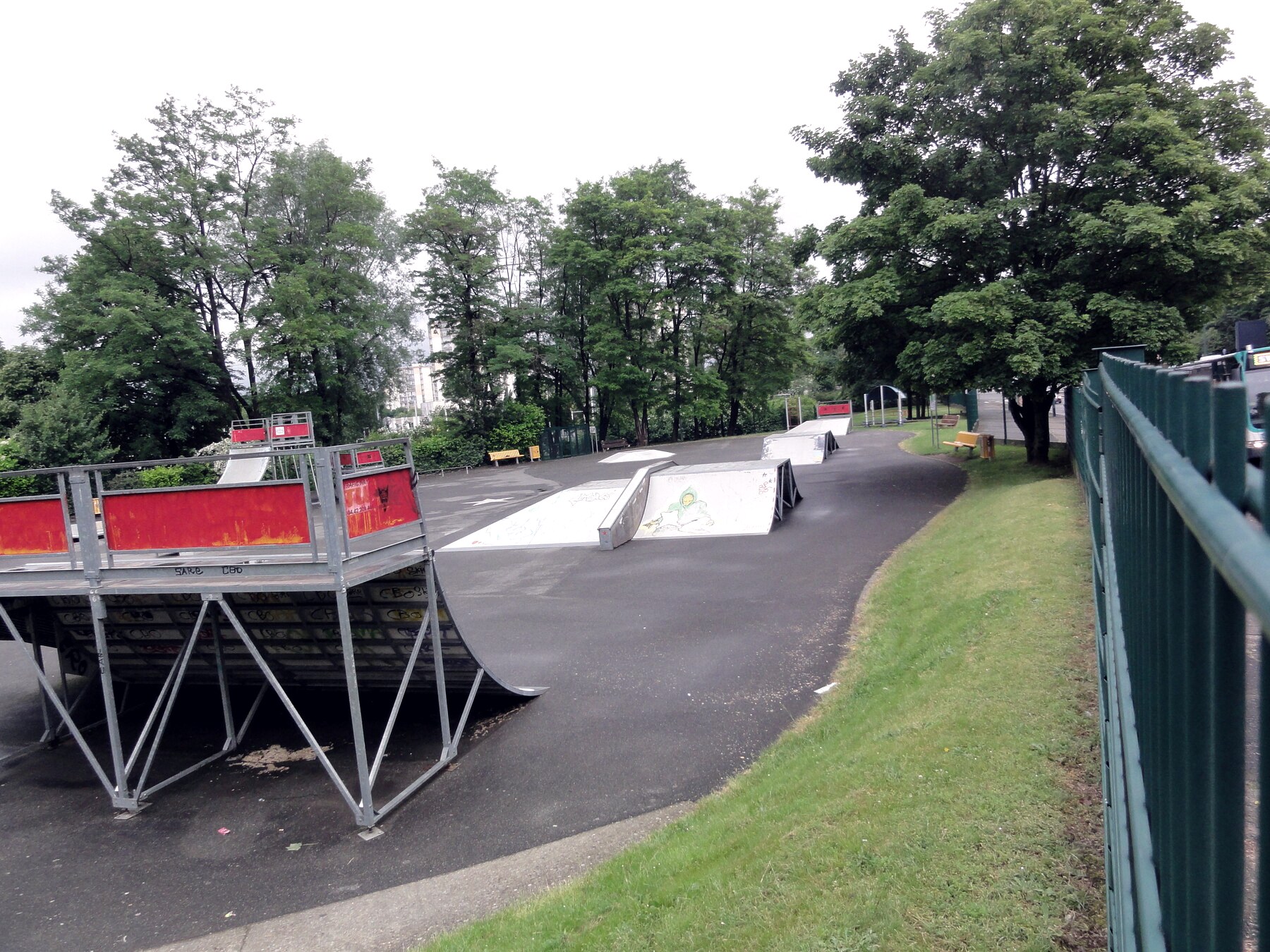
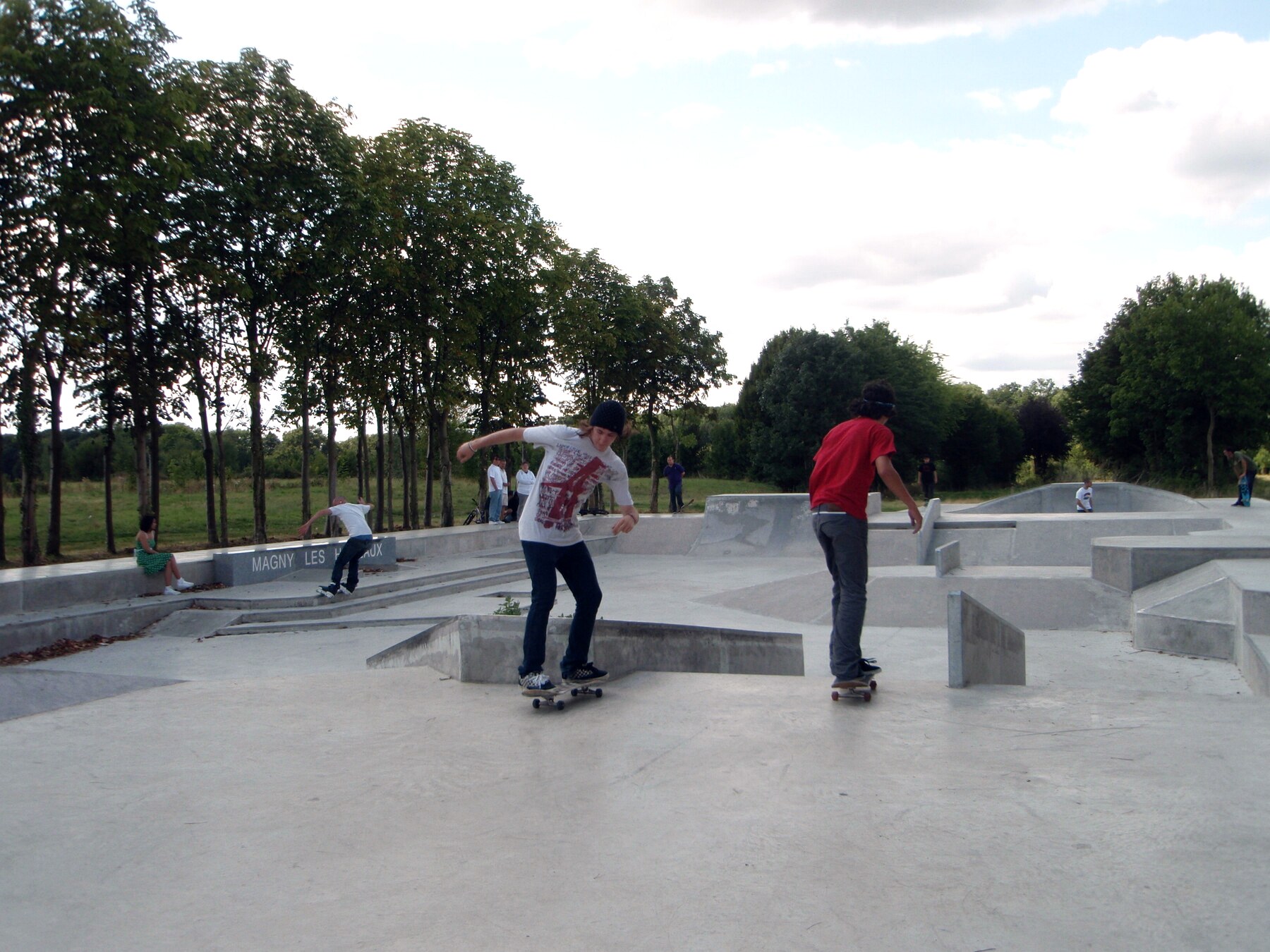
666 m² average size. Seven times smaller than Fælledparken alone. And 1,555 of them — nearly one in two — come in under 500 m². Five hundred square meters is a 25-by-20-meter rectangle: two obstacles and a patch of flat. You can't build a line in that. You just circle around, and three months later you quit.
2,327 out of 3,351 are asphalt. That's 69%. Against 817 in concrete. Asphalt is road-and-parking-lot surfacing: it buzzes, it eats your speed, it cracks, and a few years in it's ready for the scrap heap. Concrete costs more to pour and lasts thirty years.
3,183 are town-owned. 95%. Meaning: your skatepark was ordered by your town hall, out of the "sports" budget, by a department that also handles the football changing rooms and gym maintenance. Hold on to that detail — it explains everything that follows.
Why France can't pull it off: the 3 real reasons
The answer fits in one sentence, and it has nothing to do with money: in France, nobody has ever ordered a plaza. We order a sports facility — and that's exactly what we get. Everything else follows from there.
1. Here, skating is a sport. Over there, it's city-building
A French skatepark is filed as a "sports facility," same category as a caged multi-sport court or a pétanque pitch. That decides everything up front: the money comes off the sports line, the file is handled by the sports department, and the land that happens to be available sits… next to the stadium. Hence the fence, the rules board, the closing time, and the twenty-minute walk from downtown.
Superkilen and Israels Plads didn't come out of any sports budget. They're urban development projects: a plaza, a park. Skating isn't the reason they exist — it's the byproduct. Build a public plaza in smooth concrete with clean ledges and you get skaters without ever inviting them. All you have to do is not chase them off.
2. Asphalt is the cheap option, and it ends up costing more
Seven French skateparks out of ten are blacktop because that's what the road contractor already on retainer with the town knows how to do. They show up, they roll it out, they leave. Concrete takes a specialized contractor, a separate tender, and a town hall able to spell out precisely what it wants.
Net result: you save on the build, then pay again every eight to ten years when the surface is trash. Copenhagen poured concrete once, in 2011. Fifteen years later, it's still the same ground.
3. Nobody asks the skaters — and worse, nobody knows who to ask
This is the one that's hardest to swallow. In Denmark, there's an architecture firm founded by a pro skater, building public facilities in four countries. In France, there's no equivalent with a real foothold in public procurement. You already know how it goes: the local association gets invited "for input" once the brief is written, the plan is drawn and the budget is voted. They ask you what color the obstacles should be, not where they go.
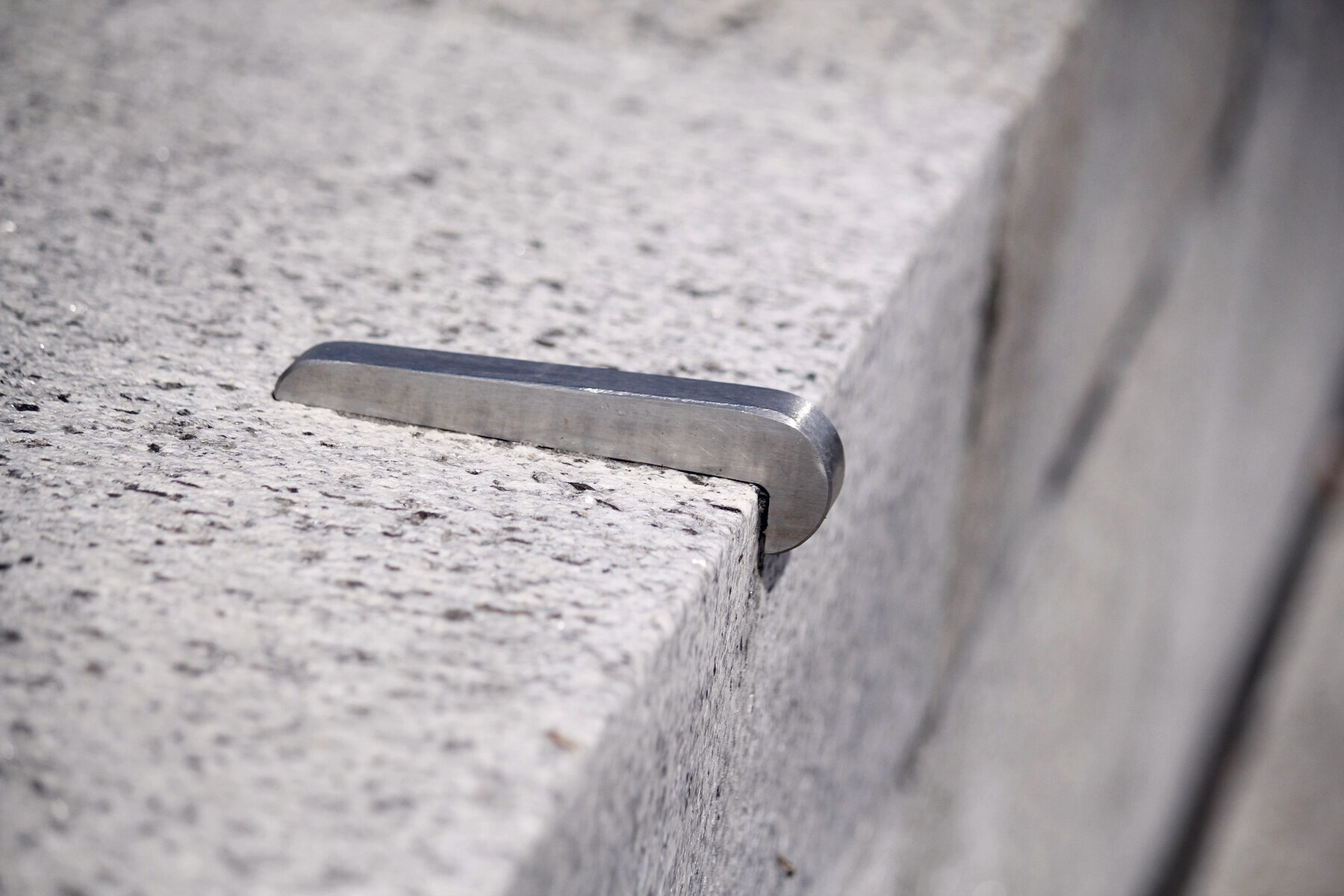
And meanwhile, the spending keeps flowing the other direction. Every metal bracket bolted onto a downtown ledge costs a few euros a pop, and there are thousands of them. It's the one area where France invests in skateboarding without ever consulting a soul.
What you can do in your own town
Go pull your skatepark's file — it's public. The sports ministry registry is open online to anyone. You'll find the exact surface area, the material and the year yours went in. Walking into town hall with "ours is 380 m² of asphalt, the national average is 666 in concrete" changes the whole conversation.
Don't ask for a skatepark — ask to talk to the planning department. As long as your file sits with the sports department, you'll get obstacles behind a fence. The next plaza redo, school forecourt or riverfront project in your town — that's where it actually gets decided. The phrase you want is "continuous troweled concrete surface": it costs next to nothing more than blacktop when it's planned in from the start.
Aim at the participatory budget, not the sports grant. Plenty of mid-size towns run one, with a few tens of thousands of euros put to a vote every year and barely any submissions. It's the only window where a crew of kids with a tight proposal carries as much weight as a thirty-year-old association.
And in the meantime: film it, count heads, show it. A clip of ten people skating a Saturday afternoon on 380 m² of cracked asphalt beats three pages of letters. Elected officials have no idea how many of you there are. Nobody ever told them.
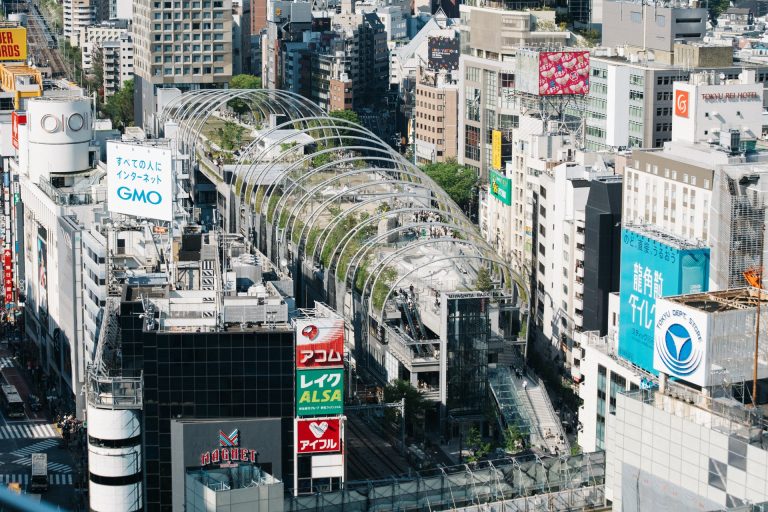
Who's rolling on those Danish plazas today? Twelve-year-old kids, dudes in their forties, people heading home from work who cut across the plaza because it's just nicer on a board. No closed crew, no minimum level to get in, no feeling of being tolerated. That's exactly what's missing from 666 m² of asphalt behind a fence — and it isn't a budget question. It's a question of who's holding the pencil. To see what happens when a city really commits, go read what 20 years of building did for Malmö, and how Tokyo put a skatepark on top of a shopping mall.
{
"@context": "https://schema.org",
"@type": "Article",
"headline": "Copenhagen designs its plazas with skaters: why does France stop at 666 m² of asphalt?",
"author": {"@type": "Organization", "name": "Nosk8"},
"datePublished": "2026-09-02",
"description": "3,351 skateparks in France, 666 m² average size, 69% asphalt. Copenhagen does it differently: the 3 concrete reasons France is stuck.",
"keywords": "skatepark France, Copenhagen skate, skate urbanism, Copenhagen spots"
}
How many square meters is your local skatepark, and what's it made of? Drop the town and the number in the comments ↓
Follow NOSK8 where you hang out
Parts, spots, behind the scenes: it all drops on the accounts first.
Le lexique
-
1
bols
Cuvettes en béton aux parois arrondies, héritées des piscines vides. On y prend de la vitesse en montant et descendant les courbes.
-
2
enrobé
Le revêtement noir des routes et des parkings, à base de bitume. Moins cher que le béton, mais rugueux et fissuré en quelques années.
-
3
béton lissé
Béton coulé puis taloché en surface pour obtenir un sol continu et régulier. C'est ce qui fait qu'une place roule bien pendant trente ans.
Shop NOSK8
Voir toute la boutique →
TEE-SHIRTS
TEE-SHIRT NOSK8® P.B CENTRE #RNB
Le prix initial était : 35,00 €.29,00 €Le prix actuel est : 29,00 €.

TEE-SHIRTS
TEE-SHIRT NOSK8® P.B HEART #ORIGINAL
Le prix initial était : 35,00 €.29,00 €Le prix actuel est : 29,00 €.

TEE-SHIRTS
TEE-SHIRT NOSK8® P.B CENTRE #ORIGINAL
Le prix initial était : 35,00 €.29,00 €Le prix actuel est : 29,00 €.
TEE-SHIRTS
TEE-SHIRT NOSK8® NOSKATE #NSITA
Le prix initial était : 35,00 €.29,00 €Le prix actuel est : 29,00 €.

TEE-SHIRTS
TEE-SHIRT NOSK8® P.B HEART #POLARBEAR
Le prix initial était : 35,00 €.29,00 €Le prix actuel est : 29,00 €.

CASQUETTES
CAP NOSK8® P.B #POLARBEAR
Le prix initial était : 35,00 €.25,00 €Le prix actuel est : 25,00 €.

CASQUETTES
CAP NOSK8® N8 #NOSK8
Le prix initial était : 35,00 €.25,00 €Le prix actuel est : 25,00 €.

CASQUETTES
CAP NOSK8® P.B.P #PAW
Le prix initial était : 35,00 €.25,00 €Le prix actuel est : 25,00 €.

HOODIES
HOODIE NOSK8® P.B HEART #NYC
Le prix initial était : 60,00 €.49,00 €Le prix actuel est : 49,00 €.

HOODIES
HOODIE NOSK8® P.B HEART #ORIGINAL
Le prix initial était : 60,00 €.49,00 €Le prix actuel est : 49,00 €.

HOODIES
HOODIE NOSK8® P.B HEART #PHILI
Le prix initial était : 60,00 €.49,00 €Le prix actuel est : 49,00 €.

HOODIES
HOODIE NOSK8® MATRICE HEART #CMD
Le prix initial était : 60,00 €.49,00 €Le prix actuel est : 49,00 €.

HOODIES
HOODIE NOSK8® P.B HEART #POLARBEAR
Le prix initial était : 60,00 €.49,00 €Le prix actuel est : 49,00 €.

SWEAT
SWEAT NOSK8® P.B HEART #BARÇA
Le prix initial était : 45,00 €.39,00 €Le prix actuel est : 39,00 €.
SWEAT
SWEAT NOSK8® P.B HEART #PHILI
Le prix initial était : 45,00 €.39,00 €Le prix actuel est : 39,00 €.
SWEAT
SWEAT NOSK8® P.B HEART #NYC
Le prix initial était : 45,00 €.39,00 €Le prix actuel est : 39,00 €.
SWEAT
SWEAT NOSK8® P.B HEART #PARIS
Le prix initial était : 45,00 €.39,00 €Le prix actuel est : 39,00 €.
SWEAT
SWEAT NOSK8® P.B HEART #POLARBEAR
Le prix initial était : 45,00 €.39,00 €Le prix actuel est : 39,00 €.
Continue ta lecture
PortraitsLizzie Armanto a bouclé la loop de Tony Hawk en 2018 : pourquoi on parle si peu d’elle ?
Première femme à boucler la loop de Tony Hawk, or au premier park féminin des X Games, part chez Vans. Et pourtant son nom ne…
Commentaires (0)