
ℹ️ 🛹 Web Média Skate 🛹 ℹ️

Spots
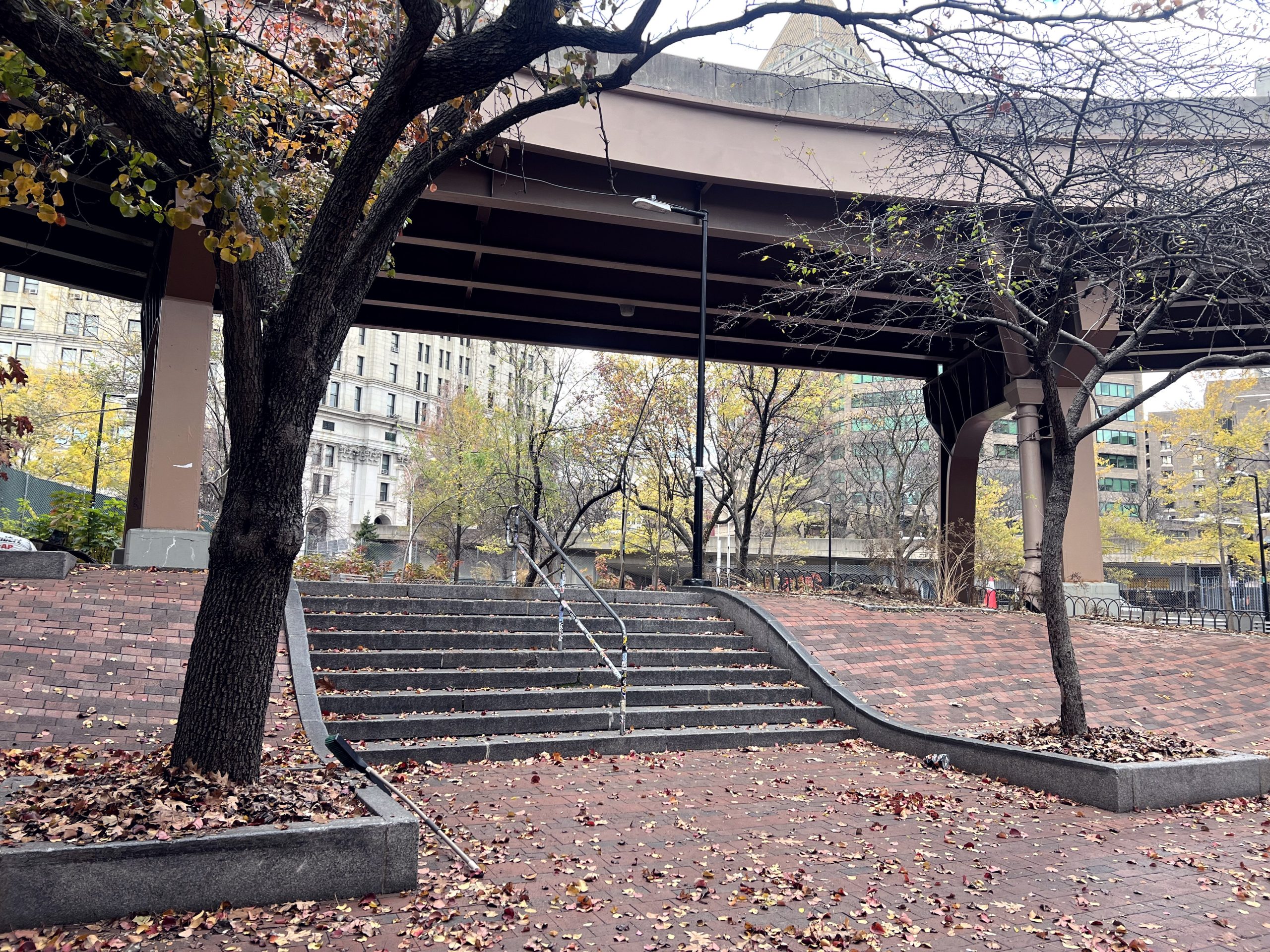
Brooklyn Banks, New York — the spot that forged the East Coast scene
Construites en 1972 sous le pont de Brooklyn, les Brooklyn Banks ont forgé le street skating East Coast. Fermées en 2010, les Big Banks ont rouvert le 5 juin 2025 après quinze ans de barrières.

→ Pour aller plus loin : Pourquoi Philly a refusé 1 million de dollars pour LOVE Park ?
In the 90s, if you wanted to see the best street skating on earth, you walked down under the Brooklyn Bridge. Sloped brick, concrete, a few steps. Nothing on paper. Everything on a board. And in June 2025, after fifteen years behind fences, the big banks reopened.
⏱ Reading time: 7 min
1972, 1 Police Plaza: the urban planning accident that built the world's best spot
First thing to set straight: the Brooklyn Banks are not as old as the bridge. They were built in 1972, as part of the 1 Police Plaza redevelopment, designed by landscape architect M. Paul Friedberg. Waves of red brick set between the columns, meant to dress up dead space under an elevated roadway.
Nobody was thinking about skateboarding. Except New York had zero skateparks in the mid-80s. And there, under a bridge, in the middle of Downtown, someone had built dozens of metres of free brick transition. Manhattan crews moved in. For two decades it became the default meeting point for anyone rolling south of Canal Street.
What made it unique was the geometry. Fast flat, a bank behind it, a ledge lined up, a wall. You could keep going without putting a foot down. The lines that came out of the Banks in the 90s redefined what a street line was — before them, people filmed tricks; after them, people filmed sequences.
What's actually down there: Big Banks and Small Banks
Two zones, and people keep mixing them up. The Big Banks: the large brick waves on the Pearl Street side, the ones in every video. The Small Banks: the little ones closer to Frankfort Street, where New York kids learned before daring to touch the big ones.
The brick was never perfect. Grabby joints, dips, damp that never fully leaves the shade of the bridge. Nobody ever complained. The Banks made nothing easy: they taught you to read bad ground and adjust your speed. A skater raised down there could roll anywhere else.
And there was the sound. Steel columns, the roadway vaulted overhead, traffic rumbling non-stop: industrial cathedral acoustics. Boards cracked with an echo you hear nowhere else. Plenty of New York riders mention that noise before they mention a single obstacle.
The first time you came down the Pearl Street stairs, you felt it before you saw it. Ten degrees cooler, the smell of the river and wet concrete, light falling in slices between the columns. Then the noise: fifteen boards at once, multiplied by the vault. You dropped your bag against a column and watched for two minutes without rolling, just to understand where you had landed. Everyone did that.
Harold Hunter, Zoo York, 411: the East Coast was built down here
Harold Hunter is the first name that comes up. A Lower East Side kid, he grew up a few blocks from the Banks and made the place his living room. His face went beyond skateboarding with Kids - 1995, Larry Clark's film where he plays himself. He died in 2006, aged 31. To this day, when a New York rider talks about the Banks, his name always comes out.
Around him, a whole scene the West Coast looked down on. Zoo York, founded in New York in 1993, filmed most of its visual identity under this bridge. The 411 Video Magazine issues stopped by every time they hit New York. Josh Kalis, Ricky Oyola, Tim O'Connor, Steve Rodriguez — the New York-Philadelphia axis grew around spots like this one and like Love Park, two hours down the line.
The difference with the West was one sentence long: here, you skated in winter. Cold ground, gloves, twenty-minute sessions between showers, in a city that wasn't waiting for you. It produced a rawer, faster, less-filmed kind of skating. That's the school European riders were chasing when they landed at JFK with a board in their bag.
2004, 2010, 2025: twenty years of arm-wrestling with the city
First blow: 2004. The city started works and killed the Small Banks by filling them with mulch beds. In 2005, Steve Rodriguez — New York skater and 5Boro founder — ran a lobbying effort that saved the big banks from the same fate. The first real precedent of a skate community negotiating directly with the city.
Second blow: 2010. The Brooklyn Bridge restoration project needed storage space. The city took the space under the bridge, put up fences, stacked materials. Not a demolition — an administrative squat, and it lasted fifteen years. A whole generation of New York skaters grew up staring through a fence, knowing the Banks only from videos.
The unlock came from an unexpected side. In 2020, the city removed bricks from the flat ground area. In 2021, Rosa Chang founded Gotham Park, a grassroots nonprofit set on giving the forgotten four acres under the bridge back to the public — skateboarding included. On 24 May 2023, for the bridge's 140th anniversary, a first section reopened.
Then 5 June 2025: the Big Banks reopened to the public, fully re-bricked, for the first time since summer 2010. Fifteen years. In November 2025, crews started on the Small Banks — the 2004 mulch finally coming out. Roughly $50 million is earmarked for the area, with a wider reconstruction planned around 2028. Unlike Love Park, bulldozed in 2016, the Banks came back. One of the rare times the story ends well.
Visiting New York in 2026: what you need to know
The Brooklyn Banks sit under the Brooklyn Bridge on the Manhattan side, between Park Row and Frankfort Street. Subway 4/5/6, Brooklyn Bridge - City Hall, five minutes on foot. The Big Banks are open and skateable. The Small Banks area is still an active construction site: you wait for it, you don't climb into it.
These days it's not the closed-off hideout of 1996. Gotham Park runs events there, families walk through, tourists photograph the bridge right above. And in the middle of it, fifteen-year-olds land their first bank ollies while a forty-five-year-old, back to check whether it was true, quietly rolls the line he still knows by heart. That's exactly what a reopened spot is supposed to produce: two generations on the same brick, same day.
Gear-wise: the new brick is less grippy than the old concrete, but the joints are still treacherous. Harder wheels, 52-54 mm, wax for the untreated stone ledges. In the shade of the bridge, damp lingers: ground that looks dry at noon can be sticky at 9am.
Follow NOSK8 where you hang out
Parts, spots, behind the scenes: it all drops on the accounts first.
Le lexique
-
1
banks
Plans inclinés en brique ou en béton utilisés comme obstacles : on y prend de la vitesse et on y pose des tricks en transition.
-
2
line
Enchaînement de plusieurs tricks sans poser le pied, filmé d'une seule traite.
-
3
noseslide
Glisse sur le nose de la planche le long d'une bordure ou d'un rail.
-
4
wax
Bloc de cire frotté sur une bordure pour la rendre glissante et permettre les slides.
-
5
bust factor
Probabilité de se faire virer d'un spot par la sécurité ou la police, sur une échelle informelle entre skateurs.
Continue ta lecture
ConseilsApprendre le nosegrind — entrer dans le territoire des tricks techniques
Prerequis, progression en 4 etapes et erreurs classiques : tout ce qu’il faut savoir avant de se mettre au nosegrind. Guide technique intermediaire pour skateurs…
Commentaires (0)