

Steve Rocco and World Industries — How $6,000 Killed the Skateboarding Empire
In 1987, a Californian freestyler with no track record dropped $6,000 to launch his skateboarding company in an El Segundo garage. Five years later, he controlled 40% of the board market, and Powell Peralta was on its knees. Steve Rocco didn’t just create a brand. He blew up an entire system.
⏱ Read: 6 min
The El Segundo Garage
Steve Rocco wasn’t an extraordinary skater. In freestyle, he was just okay. But he had something George Powell and Stacy Peralta didn’t see coming: entrepreneurial rage coupled with a predator’s instinct.
In 1987, skateboarding was a kingdom. Powell Peralta reigned supreme thanks to the Bones Brigade — Tony Hawk, Rodney Mullen, Steve Caballero. Santa Cruz and Vision completed the triumvirate. These three controlled the riders, the shops, the magazines. Nobody dared challenge them.
Rocco showed up with $6,000, a dingy warehouse, and a simple idea: skaters should own their brands. Not businessmen in suits. Not engineers who’d never set foot on a board. Skaters themselves. World Industries was born in that garage. The name was deliberately absurd — a garage operation named like a multinational corporation.
The 1987 Context
Neon green dominated. Freestyle and vert (ramp) were still king. Street skating was just barely emerging in the streets of San Francisco and Los Angeles. Pros were under exclusive contracts with the Big Three. No rider dared leave — too risky, too few alternatives. Rocco would give them that alternative.
Guerrilla Marketing and Total War
Rocco’s first strike was surgical. He convinced Rodney Mullen — the undisputed king of freestyle and the best technician on the planet — to leave Powell Peralta. That’s like poaching Michael Jordan from Nike. The industry couldn’t believe it.
But Rocco didn’t stop at recruitment. He declared total media war against Powell Peralta. In the pages of Transworld Skateboarding, he published ads where the Ripper — Powell’s iconic logo — was getting flushed down the toilet. He dumped free product into shops to flood the market. He slashed prices so retailers would rather stock World Industries than Powell.
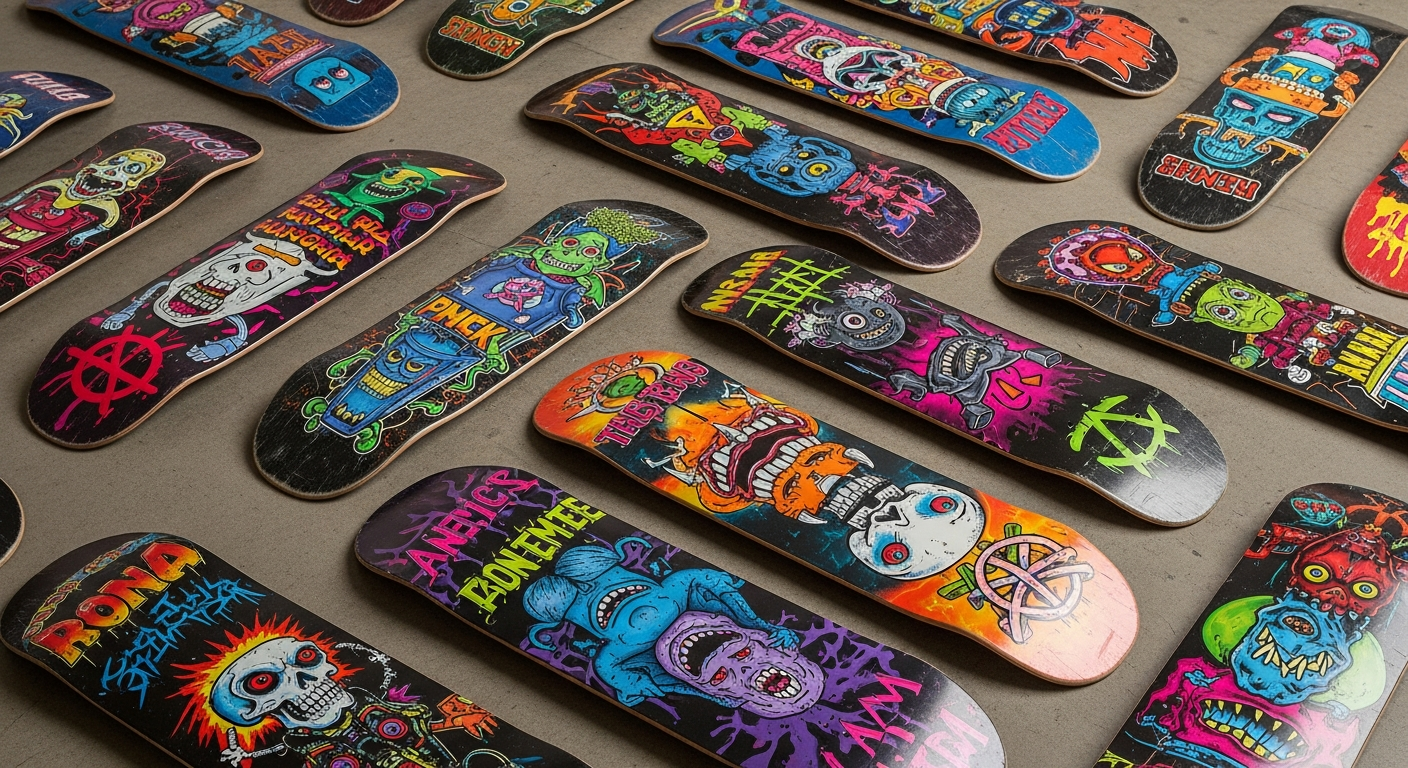
And then there were the graphics. Marc McKee, World Industries’ art director, created visuals that spat in the face of decency. Obscene parodies, trash humor, provocations on every board. Before McKee, board graphics were skulls and dragons à la Powell. After McKee, it was visual anarchy. The World Industries style was unlike anything else.
The Sub-brand Empire
Rocco’s genius was understanding that apparent diversity kills competition. In a few years, he launched a network of brands that seemed independent but were all under the same roof.
Blind Skateboards arrived in 1989, with Mark Gonzales as its headliner. The name was a middle finger to Vision Street Wear — you don’t see? You’re blind. In 1991, Blind released Video Days, directed by a certain Spike Jonze — yes, the future director of Being John Malkovich and Her. Gonz’s section set to Coltrane’s « A Love Supreme » remains one of the most beautiful video parts ever filmed.
The same year, Plan B dropped. Co-founded with legendary filmer Mike Ternasky, Plan B signed Rodney Mullen, Pat Duffy, Sal Barbier, Colin McKay. Their 1992 video « Questionable » redefined technical street skateboarding. Every trick pushed boundaries. Every section was an event.
Then came 101 Skateboards with Natas Kaupas, the street pioneer. By 1993, World Industries and its subsidiaries controlled about 40% of the board market in the United States. A guy who started in a garage with $6,000 owned almost half the industry. Powell Peralta was bleeding out. Stacy Peralta left the ship in 1991 to make movies. George Powell found himself alone against a tsunami he didn’t see coming.
1994 — The Halt
Mike Ternasky, the creative mastermind behind Plan B, died in a car accident. Skateboarding lost a visionary. Plan B would survive but never regain the alchemy of its early years. The same year, riders trained by Rocco began founding their own brands — Rick Howard and Mike Carroll launched Girl Skateboards. The student surpassed the master.
The Fall and the Legacy
In the late 90s, Rocco made a choice that changed everything. The characters Flame Boy and Wet Willy, created by Marc McKee, became the brand’s mascots. Rocco pushed them into big box stores — Walmart, Target, Kmart. Revenue exploded. Credibility collapsed.
The guy who built his empire on authenticity and « fuck the system » was now selling t-shirts at Walmart. Core skaters turned their backs. But Rocco didn’t care. In 2002, he sold all his brands to Globe International for approximately $46 million. The rebel who started with $6,000 walked away with a $46 million check.
Under Globe, the brands slowly declined. World Industries became a soulless big box store brand. In 2014, it went bankrupt under Dwindle Distribution. But Rocco’s legacy is etched in the concrete of modern skateboarding.
Every brand founded by a rider today — Girl, Chocolate, Toy Machine, Foundation, Alien Workshop — owes its existence to the Rocco model. The royalty system on pro models, the concept of sub-brands under a single distributor, the creative freedom of riders over their graphics. All of that is Rocco. He broke the monopoly of the Big Three and gave the keys to skateboarding to the skaters. The rest is history.
And somewhere in California, Steve Rocco is silently counting his money. He’s been off the scene for two decades. Nobody knows exactly what he’s doing. But every time a kid launches their board brand in a garage, every time a rider negotiates their royalties, every time a skateboarding ad pushes the limits — Rocco’s shadow looms.